Colyseus: an authoritative multiplayer server for Node.js games
⚔ Multiplayer Framework for Node.js
At a glance
- What is it?
- Colyseus pairs synchronizable server-side state with room-based matchmaking and client SDKs for TypeScript, Unity, Godot and more. It suits Node.js teams that want the server to own game logic, and it is the wrong pick if you cannot run Node.js on the game host.
- Who is it for?
- Adopt Colyseus when your game logic can live in Node.js and you want the server to be authoritative without writing your own delta encoder. Skip it if your backend is not Node.js, or if you need a fully managed service with no server to operate.
- Can I use it commercially?
- Yes. MIT is a permissive licence: you can use, modify and sell software built on it, as long as you keep its copyright and licence notices.
- Is it still maintained?
- Yes. The repository last received commits 1 day ago.
- What is it written in?
- Mainly TypeScript, according to GitHub's language statistics.
Answers come from the project's GitHub data, last synced on October 23, 2026, and from our analysis. They are not legal advice.
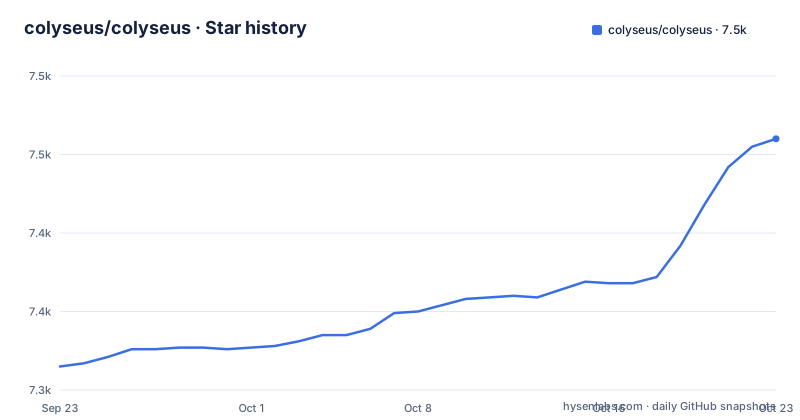
Star history
- colyseus/colyseus7,460 ★ · +145
| Repository | 2026-09-23 | 2026-10-23 |
|---|---|---|
| colyseus/colyseus | 7.3k | 7.5k |
145 Stars in the last 30 days, measured from the daily GitHub snapshot. Compare with other projects
Editorial analysis
The problem Colyseus solves: server-owned state that clients can follow
Most small multiplayer projects start the same way. A socket library moves bytes, and everything above the bytes is yours to write: who owns the truth, how often it is sent, what happens when a packet is lost, and how a reconnecting player catches up. Colyseus is aimed at that gap. The README calls it an "Authoritative Multiplayer Framework for Node.js" and states that the project focuses on "synchronizable data structures for realtime and turn-based games, matchmaking, and ease of usage both on the server-side and client-side."
The intended reader is a game developer who already works in TypeScript or JavaScript and does not want to build a netcode layer from scratch. The README also lists client SDKs beyond JavaScript, which widens that audience: TypeScript, React, Unity, Godot, GameMaker, Defold, Construct, Haxe, and C static libraries. A Unity or Godot team can therefore keep its engine of choice and still use the same server. The authoritative model is the point. Game logic runs on the server, and the README frames that as "cheat-proof by design." That is a design claim about where decisions are made, not a guarantee about any particular game.
How state synchronisation and matchmaking fit together
The mechanism the README describes is a state container on the server that is mirrored to clients. You "define your state on the server and it automatically synchronizes to all clients, delta-compressed and binary-encoded." Two properties matter there. Delta compression means the wire format carries changes rather than the full state, and binary encoding means the payload is not JSON. Both are implementation choices with consequences: the protocol is not human-readable, and debugging at the wire level means using the framework's own tooling rather than reading text frames.
Around that sits a room abstraction. The README describes "Room-based architecture with filtering, queuing, and reconnection support out of the box." A room is the unit of matchmaking and the unit of state. Filtering lets clients ask for a room matching criteria, queuing holds players until a match exists, and reconnection lets a dropped client rejoin. Scaling is described as vertical or horizontal "with Redis and load balancers," which places the coordination problem on Redis rather than in the framework itself. The README gives a range of "10 to 10,000+ CCU" for that scaling path but does not publish the conditions behind the number, so treat it as a design target rather than a measured result.
Installing Colyseus and running a first server
The README's quickstart scaffolds a server project rather than adding the framework to an existing codebase. The generator is `npm create colyseus-app@latest`, and the README shows it taking a target directory:
npm create colyseus-app@latest ./my-server
cd my-server
npm start
After `npm start`, the generated project runs a server. The README does not state the default port or print an expected console line, so the first thing to check is what the scaffold's own start script reports. The scaffold is the supported entry point; the README does not describe a manual `npm install colyseus` plus hand-written bootstrap path for the server.
Clients are installed separately, and the package differs by platform. For a TypeScript client the README gives `npm install @colyseus/sdk`, and for React it gives `npm install @colyseus/react`. Unity, Godot, GameMaker and Construct clients are distributed as downloads from their respective release pages rather than through npm, and Haxe uses `haxelib install colyseus`. That split is worth noting before you plan a build pipeline: only the JavaScript-side clients come from a package registry.
npm install @colyseus/sdkThe repository itself is a pnpm workspace. Its root `package.json` declares `"packageManager": "[email protected]"` and a `preinstall` script that runs `git submodule update --init --recursive`, so cloning and building the monorepo is a different exercise from using the published packages. If you only want to ship a game, the scaffold and the SDK packages are the path the README points at.
Where Colyseus is the wrong tool
The framework assumes Node.js on the server. That is stated plainly, and it is a hard boundary rather than a preference. If your team's backend is Go, Rust or a JVM service, Colyseus does not slot in as a library you call from that process; you would be running a second runtime alongside it. The README lists C static libraries and native SDKs, but those are client-side packages, not server runtimes.
The second constraint is that the authoritative model pushes all game logic to the server. That is the feature, and it is also the cost. Every rule you want enforced has to be expressible in the room's server-side code, and the state you synchronise has to fit the synchronizable data structures the README describes. A project that wants peer-to-peer latency, or that cannot afford a server round trip for its core interaction, is outside the intended design.
The third is operational. The README's own sustainability note says the project "relies on Colyseus Cloud subscriptions and sponsorships." That is honest about funding, and it also means the framework is a library you operate. Horizontal scaling is described in terms of Redis and load balancers, which are components you provision and monitor. There is no claim in the README that the framework removes that work. The README also does not document rollback or state-history features, so if your game needs authoritative rewind, do not assume it is there.
Colyseus compared with a raw WebSocket layer like Socket.IO
Socket.IO is the comparison most people reach for, and the difference is where the abstraction stops. Socket.IO gives you events, rooms as a broadcast channel, and transport fallback. It does not give you a server-side state container that is diffed and encoded for you, and it does not give you matchmaking with filtering and reconnection as a built-in concept. With Socket.IO you would write the state model, the delta logic and the match flow yourself, then maintain them.
Colyseus makes those decisions for you and narrows what you can express. The state must live in the synchronizable structures, and the client must speak the framework's protocol. That trade is the whole argument: less netcode to write, less freedom in how the wire behaves. Against a managed service such as Photon, the difference is the opposite direction. Photon is a hosted platform; Colyseus is MIT-licensed code you run, and the README states it is "Free forever" even for commercial games. You trade operational responsibility for control and for the absence of per-CCU platform billing.
Licence, maintenance and upgrade cost
The repository is MIT licensed, and the README states that the licence covers commercial games. MIT is permissive: it allows use, modification and redistribution with the copyright notice and licence text preserved. That is a statement about the licence text, not legal advice, and a studio with unusual distribution terms should read the LICENSE file in the repository rather than the README summary.
The maintenance signal is the release cadence. The most recent entries are `[email protected]` and `@colyseus/[email protected]`, both dated 2026-09-21, and the last push to the default branch was on 2026-09-21. The version numbers are pre-1.0, and the README points to a "public roadmap for version 1.0." Pre-1.0 versioning means minor releases can carry breaking changes, so pinning versions in your lockfile is the practical precaution. The monorepo pins its own toolchain, including pnpm 10.9.0 and a git submodule for `packages/better-call`, which suggests the build has moving parts beyond the published packages. Upgrading a game server also means upgrading client SDKs in engines that do not share npm's version resolution, so budget for the Unity, Godot or GameMaker side separately.
Editorial conclusion
Adopt Colyseus when your game logic can live in Node.js and you want the server to be authoritative without writing your own delta encoder. Skip it if your backend is not Node.js, or if you need a fully managed service with no server to operate. Before committing, scaffold a project with npm create colyseus-app@latest, open the generated room, and confirm that the state schema you need survives the delta-compression path the README describes.
Frequently asked questions
What is Colyseus?
It is an authoritative multiplayer framework for Node.js, described in the README as providing synchronizable data structures for realtime and turn-based games, matchmaking, and client SDKs for major platforms and engines. The server owns the state and game logic, and clients mirror it.
Is Colyseus good?
The README's case rests on server-authoritative state sync, built-in matchmaking with filtering and reconnection, and a scaling path through Redis and load balancers. Whether that fits depends on whether your game logic can run in Node.js and whether you want to operate the server yourself.
Is Colyseus free to use?
Yes. The repository is MIT licensed, and the README states it is free forever, including for commercial games. The project's sustainability note says it relies on Colyseus Cloud subscriptions and sponsorships rather than on licence fees.
How is Colyseus different from Socket.IO?
Socket.IO moves events and gives you broadcast rooms but leaves the state model and matchmaking to you. Colyseus adds a server-side state container that is delta-compressed and binary-encoded to clients, plus room-based matchmaking with filtering, queuing and reconnection.
How does Colyseus compare with Photon?
Photon is a hosted platform, while Colyseus is MIT-licensed code you run on your own Node.js infrastructure. The README states Colyseus is free forever even for commercial games, so the trade is operational responsibility in exchange for control.
Official sources
Add this badge to your README
If you maintain this project, the badge below links readers to this analysis and shows its maintenance status from the daily GitHub snapshot. Paste the markdown into your README; add ?metric=license or ?metric=stars to the image URL for a different field.

[](https://hysenlabs.com/projects/colyseus-colyseus)Star history chart for your README
[](https://hysenlabs.com/projects/colyseus-colyseus)Was this useful?