ddd-crew/welcome-to-ddd: A Visual Introduction to Domain-Driven Design
Definitions of DDD and fundamental concepts to reduce the learning curve and confusion
At a glance
- What is it?
- ddd-crew/welcome-to-ddd is a compact documentation repository for developers seeking clearer definitions and practical starting points in Domain-Driven Design. It is a static educational collection, not an executable DDD implementation.
- Who is it for?
- Beginners can use this repository as a compact orientation to DDD terminology and possible entry points, while developers seeking an executable framework or a complete modeling method should use the linked resources. Before adopting it as an internal reference, verify whether its page images and definitions match the DDD vocabulary and practices already used by the team.
- Can I use it commercially?
- Yes, with credit. CC-BY-SA-4.0 allows commercial use as long as you credit the authors and indicate what you changed. It is written for creative content, so check how it applies to any code.
- Is it still maintained?
- Yes. The repository last received commits 83 days ago.
- What is it written in?
- GitHub does not report a main language for this repository.
Answers come from the project's GitHub data, last synced on October 24, 2026, and from our analysis. They are not legal advice.
Star history
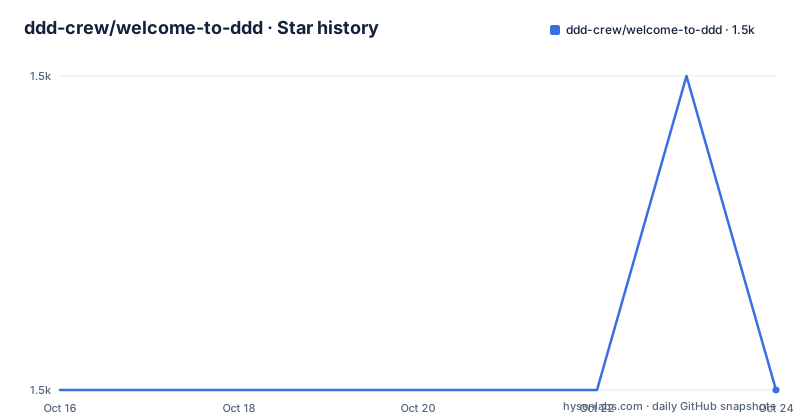
- ddd-crew/welcome-to-ddd1,547 ★ · +0
| Repository | 2026-10-16 | 2026-10-24 |
|---|---|---|
| ddd-crew/welcome-to-ddd | 1.5k | 1.5k |
0 Stars in the last 8 days, measured from the daily GitHub snapshot. Compare with other projects
Editorial analysis
What welcome-to-ddd solves for DDD beginners
ddd-crew/welcome-to-ddd addresses a specific educational problem: the learning curve and terminology confusion surrounding Domain-Driven Design. The repository description says that it contains definitions of DDD and its fundamental concepts. That makes it relevant to developers, architects, and other readers who encounter DDD language but do not yet have a clear starting point for understanding what the discipline emphasizes or how they might approach it.
The project also pushes back against a particular misunderstanding. Its README says DDD is not an all-or-nothing decision and that practitioners can apply its ideas to the extent that benefits the project. It describes partial adoption, including using DDD during discovery work or skipping strategic DDD while starting with modeling in code and lightweight visualization. This position is useful because it frames DDD as a set of choices rather than a checklist that every software project must follow in full.
The repository does not attempt to be a complete DDD manual. Instead, it gives readers a short orientation and directs them to several resources with different scopes. That boundary matters for adoption. Someone looking for definitions may find the repository useful immediately, while someone expecting implementation guidance, code examples, or a complete application method will need to follow its links.
The repository's static content structure
Based on the repository layout, this project is a static documentation collection rather than a software package or service. The top-level content consists of README.md, LICENCE.md, resources/, and translations/. The README refers to three DDD reference images named ddd_on_a_page1.png, ddd_on_a_page2.png, and ddd_on_a_page3.png. These assets indicate that visual summaries are a central part of the introductory content.
There is no application entry point, API, command-line interface, build configuration, or runtime dependency listed in the repository description. The information flow is editorial. A reader opens the README, encounters an explanation of the repository's purpose, views the linked page images, and then chooses among external resources for deeper study. No user data is described, and the repository does not document a request or processing pipeline.
The translations directory adds a second presentation path. The README links to a Brazilian Portuguese version at translations/pt-br/README.md. This makes the introductory content available in more than one language, although the README does not claim that every resource has been translated. The English README and the three page images are the main documented entry points, with the Portuguese README offered as an additional translation.
A first use through the DDD page images and learning paths
There are no installation steps because this repository does not document software that can be installed. Its getting-started guidance is to read the introductory content and select an external learning path. A first useful session can therefore begin with README.md and the three files under resources/, followed by one linked resource that matches the reader's immediate need.
Start with the README to understand the repository's position on gradual adoption. Then open resources/ddd_on_a_page1.png, resources/ddd_on_a_page2.png, and resources/ddd_on_a_page3.png in order. These are the only image paths named by the README. The images provide the visual portion of the introduction, but the README does not claim that they form an executable tutorial or cover a complete DDD workflow.
For a structured path from discovery through strategic and tactical work, the README links to ddd-crew/ddd-starter-modelling-process. It describes that repository as a way to apply DDD cohesively across those areas. For collaborative exercises, it links to Visual Collaboration Tools, a free ebook covering EventStorming, Domain Storytelling, Domain Quiz, and Context Mapping. For traditional pattern definitions, it points to Eric Evans' DDD Reference Guide. For a conceptual article, it links to Mathias Verraes' What is Domain-Driven Design?
Readers who prefer Portuguese can open the README linked as translations/pt-br/README.md. The repository does not document synchronization procedures, translation status, or a command for rebuilding the images, so a first use should remain a reading exercise.
Strategic DDD and lightweight tactical modeling as different entry points
The README distinguishes between applying DDD during discovery and starting with modeling in code plus lightweight visualization. That distinction gives the repository its most concrete editorial advice. It does not require readers to adopt every DDD technique before touching a project. Instead, it presents strategic work and more immediate modeling as possible starting points.
This framing can reduce pressure to treat DDD as a certification-driven methodology. For a project that already knows its problem domain but lacks shared language, the page images and definitions may help establish vocabulary. For a smaller project, the README explicitly permits skipping strategic DDD and beginning with code-oriented modeling and lightweight visualization. It does not claim that this approach is always sufficient, only that it is one way to begin.
The limits are equally clear. The README does not explain how to choose between these approaches, how to identify a bounded context, or how to decide when strategic design should begin. Those decisions require project-specific analysis and additional resources. This repository can support the first conversation about DDD, but it cannot determine the correct design process for a particular codebase.
Where welcome-to-ddd stops short of a complete DDD guide
The primary limitation is scope. Although the description calls the content definitions and fundamental concepts, the README is brief and delegates most deeper learning to external links. It does not include a full pattern catalog, implementation examples, exercises based on source code, or instructions for applying a technique in a team. A reader who needs those things will have to move beyond this repository.
The three page images are central, yet the README does not provide searchable explanations for every concept they contain. This makes the repository less convenient than a text-oriented reference when a reader needs to locate a precise definition quickly. It is also a poor fit as a dependency for software that needs structured, machine-readable DDD definitions, because the repository does not document such an interface.
The README does not document rollback, release versions, versioned translations, or a publication pipeline for the images. There are also no GitHub releases. Based on the repository metadata, the last push was on 2026-08-02. That date indicates recent repository activity, but it does not establish how often the educational content is reviewed or whether the images and translations stay synchronized.
Choosing between this glossary and the linked DDD resources
The repository's alternative is not a competing software package. Its alternatives are different ways of learning DDD. The DDD Starter Modelling Process is the closest match for readers who want a connected path from discovery through strategic and tactical development. Its README link describes that broader sequence, whereas welcome-to-ddd presents a compact introduction and several possible directions.
Eric Evans' DDD Reference Guide serves another purpose. The repository describes it as a source of definitions for traditional DDD patterns. That makes it the more specific reference for readers looking for established terminology after they have encountered the basic ideas. Mathias Verraes' article is presented as a conceptual explanation of what DDD is, while Visual Collaboration Tools focuses on collaborative workshop techniques.
These choices are not interchangeable. A reader seeking definitions may choose the reference guide, a reader seeking a process may choose the starter modeling repository, and a reader seeking group exercises may choose the ebook. welcome-to-ddd works best as the directory that helps make that choice. It does not document whether the linked resources are stable, paid, updated on a schedule, or subject to the same license.
License, translation, and maintenance considerations
The repository identifies its license as CC-BY-SA-4.0. The license file is LICENCE.md. That designation matters when someone copies or adapts the repository's written or visual content, because reuse is governed by the terms in that file. This article does not interpret those terms or provide legal advice.
The README lists a Brazilian Portuguese translation, which reduces one language barrier for readers. However, the README does not state who owns each translation, whether the images have localized equivalents, or how changes are coordinated between language versions. An organization considering reuse should inspect LICENCE.md and the relevant translated file rather than assuming that every item has identical revision status.
The repository is not archived, and its last push was on 2026-08-02. That is the full maintenance claim supported by the repository metadata. There are no GitHub releases, no documented support policy, and no stated review cadence. The absence of release entries also means the README does not offer release notes through which readers could learn about breaking changes or revisions to the definitions.
Editorial conclusion
Beginners can use this repository as a compact orientation to DDD terminology and possible entry points, while developers seeking an executable framework or a complete modeling method should use the linked resources. Before adopting it as an internal reference, verify whether its page images and definitions match the DDD vocabulary and practices already used by the team. The clearest boundary is that this repository is a static educational collection, not a DDD implementation.
Frequently asked questions
What is ddd-crew/welcome-to-ddd?
It is a documentation repository containing definitions of Domain-Driven Design and fundamental concepts intended to reduce the learning curve and terminology confusion. The repository presents three DDD page images and links to additional learning resources.
How do I install ddd-crew/welcome-to-ddd?
The project does not document an installation procedure because its documented contents are a README, reference images, a license file, and a translation. Its getting-started path is to read those resources and choose an external DDD learning resource.
Does ddd-crew/welcome-to-ddd require using all DDD practices?
No. The README says DDD is not an all-or-nothing deal and that its ideas can be applied to whatever extent benefits the project. It gives partial adoption as a valid starting point.
Official sources
Add this badge to your README
If you maintain this project, the badge below links readers to this analysis and shows its maintenance status from the daily GitHub snapshot. Paste the markdown into your README; add ?metric=license or ?metric=stars to the image URL for a different field.

[](https://hysenlabs.com/projects/ddd-crew-welcome-to-ddd)Star history chart for your README
[](https://hysenlabs.com/projects/ddd-crew-welcome-to-ddd)Was this useful?