DotWeb Review: A Go Micro Framework With Built-in Web Features
Simple and easy go web micro framework
At a glance
- What is it?
- DotWeb is a Go web micro framework for developers who want routing, middleware, binding, sessions, cache, TLS, and server configuration in one small package. Its feature set is broad for a micro framework, but documentation gaps and a recent dependency upgrade require careful evaluation before adoption.
- Who is it for?
- DotWeb fits Go developers who want one framework with routing, middleware, request binding, sessions, cache, Redis support, and TLS close at hand. It is a poor fit for a team that needs clearly documented extension points or a minimal dependency surface without reviewing the framework internals first.
- Can I use it commercially?
- Yes. MIT is a permissive licence: you can use, modify and sell software built on it, as long as you keep its copyright and licence notices.
- Is it still maintained?
- Yes. The repository last received commits 128 days ago.
- What is it written in?
- Mainly Go, according to GitHub's language statistics.
Answers come from the project's GitHub data, last synced on November 7, 2026, and from our analysis. They are not legal advice.
Star history
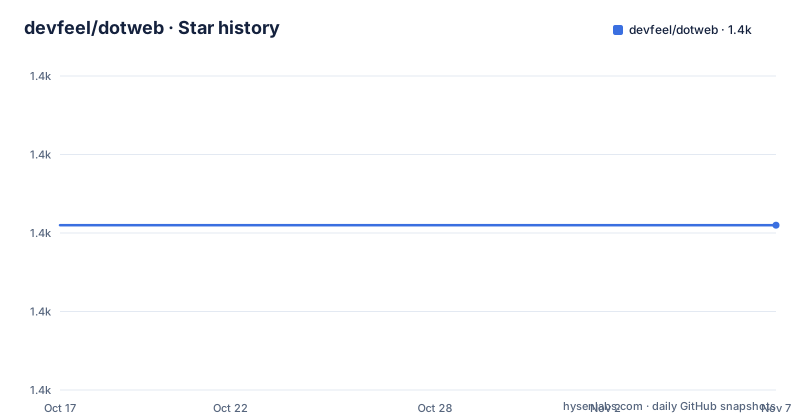
- devfeel/dotweb1,381 ★ · +0
| Repository | 2026-10-17 | 2026-11-07 |
|---|---|---|
| devfeel/dotweb | 1.4k | 1.4k |
0 Stars in the last 21 days, measured from the daily GitHub snapshot. Compare with other projects
Editorial analysis
DotWeb's Scope and Intended Users
DotWeb addresses the basic problem of assembling an HTTP service in Go without immediately choosing separate packages for routing, request handling, middleware, binding, sessions, cache, static files, and TLS configuration. The README positions it as a "Simple and easy go web micro framework," and its examples target server applications that register handlers on an application object and start an HTTP server.
The project is most relevant to Go developers who want a framework-shaped starting point for small services, internal tools, administrative APIs, or applications that need several web facilities together. It is also relevant to teams already familiar with Go modules, because the repository declares `module github.com/devfeel/dotweb` and uses `go mod`. The README points to separate documentation and a `devfeel/dotweb-example` repository for more examples.
This is not a general-purpose Go web stack with one narrowly defined abstraction. It includes global HTTP error handling, logging, timeout hooks, mock support, custom contexts, WebSocket and Hijack support, file and directory serving, JSON, JSONP, HTML, and string output. That broad surface may save setup work, but it also means adoption decisions should consider the maintenance and dependency cost of features a service may never use.
Application, Router, and Request Flow in DotWeb
The documented request path begins with `dotweb.New()`, which creates an application. A handler is then registered through `app.HttpServer.GET`, `POST`, `HEAD`, `OPTIONS`, `PUT`, `PATCH`, `DELETE`, or other specialized methods. The handler receives a `dotweb.Context`, and its return value is an `error`. In the first README example, the handler returns the result of `ctx.WriteString("welcome to my first web!")`.
DotWeb supports static paths, parameter paths, and grouped routes. A static route has no parameter variables. A parameter route uses a colon followed by a name, such as `/hello/:name`, and the handler reads it with `ctx.GetRouterName("name")`. Multiple parameters can be declared, as shown by `/news/:category/:newsid`. A route group has a shared prefix, such as `/user`, with child routes such as `/profile`.
The framework also exposes higher-level request facilities. `HttpContext.Bind(interface{})` binds JSON, XML, and form data into a Go value. Middleware can be attached at App, Group, and RouterNode levels. The README states the execution order as App, then Group, then RouterNode, with same-level middleware following the order in which it was added through `Use`. This ordering is a concrete design detail that matters when authentication, logging, or request transformation middleware are combined.
Installing DotWeb and Running the First Route
The README requires Go 1.24 or newer and says that Go 1.23 and earlier have standard-library security vulnerabilities. It also states that Go modules are supported. The documented installation command is:
go get github.com/devfeel/dotwebFor a first application, create a Go program with the following content. This example registers `/index`, writes a plain string response, and starts the server on port 80:
package main

import (
    "fmt"
    "github.com/devfeel/dotweb"
)

func main() {
    app := dotweb.New()
    app.SetLogPath("/home/logs/wwwroot/")
    app.HttpServer.GET("/index", func(ctx dotweb.Context) error {
        return ctx.WriteString("welcome to my first web!")
    })
    fmt.Println("dotweb.StartServer begin")
    err := app.StartServer(80)
    fmt.Println("dotweb.StartServer error => ", err)
}
The README's testing convention for a route is `curl` against the local server, for example:
curl http://127.0.0.1/helloThe installation command does not show a version constraint for DotWeb itself. The repository's module file requires Go 1.24 and declares dependencies including `github.com/redis/go-redis/v9 v9.18.0`, `golang.org/x/net v0.33.0`, and `gopkg.in/yaml.v3 v3.0.1`.
DotWeb's Built-in Facilities and Extension Points
DotWeb's differentiator is the number of facilities included in the framework package. Static and directory serving is configurable, including whether directory browsing is allowed. Modules can run global code before routes are processed. Middleware can be applied at several routing scopes, and the repository refers to `github.com/devfeel/middleware` for the available middleware ecosystem.
The framework also includes or documents cache, session, TLS, timeout hooks, mock support, custom contexts, global HTTP error handling, global logging, and WebSocket or Hijack handling. Session support includes primary and standby Redis switching. The module file confirms that DotWeb uses `github.com/redis/go-redis/v9`, which is relevant when reviewing the dependency and Redis client behavior.
For response handling, the README lists string, JSON, JSONP, and HTML formats. Third-party template engines can be connected by implementing `dotweb.Renderer`. This is an explicit interface boundary, unlike some features for which the README only names the capability without showing a complete configuration example. The repository includes `example/config/dotweb.conf` and `example/config/dotweb.json`, plus examples for JSON APIs, middleware, sessions, WebSockets, routing, file upload, mock support, and quickstart usage.
The README also includes a benchmark table comparing DotWeb with ECHO and Gin. Those figures are presented as repository documentation for DotWeb 1.9.2 on 16 cores and 16G. They are not an independent verification, and the table does not document the full workload, application code, or test method, so it should not be treated as a purchasing decision by itself.
Limitations, Alternatives, and Operational Trade-offs
The first limitation is documentation depth. The README names a broad feature set, but it does not provide a complete production configuration walkthrough for TLS, Redis session failover, cache eviction, timeout behavior, or custom renderer registration. The README links to a guide and external documentation, but those sources are not reproduced here, so their operational details cannot be confirmed from the repository information available.
There is also a versioning concern. The repository's `go.mod` requires Go 1.24, while the README says Go 1.23 and below have standard-library security vulnerabilities. A team on an older toolchain cannot use the documented module configuration without upgrading Go or changing the project, and changing the framework version may affect dependencies.
ECHO and Gin are real alternatives named by the README, but DotWeb's documentation does not explain their architectural differences. The only comparison supplied is the benchmark table. Based on the documented project choice, DotWeb favors bundling application, routing, middleware, binding, cache, session, Redis, TLS, and server facilities, whereas the README gives no evidence that ECHO or Gin expose the same integrated feature set. That is a feature comparison, not a claim about their performance or internal design. A team needing a very small routing layer or a clearly documented minimal API may find a smaller framework more suitable.
DotWeb Maintenance, License, and Upgrade Burden
DotWeb is not archived. The last push was on 2026-07-02, which is within six months of 2026-10-17, so the repository has recent development activity by the stated maintenance criteria. The recent release history includes v1.8.3 on 2026-03-10, 1.8.1 on 2026-03-05, and 1.8 on 2026-03-02. The release descriptions identify Redis client migration, security updates, bug fixes, Go 1.21 upgrading work in the earlier release, dependency updates, and pprof production hardening. Those descriptions indicate changes that deserve review during upgrades, especially for services using Redis or pprof.
The project is licensed under MIT. That license permits use, modification, distribution, and sublicensing subject to its conditions, but the repository's `LICENSE` file should be read for the exact obligations. The license does not remove the need to review third-party dependencies or to verify how Redis, middleware, and template integrations are licensed.
Upgrade cost is likely higher than adding a single router package would be, because `go.mod` tracks Redis, networking, and YAML dependencies and because DotWeb exposes several built-in subsystems. The presence of `go.sum` helps dependency verification, while the README's requirement to use Go 1.24 makes the toolchain itself part of the upgrade decision.
Editorial conclusion
DotWeb fits Go developers who want one framework with routing, middleware, request binding, sessions, cache, Redis support, and TLS close at hand. It is a poor fit for a team that needs clearly documented extension points or a minimal dependency surface without reviewing the framework internals first. Before adoption, verify Go 1.24 compatibility, the exact `github.com/devfeel/middleware` integration, and the Redis and TLS configuration behavior for the intended deployment.
Frequently asked questions
How do I install DotWeb for a Go project?
The README documents installing it with `go get github.com/devfeel/dotweb`. It requires Go 1.24 or newer and supports Go modules.
How does DotWeb handle route parameters?
DotWeb uses colon-prefixed parameter names in paths, such as `/hello/:name`. A handler reads the value with `ctx.GetRouterName("name")`.
Does DotWeb support middleware and request binding?
Yes. The README documents middleware at App, Group, and RouterNode levels, with execution from App to Group to RouterNode. `HttpContext.Bind(interface{})` supports binding JSON, XML, and form data.
What database or cache components does DotWeb include?
The README lists built-in cache and session support, and session support includes primary and standby Redis switching. The repository's `go.mod` declares `github.com/redis/go-redis/v9 v9.18.0`.
Official sources
Add this badge to your README
If you maintain this project, the badge below links readers to this analysis and shows its maintenance status from the daily GitHub snapshot. Paste the markdown into your README; add ?metric=license or ?metric=stars to the image URL for a different field.

[](https://hysenlabs.com/projects/devfeel-dotweb)Star history chart for your README
[](https://hysenlabs.com/projects/devfeel-dotweb)Was this useful?