ericosiu/ai-marketing-skills: Claude Code Skill Packs for Marketing and Sales
Open-source AI marketing skills — growth experiments, sales pipeline, content ops, outbound, SEO, and finance automation
At a glance
- What is it?
- A collection of workflow directories for Claude Code, covering experiment engines, outbound, SEO, finance and video production. The repository is a set of installable skills rather than a single application, and the setup is per category.
- Who is it for?
- Adopt it if your team already runs Claude Code or another coding agent and you want ready-made workflow directories, starting with one category such as growth-engine and its SKILL.md. Do not adopt it if you expect a single installable application, a hosted service, or a package with versioned releases: the repository has no releases, and each category has its own README, requirements.txt and .env.example.
- Can I use it commercially?
- Yes. MIT is a permissive licence: you can use, modify and sell software built on it, as long as you keep its copyright and licence notices.
- Is it still maintained?
- Yes. The repository last received commits 2 days ago.
- What is it written in?
- Mainly Python, according to GitHub's language statistics.
Answers come from the project's GitHub data, last synced on November 15, 2026, and from our analysis. They are not legal advice.
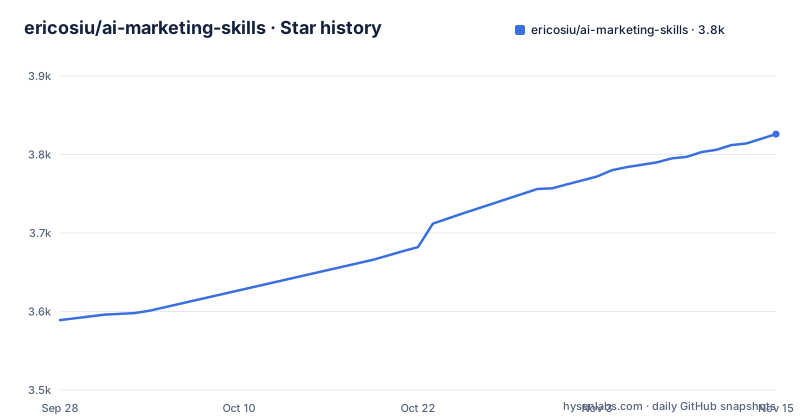
Star history
- ericosiu/ai-marketing-skills3,826 ★ · +237
| Repository | 2026-09-28 | 2026-11-15 |
|---|---|---|
| ericosiu/ai-marketing-skills | 3.6k | 3.8k |
237 Stars in the last 48 days, measured from the daily GitHub snapshot. Compare with other projects
Editorial analysis
What ai-marketing-skills actually ships
This is not a library you import. The repository is a set of directories, each one a self-contained skill for Claude Code or another AI coding agent, and each with its own README, dependencies and environment file. The top level lists categories such as growth-engine, sales-pipeline, content-ops, outbound-engine, seo-ops, finance-ops, revenue-intelligence, podcast-ops and a long tail of video and short-form directories. The README describes them as "complete workflows (scripts, scoring algorithms, expert panels, and automation pipelines)" rather than prompts, which is the right framing: what you get is Python scripts plus a SKILL.md that tells the agent how to drive them.
The intended user is a marketing or sales operator who already works inside an agent. If you do not run Claude Code or a comparable coding agent, the SKILL.md files have nothing to attach to, and you would be left running the Python scripts by hand. The repository is Python-first and MIT-licensed, with a Makefile at the top level. There are no published releases, so the way to consume it is to clone the repository and track the main branch.
How a skill directory is structured and executed
The mechanism is file-based, not service-based. A category directory holds a SKILL.md plus whatever the workflow needs: scripts, references, agents and other bundled files. Claude Code reads SKILL.md from a skills directory in your project, and the file describes the workflow the agent should follow. The Python scripts underneath do the actual work, reading configuration from environment variables and writing results to disk or to an external API.
The README is explicit that the unit of installation is the directory, not the markdown file: "Copy the complete skill directory when it also contains scripts/, references/, agents/, or other bundled files. Copying only SKILL.md will leave those workflows incomplete." That is the single most important structural fact about the repository. A skill that looks like documentation is often a thin wrapper around executable code, and the code is what produces the output.
Data flow differs by category. The growth-engine example takes a hypothesis, a variable, a list of variants and a metric, which implies the script creates an experiment record and tracks it against a measurement source. The outbound, revenue and video categories imply connectors to CRMs, call recordings or model providers, but the top-level README does not enumerate those integrations; only the per-category READMEs would.
Installing ai-marketing-skills and running a first experiment
The README gives a five-step pattern that applies to every category. Clone the repository, change into one category directory, install its Python dependencies, copy the environment template and fill in your API keys. The commands below are copied from that Quick Start block.
git clone https://github.com/ericosiu/ai-marketing-skills.git
cd ai-marketing-skills
cd growth-engine
pip install -r requirements.txt
cp .env.example .env
After `cp .env.example .env` you edit the file with your API keys. The README does not list which keys a given category needs, so the .env.example inside that directory is the source of truth. Once the environment is set, the example invocation creates an experiment:
python experiment-engine.py create \
  --hypothesis "Thread posts get 2x engagement vs single posts" \
  --variable format \
  --variants '["thread", "single"]' \
  --metric impressions
The four flags are the whole interface shown in the README: a hypothesis string, the variable being changed, a JSON array of variants and the metric to track. Expect the script to register the experiment rather than run it immediately; the README does not document a separate run or report subcommand.
To wire the skill into an agent, copy the markdown into your project's skills directory:
cp ai-marketing-skills/growth-engine/SKILL.md .claude/skills/growth-engine.mdFor a bundled skill the README shows a recursive copy instead, using the YouTube Packaging directory as the example:
cp -R ai-marketing-skills/packaging-youtube-thumbnails \
  .claude/skills/packaging-youtube-thumbnails
There is also a top-level Makefile with a single `setup` target that installs a pre-commit hook from security/pre-commit-hook.sh. That target is about repository hygiene, not about installing skills.
The install is per category, and that is the main cost
Nothing at the top level installs the whole collection. There is no `pip install ai-marketing-skills`, no packaging metadata shown at the root, and no release artifacts. Each category carries its own requirements.txt and its own .env.example, which means dependencies and credentials are duplicated across directories you use. Running four categories means four virtual environments or one environment where the dependency sets have to agree.
The README also does not document rollback, versioning or upgrade paths. With no releases and a main-branch workflow, updating means pulling the repository and re-copying the skill directories into .claude/skills, which will overwrite any local edits you made to SKILL.md. Teams that customize a skill should keep their changes outside the copied file or track them separately.
The documentation is uneven in a predictable way: the top-level README is a catalogue with one-line descriptions, while the real setup detail lives in each category README. The README states that each category has its own README with setup instructions, so the absence of detail at the top is a deliberate split rather than an omission. The practical consequence is that you cannot evaluate the whole repository from the front page.
When this is the wrong tool
If you want a marketing automation platform with a UI, scheduling and a support contract, this repository is not that. It is a set of scripts and agent instructions that you operate yourself, and every category assumes you can read Python, manage a virtual environment and obtain API keys for third-party services.
It is also the wrong choice if you do not use an agent. The SKILL.md layer is what turns these directories into workflows an assistant can execute; without it you are manually invoking experiment-engine.py and its siblings. And if you need deterministic, auditable marketing operations, be careful: the scripts call external APIs and model providers, and the repository does not describe test coverage or a validation harness for the outputs. The presence of an eval/ directory in the top-level listing suggests some evaluation material exists, but the README does not explain what it covers.
Finally, the breadth is a liability for small teams. Thirty-odd categories with different dependency sets is a lot of surface area to keep current on a main-branch model.
How it differs from prompt libraries and from agent frameworks
The nearest comparison is a prompt or template collection, such as a set of marketing prompts you paste into a chat. The difference is that these skills ship executable code: the README frames them as workflows with scripts and scoring algorithms, and the install steps include pip and environment variables. A prompt library has no requirements.txt and no API keys to configure.
The other comparison is an agent framework, which gives you primitives for building agents and leaves the marketing logic to you. This repository goes the other way: the marketing logic is already written, and you supply the agent runtime (Claude Code or another AI coding agent, per the README). If your need is a general agent toolkit, a framework is the better fit; if your need is a working outbound or SEO loop, the prebuilt skill is the shorter path, at the cost of adopting someone else's opinions about how that loop should run.
Licence, maintenance and what to check before adopting
The repository is MIT-licensed, which permits commercial use and modification provided the licence and copyright notice are retained. That matters here because the skills are meant to be copied into your own project, and MIT is compatible with that workflow. It says nothing about the third-party APIs the scripts call, and those services carry their own terms and costs. This is not legal advice; check the LICENSE file and the terms of any service a category connects to.
On maintenance, the last push was on 2026-09-13, so the main branch has recent activity. The repository has no published GitHub releases, which means there is no version to pin and no changelog to read. Treat the commit history as the upgrade log.
Before adopting, verify three things in the specific category you want: that its requirements.txt installs cleanly on your Python version, that its .env.example lists every credential the scripts read, and that the SKILL.md references only files that exist in that directory. The README's own warning about incomplete copies makes that last check worth doing by hand.
Editorial conclusion
Adopt it if your team already runs Claude Code or another coding agent and you want ready-made workflow directories, starting with one category such as growth-engine and its SKILL.md. Do not adopt it if you expect a single installable application, a hosted service, or a package with versioned releases: the repository has no releases, and each category has its own README, requirements.txt and .env.example. Verify first that the category you need ships the bundled scripts and references its SKILL.md expects, because the README warns that copying only SKILL.md leaves those workflows incomplete. Also check the per-category README for the environment variables it requires before you run any script.
Frequently asked questions
What is ericosiu/ai-marketing-skills?
It is an MIT-licensed collection of Claude Code skills for marketing and sales teams, organized into categories such as growth-engine, sales-pipeline, content-ops and seo-ops. Each category is a directory with its own README, scripts and setup instructions.
How do I install ai-marketing-skills?
Clone the repository, change into one category directory, run pip install -r requirements.txt and copy .env.example to .env to fill in your API keys. The README gives this as the general pattern for every category.
Can I copy only the SKILL.md file into my project?
No. The README states that when a skill directory also contains scripts, references, agents or other bundled files, you must copy the complete directory, because copying only SKILL.md leaves those workflows incomplete.
Does the repository publish versioned releases?
The repository has no published GitHub releases, so consumption is by cloning the repository and tracking the main branch. The README does not document rollback or an upgrade procedure.
Official sources
Add this badge to your README
If you maintain this project, the badge below links readers to this analysis and shows its maintenance status from the daily GitHub snapshot. Paste the markdown into your README; add ?metric=license or ?metric=stars to the image URL for a different field.

[](https://hysenlabs.com/projects/ericosiu-ai-marketing-skills)Star history chart for your README
[](https://hysenlabs.com/projects/ericosiu-ai-marketing-skills)Was this useful?