Gentle-AI: memory, ODD workflow rules and delegation limits layered onto the coding agent you already run
Gentle-AI configures the AI coding agents you already use: Claude Code, Cursor, OpenCode, Codex, Pi, and more. Choose persistent memory, Spec-Driven Development, curated skills, MCP servers, personas, and optional bounded review. Open source, no agent lock-in.
At a glance
- What is it?
- Gentle-AI is a Go tool that configures existing AI coding agents such as Claude Code, Cursor, OpenCode and Codex with persistent memory, a sizing workflow called ODD, curated skills and MCP servers. It is opinionated about when an agent may delegate, and it changes fast.
- Who is it for?
- Gentle-AI suits developers who already rely on one of its 17 supported agents and want project memory, explicit rules for task sizing and delegation, and a curated skill and MCP setup without switching tools. It is a poor fit if you want a minimal agent setup you can freeze for months, since the v4 line shipped three releases in October 2026 alone.
- Can I use it commercially?
- Yes. MIT is a permissive licence: you can use, modify and sell software built on it, as long as you keep its copyright and licence notices.
- Is it still maintained?
- Yes. The repository received new commits within the last day.
- What is it written in?
- Mainly Go, according to GitHub's language statistics.
Answers come from the project's GitHub data, last synced on November 13, 2026, and from our analysis. They are not legal advice.
Star history
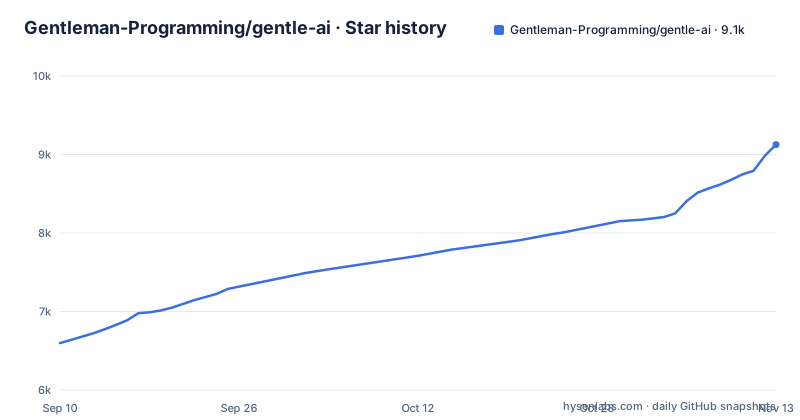
- Gentleman-Programming/gentle-ai9,126 ★ · +2,529
| Repository | 2026-09-10 | 2026-11-13 |
|---|---|---|
| Gentleman-Programming/gentle-ai | 6.6k | 9.1k |
2,529 Stars in the last 64 days, measured from the daily GitHub snapshot. Compare with other projects
Editorial analysis
It reconfigures the agent you have instead of shipping a new one
Gentle-AI calls itself the deterministic engineering environment for the AI agent you already use. It does not bring its own model or editor. It writes native configuration for existing agents and lists 17 integrations: Pi, OpenCode, Claude Code, Codex, Cursor, VS Code Copilot, Gemini CLI, Kilo Code, Kimi Code, Kiro IDE, Qwen Code, Hermes, Antigravity, Windsurf, OpenClaw, Trae and Conductor. From there you choose what to install: persistent memory, Spec-Driven Development, curated skills, MCP servers, personas, and an optional bounded review step.
The pitch is aimed at a specific complaint: an agent writes code, then forgets everything, has no opinion about your project, and cannot prove what it did beyond asking you to read every line. Gentle-AI's answer is memory, a workflow and evidence. Because support is spread across 17 different tools, the project keeps a capability comparison in docs/agents.md. Check your own agent's entry there before assuming every feature behaves the same in your setup.
Engram keeps project context between sessions
Engram is the memory layer. The argument behind it is that the real cost of a fresh session is not tokens but the developer re-explaining the same decisions every morning. With Engram enabled, the agent writes down what it learns as it goes and consults those notes before it asks you, so context accumulates across sessions instead of resetting. Details are in docs/engram.md.
For a team, the practical effect is that decisions captured in one session are available in the next without being pasted back into a prompt. The go.mod lists modernc.org/sqlite among the direct dependencies, alongside YAML, TOML and JSON Schema libraries, so the tool carries its own storage and configuration parsing rather than depending on a server.
ODD sizes work by resumability, not by file count
Organic Driven Development, or ODD, is Gentle-AI's workflow. Its rule is that small changes should not need a planning pipeline, and larger work should not lose its context between sessions. Questions, reviews and proposals stay read-only until you ask for a change. The agent explores before changing code, checks results, and keeps progress current.
Size is judged by understanding, risk and resumability, never by how many files are touched. A small task is one that is understood, has contained risk and can be resumed from the diff alone; it runs inline with no subagents and no task document. Work becomes large only when it cannot be resumed from the diff: several sessions, external waits, or requirements too long to survive context compaction. A large task gets one recoverable feature document that holds your spec verbatim, and every handoff points to that document instead of paraphrasing it. The consequence is that a sprawling but mechanical refactor stays small under ODD, while a two-line change blocked on an outside answer becomes large.
Subagents need a named reason before the orchestrator spawns one
Gentle-AI treats delegation as expensive: a subagent costs a fresh session, uncached reads and a handoff. The orchestrator may delegate only for a reason it can name.
Exploration applies when understanding needs more than one inline batch, about 3 calls and 10k tokens, or more than about five sequential lookups; a single read-only explorer then returns a short map with path:line evidence. Parallel writers apply when there are two or more independent units of behavior, such as code, tests and docs, with disjoint edit surfaces and several minutes of work each, meaning several files or roughly 100 or more changed lines. The threshold exists because a subagent spends one to two minutes reading before it writes. A delivery that depends on another does not count as independent. A context backstop hands the next bounded unit of a long session to a fresh worker, and an independent verifier is reserved for changes that touch high-risk items such as data, security or shared contracts.
If you are used to agents fanning out on every request, expect fewer parallel workers and more inline work.
Three releases in October 2026 means configs move under you
The v4 line is moving quickly. v4.1.1 arrived on 12 October 2026 with the title Consistent Module Checksum for the v4.1 Line, v4.2.0 followed on 15 October with routing for Gentle Shell shipped in the provider contract, and v4.3.1 landed on 27 October, letting Gentle Shell install and update from the TUI on every platform. The last push to the repository was on 2 November 2026.
For users this cuts both ways. Fixes arrive fast, but a tool whose job is writing configuration into your agent can change that configuration between releases. A team that wants every developer's agent to behave the same should pin one version, upgrade deliberately, and read the release notes before rolling forward. The v4.1.1 checksum fix is a reminder that anyone consuming the Go module directly, at github.com/gentleman-programming/gentle-ai/v4, should verify which tag they resolve.
A Go binary with a terminal UI, not an npm package
Despite a package.json at the root, named gentleman-ai-installer and marked private, the tool is written in Go. go.mod declares go 1.25.10 and pulls in Charmbracelet's bubbletea, bubbles and lipgloss for the terminal interface, plus jedisct1/go-minisign and google/uuid among the dependencies. A .goreleaser.yaml at the top level shows releases are produced with GoReleaser. Building from source therefore means a Go toolchain at that version; most users should start from docs/quickstart.md and the GitHub releases instead.
The repository also carries an AI_POLICY.md, a CONTRIBUTING.md and an e2e/ directory, and the agent instructions it expects contributors to follow live in AGENTS.md.
MIT code, trademarked names
The code is MIT licensed, but the README marks both Gentle-AI and Engram with a trademark symbol, and the repository includes a TRADEMARKS.md. That split matters if you plan to fork. The license lets you reuse and modify the code, while the names are a separate question governed by that trademark file. Anyone shipping a modified build inside a company or as a public fork should read TRADEMARKS.md before keeping the Gentle-AI or Engram names on it.
Editorial conclusion
Gentle-AI suits developers who already rely on one of its 17 supported agents and want project memory, explicit rules for task sizing and delegation, and a curated skill and MCP setup without switching tools. It is a poor fit if you want a minimal agent setup you can freeze for months, since the v4 line shipped three releases in October 2026 alone. Before installing, check your agent's entry in docs/agents.md, read docs/quickstart.md, and pin the release you test against.
Frequently asked questions
How do you install Gentle-AI?
Start from docs/quickstart.md in the repository and the GitHub releases page. Since v4.3.1, Gentle Shell can install and update from the TUI on every platform.
How do you use Gentle-AI?
Gentle-AI configures an agent you already run, such as Claude Code, Cursor, OpenCode or Codex. You pick persistent memory, Spec-Driven Development, curated skills, MCP servers, personas and optional bounded review, and docs/intended-usage.md covers the workflow.
Does Gentle-AI work with VS Code?
VS Code Copilot is one of the 17 integrations Gentle-AI lists, alongside Cursor, Windsurf and Kiro IDE. docs/agents.md compares what each integration supports.
Official sources
Add this badge to your README
If you maintain this project, the badge below links readers to this analysis and shows its maintenance status from the daily GitHub snapshot. Paste the markdown into your README; add ?metric=license or ?metric=stars to the image URL for a different field.

[](https://hysenlabs.com/projects/gentleman-programming-gentle-ai)Star history chart for your README
[](https://hysenlabs.com/projects/gentleman-programming-gentle-ai)Was this useful?