gomods/athens: a self-hosted Go module proxy you run yourself
A Go module datastore and proxy
At a glance
- What is it?
- Athens implements the Go module download protocol and stores module versions in whatever backend you point it at. It suits teams that need a private module cache or an internal registry, and it is not a general-purpose artifact repository.
- Who is it for?
- Adopt Athens if you need a Go module proxy you control, with storage in cloud blob storage, MongoDB, a CDN, shared disk or memory, and you are prepared to run and upgrade that server yourself. Do not adopt it if you need a general artifact repository for non-Go ecosystems, or if your only goal is faster downloads that a public proxy already gives you.
- Can I use it commercially?
- Yes. MIT is a permissive licence: you can use, modify and sell software built on it, as long as you keep its copyright and licence notices.
- Is it still maintained?
- Yes. The repository last received commits 1 day ago.
- What is it written in?
- Mainly Go, according to GitHub's language statistics.
Answers come from the project's GitHub data, last synced on November 15, 2026, and from our analysis. They are not legal advice.
Star history
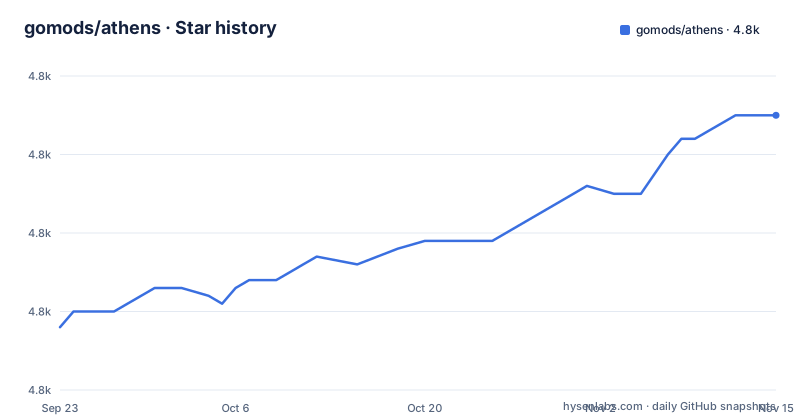
- gomods/athens4,825 ★ · +27
| Repository | 2026-09-23 | 2026-11-15 |
|---|---|---|
| gomods/athens | 4.8k | 4.8k |
27 Stars in the last 53 days, measured from the daily GitHub snapshot. Compare with other projects
Editorial analysis
What Athens solves, and for whom
Go downloads modules over a documented HTTP protocol. By default the go command talks to a public proxy or fetches from version control directly. Athens replaces that endpoint with a server you operate, so every module version your team resolves passes through infrastructure you control and lands in storage you choose.
The README describes Athens as "an open source, enterprise ready implementation of the Go Module proxy for the Go Modules download API". The word enterprise here is about deployment shape, not features: the project expects you to bring the storage and the operational discipline. It also states that development teams at several companies run their own Athens servers, connect them to their own storage backends, and point local Go environments at them.
That places the audience narrowly. If you need Go modules to survive a public proxy outage, or you want an internal cache that does not depend on an external service, Athens is aimed at you. If you want one binary that also serves npm, PyPI and Docker images, Athens is not that, and the README never suggests it is.
The download protocol is the whole interface
Athens is not a package manager. It is a server that answers the requests the go command already knows how to make. The README links to the Go modules download protocol as the thing the proxy implements, and to the Go Modules download API for the details.
That design keeps the client side unchanged. You do not install an Athens client, and developers do not learn a new command. They set an environment variable or a Go configuration entry, and the go command sends its module requests to Athens instead of the default endpoint. Athens either serves the module from its storage or fetches it and stores it for the next request.
Storage is the configurable half. The README lists cloud blob storage services, MongoDB, content distribution networks, shared disk and in-memory as supported drivers. The go.mod file backs that list with concrete dependencies: cloud.google.com/go/storage, the Azure blob SDK, aws-sdk-go-v2 with the S3 service and transfer manager, go.mongodb.org/mongo-driver/v2, minio-go, and lib/pq for PostgreSQL.
Installing Athens and pointing go at it
The README sends readers to the documentation site for installation rather than printing steps inline, so treat the commands below as the path the repository itself exposes. The Makefile builds the proxy binary from ./cmd/proxy, and the docker-compose.yml runs a development instance on port 3000 backed by MongoDB.
To build locally, the Makefile target is:
make buildThat produces ./cmd/proxy/proxy. The Makefile also has a run target that starts the proxy with the development configuration:
make runFor a container-based first run, the repository ships a Compose file whose dev service builds cmd/proxy/Dockerfile and publishes port 3000. The service sets ATHENS_STORAGE_TYPE=mongo and ATHENS_MONGO_STORAGE_URL=mongodb://mongo:27017, and depends on a mongo service. The Makefile wraps this:
make run-dockerOnce the server is up, the client side is an environment variable the go command reads. The README does not print a client-side command, so the check is a module download against the running server rather than a documented verification step.
Where Athens is the wrong tool
The in-memory driver is the clearest failure mode. It is listed as a supported backend, and it behaves exactly as the name suggests: module data lives in the process. Restart the proxy and the cache is gone. For a single developer testing the protocol locally that is fine. For a team cache it defeats the purpose, because every restart sends traffic back to the upstream source.
A second limitation is scope. Athens serves Go modules. The README and the repository layout describe a Go module datastore and proxy, and the storage drivers are generic blob and database backends rather than format-aware repositories. If your organization wants one service for Go, container images and language packages, Athens covers only the first.
There is also an operational cost that the README does not hide. You are running a server, choosing a storage backend, and keeping both alive. The repository carries a Dockerfile.test, a docker-compose.yml with mongo, minio, azurite and jaeger services, and CI configuration across .circleci, .github, appveyor.yml and azure-pipelines.yml. That is the shape of a project with real deployment surface, not a single script. If your team has no one who wants to own that surface, a public proxy is the cheaper answer.
Athens compared with a plain module cache
The go command already keeps a local module cache on each machine. It also supports a proxy setting, and the public Go proxy is a default many teams rely on. The difference between those and Athens is where the data lives and who controls it.
A local cache is per machine. A developer who joins the team, or who wipes a module directory, refetches everything. Athens centralizes that: one server, one storage backend, shared by everyone who points their Go environment at it. The README's description of companies running their own servers and hooking them to their own storage backends is exactly this pattern.
The public proxy is shared infrastructure you do not operate. It is the right default for most projects. Athens becomes worth the effort when the requirement is control rather than speed: an internal registry for private modules, a cache that keeps serving when an external service is unreachable, or a store that must live in a specific cloud account or on specific hardware. Note that Athens is not a private module host in the registry sense. It stores and serves module data through the download protocol, so private modules still need a source the proxy can reach.
Maintenance, upgrades and the MIT licence
The last push to the repository was on 2026-10-31. The most recent release is v0.20.0, published on 2026-10-22, following v0.19.2 and v0.19.1, both on 2026-10-01. The repository is not archived. The README also carries a maintainer call to action, pointing at issue #1734 for people interested in becoming core maintainers, which is worth reading before you build a dependency on the project's roadmap.
Upgrade cost is tied to the Go toolchain. go.mod declares go 1.26.10, and the Compose file passes GOLANG_VERSION: "1.26.10" as a build argument, so the server image follows that version. The Makefile defaults GOLANG_VERSION to 1.26.10 as well. If you build from source, your toolchain needs to satisfy that directive.
Athens is MIT licensed. In practical terms that is a permissive licence with few obligations beyond keeping the copyright notice, but it is not legal advice and your organization's policy governs. The dependency list is long and includes cloud SDKs, database drivers, etcd, Prometheus and OpenTelemetry packages, so a licence review of the full module graph is a larger job than reading the single LICENSE file at the repository root.
Editorial conclusion
Adopt Athens if you need a Go module proxy you control, with storage in cloud blob storage, MongoDB, a CDN, shared disk or memory, and you are prepared to run and upgrade that server yourself. Do not adopt it if you need a general artifact repository for non-Go ecosystems, or if your only goal is faster downloads that a public proxy already gives you. Before committing, verify which storage driver fits your infrastructure, whether your Go toolchain version matches the go.mod requirement of 1.26.10, and how you will pin and upgrade the server image.
Frequently asked questions
What is gomods/athens?
It is an open source implementation of the Go module proxy for the Go Modules download API, described in the README as a Go module datastore and proxy. You run the server yourself and connect it to a storage backend.
Which storage backends does gomods/athens support?
The README lists cloud blob storage services, MongoDB, content distribution networks, shared disk and in-memory. The go.mod file includes SDKs for Google Cloud Storage, Azure Blob, AWS S3, MongoDB, MinIO and PostgreSQL.
How do I install gomods/athens?
The README points to the documentation site for installation. In the repository, the Makefile builds the proxy with make build and runs a development instance with make run, and make run-docker starts the Compose-based dev service on port 3000.
Is gomods/athens still maintained?
The repository is not archived and the last push was on 2026-10-31. The latest release listed is v0.20.0 from 2026-10-22, and the README asks for people interested in becoming core maintainers via issue #1734.
What licence does gomods/athens use?
The repository is MIT licensed, with a LICENSE file at the top level. The project depends on many third-party Go modules, so a full licence review covers more than that one file.
Official sources
Add this badge to your README
If you maintain this project, the badge below links readers to this analysis and shows its maintenance status from the daily GitHub snapshot. Paste the markdown into your README; add ?metric=license or ?metric=stars to the image URL for a different field.

[](https://hysenlabs.com/projects/gomods-athens)Star history chart for your README
[](https://hysenlabs.com/projects/gomods-athens)Was this useful?