Grafana Mimir: Long-Term Prometheus Storage with a Monolithic Mode and AGPL-3.0 License
Grafana Mimir provides horizontally scalable, highly available, multi-tenant, long-term storage for Prometheus.
At a glance
- What is it?
- Grafana Mimir is a horizontally scalable, multi-tenant Prometheus storage backend that can run as a single binary. Its AGPL-3.0 license and object-storage dependency shape who should adopt it.
- Who is it for?
- Adopt Grafana Mimir if you need a multi-tenant, horizontally scalable Prometheus storage backend and can accept the AGPL-3.0 license and the operational overhead of object storage. Do not adopt it if you require a permissive license or want to avoid running a separate storage service.
- Can I use it commercially?
- Yes, with strict conditions. AGPL-3.0 is a network copyleft licence: if people use a modified version over a network, for example as a hosted service, you must offer them its source code under the same licence.
- Is it still maintained?
- Yes. The repository received new commits within the last day.
- What is it written in?
- Mainly Go, according to GitHub's language statistics.
Answers come from the project's GitHub data, last synced on November 13, 2026, and from our analysis. They are not legal advice.
Star history
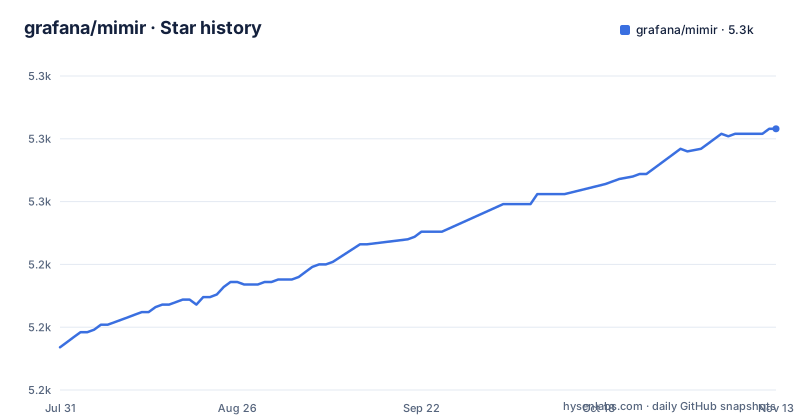
- grafana/mimir5,279 ★ · +87
| Repository | 2026-07-31 | 2026-11-13 |
|---|---|---|
| grafana/mimir | 5.2k | 5.3k |
87 Stars in the last 105 days, measured from the daily GitHub snapshot. Compare with other projects
Editorial analysis
The Problem: Prometheus Storage That Does Not Scale Forever
Prometheus is excellent at scraping and alerting, but its local storage is not built for long-term retention across many instances. When you run multiple Prometheus servers, you lose a global view of your metrics, and querying across them becomes a manual exercise. Grafana Mimir solves this by acting as a central, long-term storage backend. It ingests metrics from many Prometheus instances, stores them durably in object storage, and lets you query all of them with a single engine. The intended audience is an organization that runs Prometheus at scale and needs to retain metrics for months or years, not a single-team setup with modest cardinality. The README positions Mimir as easy to install, but the real value is in its horizontal architecture and multi-tenancy, which are for platforms teams, not casual users.
How It Works: Object Storage, Replication, and Parallel Queries
The core mechanism is separation of compute from storage. Mimir uses object storage for long-term data, which means the storage layer is cheap and durable, and the query engine can run on separate machines. The README states that Mimir replicates incoming metrics, so data survives machine failure. The architecture is horizontally scalable, allowing you to add machines to increase capacity. Query execution is parallelized across the cluster, which the README claims makes even high-cardinality queries fast. Multi-tenancy is built in, with limits and quality-of-service controls to share capacity fairly. The data flow is: Prometheus instances send metrics to Mimir, Mimir replicates and writes them to object storage, and queries are executed against that storage in a distributed fashion.
Getting It Running: Monolithic Mode and Deployment Options
The README emphasizes that you can get Mimir running with just one binary and no additional dependencies. This is the monolithic mode, where all components run in a single process. The command to start it is not given in the README, but the documentation link for deployment is provided. The README points to a Deploy Grafana Mimir guide. To migrate from Thanos or Prometheus, there are dedicated guides, which suggests the migration path is well-trodden. The key point is that the barrier to starting is low, but the production setup requires reading the architecture and configuration docs before you begin.
A Genuine Limitation: Object Storage Dependency and AGPL-3.0
The most obvious limitation is that Mimir requires object storage. The README lists AWS S3, GCS, Azure Blob, OpenStack Swift, and S3-compatible stores, but that still means you must operate or pay for a separate storage service. If you are on-premises without an S3-compatible endpoint, you have to set one up, which adds complexity. The second limitation is the license. Mimir is AGPL-3.0-only, which is a strong copyleft license. If you modify Mimir and offer it as a network service, you must release your modifications under the same license. For many internal deployments, this is fine, but if you are building a commercial product that embeds or extends Mimir, you need to review the implications carefully. The README does not mention any alternative licensing, so you should assume AGPL-3.0 applies to any derivative work.
Alternative: Thanos as a Different Approach
The README explicitly mentions migrating from Thanos or Prometheus to Mimir, so Thanos is a direct alternative. Mimir's own pitch is a global view of metrics across multiple Prometheus instances, native multi-tenancy, and object storage for long-term data.
Maintenance and Upgrade Cost
The README claims that Mimir can be restarted, upgraded, or downgraded with zero downtime, which is a strong operational promise. That implies the project has put effort into making upgrades safe, but it also means you need to follow the documented procedures. The maintenance cost is tied to the object storage backend, which you must monitor for latency and costs. The project ships dashboards, alerts, and runbooks, which reduces the burden of building your own monitoring. However, you still need to keep up with releases. The recent release history shows 3.1.9 and 3.2.4, both published on 2026-10-30, and 3.1.8 on 2026-10-22, which suggests patch releases are frequent. You should plan to read the release notes for each upgrade, as the documentation for the upcoming release is available at the tip of the main branch. The license does not impose a cost, but AGPL-3.0 may require you to share modifications if you distribute a service, which is a legal cost to review.
Editorial conclusion
Adopt Grafana Mimir if you need a multi-tenant, horizontally scalable Prometheus storage backend and can accept the AGPL-3.0 license and the operational overhead of object storage. Do not adopt it if you require a permissive license or want to avoid running a separate storage service. Before adopting, verify your object storage compatibility, review the production runbook for zero-downtime upgrades, and test the monolithic mode against your ingestion rate. The project's claim of handling up to 1 billion active time series is based on internal testing, so validate it against your own workload.
Frequently asked questions
What is grafana/mimir, the project hosted on GitHub?
Grafana Mimir is an open source project providing scalable long-term storage for Prometheus. It is horizontally scalable, natively multi-tenant with limits and quality-of-service controls, stores long-term data in object storage, and runs as a single binary in monolithic mode with no additional dependencies. It is distributed under AGPL-3.0-only.
How do I install grafana mimir?
The README routes installation to the Grafana documentation rather than giving a command: read the get started guide first, then the architecture overview, Configure Grafana Mimir, and Run Grafana Mimir in production before deploying. In the repository itself, `make help` prints the documented user-facing targets, and `make exes` builds the binaries.
How do I set up mimir for a deployment?
Deployment detail lives in the documentation, not the README, which points at a Deploy Grafana Mimir page plus an architecture overview, the configuration reference and a production runbook. Monolithic mode is the low-ceremony starting shape: one binary, no additional dependencies.
How do I add mimir to grafana as a datasource?
The README says nothing about Grafana datasource wiring. What it does offer for an existing setup are migration guides, one for coming from Thanos or Prometheus and one for Cortex, plus documentation links for the latest and upcoming releases.
Official sources
Where developers are discussing it
Posts on Hacker News, dev.to and Lobsters that link to this repository, found by our scan of those communities. 1 in the last 30 days; newest first.
- Two rejected series stalled all my metricsdev.to · Nov 12, 2026 · 3 points · 1 comments
Add this badge to your README
If you maintain this project, the badge below links readers to this analysis and shows its maintenance status from the daily GitHub snapshot. Paste the markdown into your README; add ?metric=license or ?metric=stars to the image URL for a different field.

[](https://hysenlabs.com/projects/grafana-mimir)Star history chart for your README
[](https://hysenlabs.com/projects/grafana-mimir)Was this useful?