Kysely: A Type-Safe SQL Query Builder for TypeScript Projects
A type-safe TypeScript SQL query builder. Mainly developed for Node.js but also runs on all other JavaScript environments like Deno, Bun, Cloudflare Workers and web browsers.
At a glance
- What is it?
- Kysely is a TypeScript SQL query builder that brings compile-time type safety to SQL queries, running on Node.js, Deno, Bun, Cloudflare Workers, and browsers. This review covers its mechanism, setup, limitations, and alternatives.
- Who is it for?
- Adopt Kysely if you are a TypeScript developer building on Node.js, Deno, Bun, Cloudflare Workers, or browsers and you want compile-time checking for your SQL queries without a full ORM. Avoid it if you need dynamic SQL generation without type constraints or if you prefer a query builder that does not force strict schema typing.
- Can I use it commercially?
- Yes. MIT is a permissive licence: you can use, modify and sell software built on it, as long as you keep its copyright and licence notices.
- Is it still maintained?
- Yes. The repository last received commits 1 day ago.
- What is it written in?
- Mainly TypeScript, according to GitHub's language statistics.
Answers come from the project's GitHub data, last synced on November 13, 2026, and from our analysis. They are not legal advice.
Star history
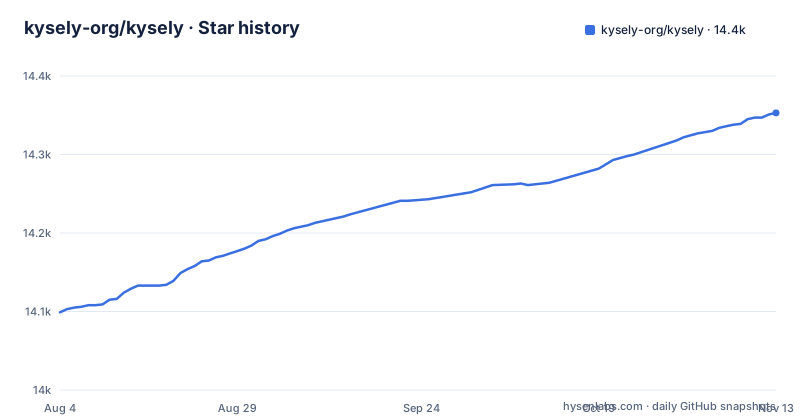
- kysely-org/kysely14,353 ★ · +254
| Repository | 2026-08-04 | 2026-11-13 |
|---|---|---|
| kysely-org/kysely | 14.1k | 14.4k |
254 Stars in the last 101 days, measured from the daily GitHub snapshot. Compare with other projects
Editorial analysis
The Problem: SQL Without Type Safety
Writing raw SQL in TypeScript is error-prone. Typos in column names surface only at runtime. Result rows come back as untyped objects, so you manually cast or guess shapes. Kysely solves this by making the query builder aware of your database schema at compile time. It is aimed at developers who want the flexibility of SQL but with the safety net of TypeScript's type checker. The README describes it as a type-safe and autocompletion-friendly TypeScript SQL query builder, inspired by Knex. This is not an ORM; it does not map objects to tables. It builds SQL strings with types attached, so you keep control over the SQL while gaining editor help and compile-time validation.
How Kysely Achieves Type Safety
The core mechanism is TypeScript's type system. Kysely defines types for your tables and columns, and the query builder methods are typed to only accept valid references. For example, when you write a select on a table, the result type is inferred from the selected columns, including aliases. The README highlights a specific feature: if you alias pet.name as pet_name, Kysely can parse that alias and add pet_name to the result row type. This inference extends to subqueries, joined subqueries, and with statements. The type system does the heavy lifting at compile time, so there is no runtime overhead for type checking. The library also offers escape hatches for cases where types cannot be inferred, such as the sql template tag and the DynamicModule. These are important because not every query fits the static type model.
Getting Started: Installation and Dialects
The README points to the documentation site for getting started, with dialect-specific guides for PostgreSQL, MySQL, MSSQL, SQLite, and pglite. Installation is via npm or JSR, as the package is published on both npm and jsr.io. For a typical Node.js project, you would install kysely and a database driver, then create a Kysely instance with a dialect. The exact commands are not in the README, but the documentation site provides them. The dialect abstraction is key: it allows Kysely to run on multiple environments, from Node.js to Cloudflare Workers, because the dialect handles the connection specifics. The README lists Deno, Bun, Cloudflare Workers, and web browsers as supported environments.
Escape Hatches for Dynamic SQL
Not everything can be typed at compile time. Kysely acknowledges this with two escape hatches: the sql template tag and the DynamicModule. The sql template tag lets you embed raw SQL fragments when the type system cannot express what you need. This is useful for database-specific functions or complex expressions. The DynamicModule, with its ref method, allows you to reference tables or columns dynamically, such as when building queries from user input or configuration. These escape hatches are not afterthoughts; they are essential for real-world usage. Without them, you would be forced to cast types or use raw queries, defeating the purpose of type safety. The trade-off is that these features shift some type checking back to runtime, so you lose compile-time guarantees in those spots.
Limitations and When It Is the Wrong Tool
Kysely's type safety depends on having a well-defined schema. If your database schema is not known at compile time, or if you generate queries dynamically from untyped sources, the type system becomes a hindrance rather than a help. The escape hatches exist, but using them extensively means you are bypassing the main benefit. Also, Kysely is not an ORM; it will not handle relationships. For developers who want object-relational mapping, a tool like Prisma might be more appropriate. Another limitation is that the type inference is complex, and as the README hints, there are cases where things cannot be typed. If you need to write highly dynamic SQL, such as a reporting tool with arbitrary filters, Kysely may force you into awkward type gymnastics.
Alternative: Knex.js and the Difference
Kysely is inspired by Knex.js, and the README lists Tim Griesser, credited for Knex, among its honorable mentions. Knex is a mature SQL query builder that has been around for years. The README does not compare the two in detail; its emphasis is that Kysely only lets you refer to tables and columns visible to the part of the query you are writing, and infers result columns, aliases and types. If you are already using Knex and are happy with runtime error checking, switching to Kysely requires adopting TypeScript's type system more deeply. For teams that are not ready for that, Knex remains a solid choice. Kysely's advantage is that it catches typos and type mismatches before you run the query, which can save debugging time.
Maintenance and License
Kysely is licensed under MIT, which is permissive and allows commercial use with attribution. The project is actively maintained, with v0.29.8 released on 2026-11-01 and v0.28.19 released the same day for the 0.28 line. The core team includes the original author and a co-maintainer, with a list of honorable mentions. The repository is not archived, indicating ongoing development. You should check the release notes before upgrading. The documentation is comprehensive, with API docs in the typing files and a hosted version, which helps with maintenance.
Editorial conclusion
Adopt Kysely if you are a TypeScript developer building on Node.js, Deno, Bun, Cloudflare Workers, or browsers and you want compile-time checking for your SQL queries without a full ORM. Avoid it if you need dynamic SQL generation without type constraints or if you prefer a query builder that does not force strict schema typing. Before adopting, verify that your database dialect is supported and that the escape hatches (sql template tag, DynamicModule) cover your dynamic query needs, as the type system has limits.
Frequently asked questions
How do you pronounce "Kysely"?
The README gives the pronunciation as Key-Seh-Lee, and says so on the first line of its introduction.
Is Kysely an ORM?
No. It describes itself as a type-safe, autocompletion-friendly TypeScript SQL query builder, and its getting started pages are organised by SQL dialect: postgresql, mysql, mssql, sqlite and pglite.
What is Kysely?
A type-safe and autocompletion-friendly TypeScript SQL query builder inspired by Knex.js. It is mainly developed for Node.js but also runs on Deno, Bun, Cloudflare Workers and web browsers.
What are the differences between Kysely and Knex?
Kysely was inspired by Knex.js, and its emphasis is on types: result types are inferred from the query itself, including the alias parsed from pet.name, with the sql template tag and DynamicModule available where SQL cannot be typed. The repository's docker-compose.yml also credits the Knex.js team for the mssql setup it borrows.
kysely vs drizzle vs prisma
The README's introduction and credits do not mention Drizzle. What is named is Knex, the project Kysely was inspired by, and two honorable mentions for Prisma work, one credited with the idea and one with an implementation.
Official sources
Where developers are discussing it
Posts on Hacker News, dev.to and Lobsters that link to this repository, found by our scan of those communities. 1 in the last 30 days; newest first.
- Does AbortSignal Cancel a Node.js Database Query? 4 Drivers Testeddev.to · Nov 2, 2026 · 26 points · 6 comments
Add this badge to your README
If you maintain this project, the badge below links readers to this analysis and shows its maintenance status from the daily GitHub snapshot. Paste the markdown into your README; add ?metric=license or ?metric=stars to the image URL for a different field.

[](https://hysenlabs.com/projects/kysely-org-kysely)Star history chart for your README
[](https://hysenlabs.com/projects/kysely-org-kysely)Was this useful?