Transportr is a non-profit Android app for public transport without ads or tracking
Free Public Transport Assistant without Ads or Tracking
At a glance
- What is it?
- Transportr is a free Android public transport assistant built by volunteers, distributed on F-Droid and Google Play, and released under the GPL so the data it uses stays in the hands of the community. It is a finished app rather than a library, and its map tiles are the one part someone else provides.
- Who is it for?
- Adopt Transportr if you want a public transport app on Android that does not track you, and you are happy to install from F-Droid rather than only from the Play Store. Do not adopt it if you need a maintained library or a feature roadmap, because this is an application, and the recent release history suggests changes land in small increments.
- Can I use it commercially?
- Yes, with conditions. GPL-3.0 is a copyleft licence: if you distribute software that includes it, you must release that software's source code under the same licence. Running it internally without distributing it does not trigger that obligation.
- Is it still maintained?
- Yes. The repository last received commits 8 days ago.
- What is it written in?
- Mainly Kotlin, according to GitHub's language statistics.
Answers come from the project's GitHub data, last synced on November 7, 2026, and from our analysis. They are not legal advice.
Star history
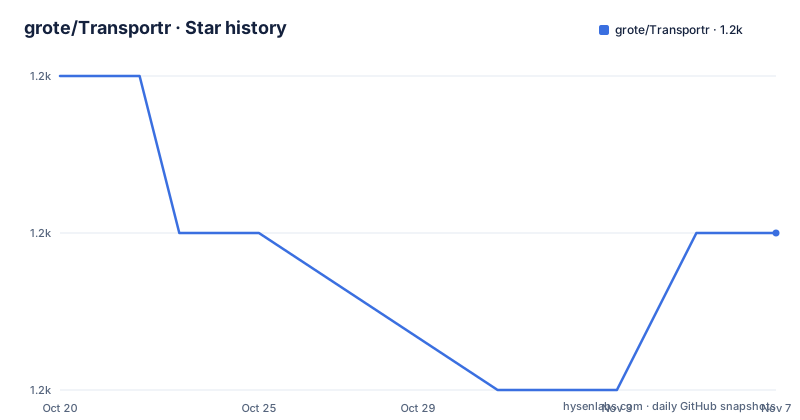
- grote/Transportr1,170 ★ · -1
| Repository | 2026-10-20 | 2026-11-07 |
|---|---|---|
| grote/Transportr | 1.2k | 1.2k |
-1 Stars in the last 18 days, measured from the daily GitHub snapshot. Compare with other projects
Editorial analysis
A companion app for people who take the bus
Transportr describes itself as the public transport companion that respects your privacy and your freedom, and it is a non-profit app developed by people around the world to make using public transport as easy as possible wherever you are.
The repository description is shorter and more concrete. Free Public Transport Assistant without Ads or Tracking.
So the scope is an Android application for finding departures, planning trips and looking up stations, and the differentiator is stated in the same sentence as the feature. There is no advertising SDK, and there is no tracking. For a public transport app that is a meaningful claim, because route planning and location data is exactly the combination that advertising and analytics businesses are built on.
The application id is de.grobox.liberario, which reflects the project's earlier name, and the site is transportr.app. The primary language is Kotlin, the licence is GPL-3.0, and the repository is not archived, with the last push on 2026-05-28.
The project's own framing is worth repeating, because it explains the shape of everything else. This is a community application. It has a CLA.md, a CONTRIBUTING.md, a Transifex configuration in a .tx/ directory for translations, and a fastlane/ directory holding the store metadata, which are the files of a project with many contributors across many countries rather than a product with a roadmap.
Two stores, and a third for people who want beta builds
The distribution section is short and it has three parts, which is more than most open source apps manage.
Transportr is on F-Droid, and it is on Google Play. Both are linked with badges in the readme, the F-Droid one for the package de.grobox.liberario and the Play one for the same application id.
The third part is the one that tells you about the project's character. Pre-releases and beta versions for advanced users are available via a special F-Droid repository, hosted on a personal domain rather than on the main F-Droid catalogue.
That arrangement matters for two reasons. A dedicated F-Droid repository means the builds are reproducible from source in the F-Droid model, and it means the beta channel is separate from the stable one, so a user who wants a pre-release opts into it rather than receiving it by default.
It also means the app can be installed without any Google service on the device, which is the arrangement most privacy conscious Android users prefer, and which is consistent with the claim in the project description.
The build badge at the top of the readme points at a GitHub Actions workflow for building and testing, so every commit is compiled somewhere other than on a contributor's machine.
The screenshot set is closer to a feature list
The readme has no feature list, which is a common pattern for an application whose audience already knows what it does. Instead there are six screenshots, and the file names tell you what the app does.
There is a first start screen, a saved searches screen, a trips screen, a trip details screen, a station screen and a departures screen. The images live under fastlane/metadata/android/en-US/images/phoneScreenshots, which is the store listing metadata directory, so the same pictures that appear in the readme are the ones shown in the store.
Read as a set, they describe the core loop of a public transport app. You save the trips you make often, you look at what is currently running at a station, you open a trip to see its legs, and you get details for a specific departure. The first start screen is the setup, and it is the only screen in the set that is about the app rather than about the transport network.
There is no screen for settings, no screen for account or for a ticket, and no advertisement. That is consistent with the description, and it is also the quickest way to understand the scope of the project: it is a departure board and a trip planner, and it leaves everything else to other apps.
Building it from source with the Gradle wrapper
The build section is written for contributors and it starts by pointing new people at Android development and setting up a development environment.
The first step is to clone the source code repository.
$ git clone https://github.com/grote/Transportr.gitThen, if you do not want to use an IDE like Android Studio, you can build on the command line.
$ cd Transportr
$ ./gradlew assembleRelease
Using the wrapper rather than a system Gradle is the detail that keeps the build reproducible, and the repository carries the gradlew and gradlew.bat launchers along with a gradle/ directory and a gradle.properties file, plus an update-dependency-pinning.sh script at the top level for the dependency pinning.
The build files are the older Groovy style, build.gradle and settings.gradle rather than the Kotlin DSL, and there is an .idea/ directory checked in, which is unusual and means the project shares a fixed IDE configuration with contributors.
The top level layout is otherwise what you would expect for an Android application, with an app/ directory holding the module, artwork/ for the images used in the readme and the store listing, and the .github/ directory for the workflows and issue templates.
Privacy as a licence choice, not just a feature
The privacy claim is supported by structure rather than by a policy document alone, and the GPL-3.0 licence is part of that structure.
The application is distributed as Free Software, with the rights to use, study, share and improve it, and to redistribute and modify it under the terms of the GNU General Public License. For a consumer app, that licence is unusual. It means the source is available and the derivatives have to stay open, and it makes the promise of no tracking auditable in a way a privacy policy is not.
The repository also carries a privacy-policy.md file at the top level, next to the licence and the contribution files, which is the document a store listing and a user would point at.
The claims in the readme are limited to the absence of ads and of tracking. The readme does not make a claim about what the app stores locally, how long it keeps data, or which transport data providers are queried, and those are the questions a privacy conscious user will have. The repository is the place to look, along with the app's own settings screen, rather than the marketing line in the description.
The funding model is visible in the acknowledgements, and it is a good example of how a non-profit app covers its running costs without advertising.
The map tiles are provided by a sponsor
The acknowledgements section names one company, and it is the piece of the stack that is not the community's.
JawgMaps is a provider of online custom maps, geocoding and routing based on OpenStreetMap data, and the project thanks them for providing their vector map tile service to Transportr free of charge.
So the maps come from a commercial provider, donated at no cost, while the routing and timetable data come from the transport data sources the app is built on. That division is normal for a non-profit app and worth being explicit about, because a map tile provider sees the tile requests, and tile requests carry the coordinates of the places you look up. It is a narrower exposure than behavioural tracking, and it is a different thing from the app tracking you, but it is not nothing.
The readme is honest about the arrangement rather than presenting it as fully self-hosted, and the acknowledgement is the only external service named in the visible documentation.
The topic tags on the repository are android-app, map and public-transportation, which is a small set for a project of this size, and the last push on 2026-05-28 suggests the work is in maintenance rather than in heavy development.
A slow cadence of small releases
The release history shows a project that ships increments rather than features, and the numbers are the evidence.
Version 2.2.7 was released on 2025-12-03, 2.2.6 on 2025-11-25 and 2.2.5 on 2025-11-18. Three releases in sixteen days, all within the same 2.2 series, is the pattern of a project fixing things as they are reported rather than a project working through a roadmap.
The last push to the repository was on 2026-05-28, so the code is being touched even though the last tagged release is from December 2025. For a consumer application that is a comfortable place to be, and for a user it means the app in the store is close to the source.
Two structural details are worth noting for anyone who wants to help. The.tx/ directory is a Transifex configuration, which is how the interface gets translated, and the fastlane/ directory holds the release metadata and the store screenshots, so a translator or a designer can contribute without touching Kotlin. The repository also carries a CLA.md, a Contributor Licence Agreement, which is the piece of paperwork a project like this needs before it can accept outside contributions at scale.
The issue tracker is on GitHub, and the readme points contributors at the website for how to help.
Editorial conclusion
Adopt Transportr if you want a public transport app on Android that does not track you, and you are happy to install from F-Droid rather than only from the Play Store. Do not adopt it if you need a maintained library or a feature roadmap, because this is an application, and the recent release history suggests changes land in small increments. Verify first which build channel you are installing, since pre-releases and beta versions come from a separate F-Droid repository, and check the privacy policy file in the repository against what you expect the app to do with your location data before you rely on the no tracking claim.
Frequently asked questions
What is Transportr?
It is a free, non-profit Android public transport assistant developed by people around the world, whose repository description is a Free Public Transport Assistant without Ads or Tracking. It is a finished application rather than a library, and it is licensed under the GPL-3.0.
Where can I get Transportr?
It is on F-Droid as de.grobox.liberario and on Google Play under the same application id. Pre-releases and beta versions for advanced users are available through a separate F-Droid repository.
How do I build Transportr from source?
Clone the repository with git clone, change into the Transportr directory and run ./gradlew assembleRelease from the command line, or open the project in Android Studio. The repository ships the Gradle wrapper launchers and a gradle.properties file, and an update-dependency-pinning.sh script.
Who provides the maps in Transportr?
JawgMaps, a provider of online custom maps, geocoding and routing based on OpenStreetMap data, provides its vector map tile service to Transportr free of charge, and the project thanks them in the acknowledgements section.
Is Transportr open source?
Yes. It is distributed as free software under the GNU General Public License version 3, with the licence text in the LICENSE file, and the repository also carries a privacy-policy.md file and a CONTRIBUTING.md.
How do I help with Transportr?
Issues go to the GitHub issue tracker, and the readme points contributors at the website for more information. The repository includes a Transifex configuration in a .tx/ directory for translations, a fastlane/ directory with the store metadata and screenshots, a CLA.md and a CONTRIBUTING.md.
Official sources
Add this badge to your README
If you maintain this project, the badge below links readers to this analysis and shows its maintenance status from the daily GitHub snapshot. Paste the markdown into your README; add ?metric=license or ?metric=stars to the image URL for a different field.

[](https://hysenlabs.com/projects/grote-transportr)Star history chart for your README
[](https://hysenlabs.com/projects/grote-transportr)Was this useful?