Infisical is an open-source platform for secrets and certificates
Infisical is the open-source platform for secrets, certificates, and privileged access management.
At a glance
- What is it?
- Infisical centralizes secrets, certificates, and privileged access management with versioning, rotation, and leak prevention, and it can be self-hosted with Docker or run as a managed cloud.
- Who is it for?
- Infisical bundles secrets, certificates, and privileged access management into one open-source platform, with versioning, rotation, leak scanning, a private PKI, and PAM controls that cover both machine and human access. The core repository is MIT licensed and can be self-hosted with Docker Compose, while premium enterprise features live in the ee directory under a separate license.
- Can I use it commercially?
- Check first. The repository uses a licence we do not classify automatically, so read its LICENSE file before any commercial use.
- Is it still maintained?
- Yes. The repository received new commits within the last day.
- What is it written in?
- Mainly TypeScript, according to GitHub's language statistics.
Answers come from the project's GitHub data, last synced on November 15, 2026, and from our analysis. They are not legal advice.
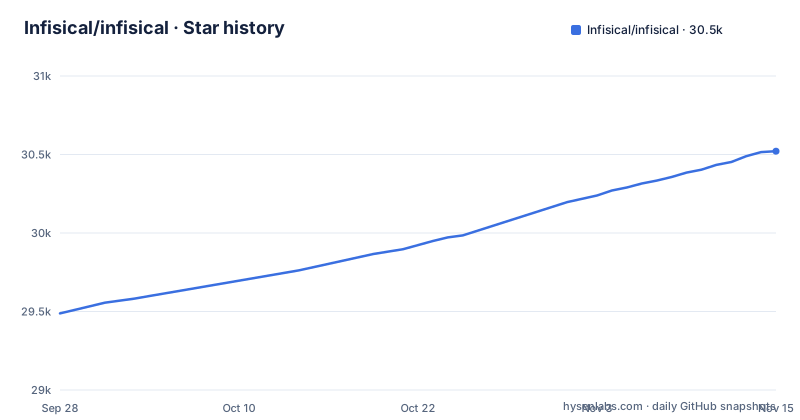
Star history
- Infisical/infisical30,521 ★ · +1,033
| Repository | 2026-09-28 | 2026-11-15 |
|---|---|---|
| Infisical/infisical | 29.5k | 30.5k |
1,033 Stars in the last 48 days, measured from the daily GitHub snapshot. Compare with other projects
Editorial analysis
Infisical is an open-source security infrastructure platform
Infisical is described in its README as the open source security infrastructure platform that teams use for secrets, certificates, and privileged access management. The project positions itself as a way to make security tooling accessible to everyone, not only dedicated security teams, by redesigning the developer experience.
The repository is released under the MIT license, with one exception: the ee directory holds premium enterprise features that require an Infisical license. The project offers both a free self-hosted path and managed cloud or enterprise tiers.
Secrets management with versioning and rotation
The secrets management feature centralizes application secrets and configuration across every environment, with versioning, rotation, and leak prevention built in. A dashboard lets teams manage secrets across projects and environments such as development and production through a user interface.
Secret syncs push secrets to platforms including GitHub, Vercel, and AWS, and work with tools such as Terraform and Ansible. Secret versioning and point-in-time recovery keep track of every secret and project state so teams can roll back when needed. Secret rotation supports services like PostgreSQL, MySQL, and AWS IAM, while dynamic secrets generate ephemeral credentials on demand for services like PostgreSQL, MySQL, and RabbitMQ.
Preventing leaks with scanning, agents, and honey tokens
Beyond storage, Infisical scans for over 140 secret types across files, directories, and git repositories to stop credentials from reaching git. The Infisical Kubernetes Operator delivers secrets to workloads and reloads deployments automatically, and the Infisical Agent injects secrets into applications without changing code logic.
Honey tokens plant decoy credentials next to real secrets so that any attempt to use them acts as a tripwire and alerts the team. Agent Vault brokers AI agent access to external APIs so agents never hold real credentials, routing outbound requests through a proxy that injects secrets before forwarding and removing the risk of credential exfiltration from prompt injection.
Certificate management and a key management system
Infisical runs a complete private PKI for issuing, managing, and monitoring X.509 certificates from a centralized platform. Teams can create an internal CA hierarchy directly within Infisical, or integrate external certificate authorities such as Let's Encrypt, DigiCert, and Microsoft AD CS to issue publicly trusted certificates.
Certificate lifecycle management controls how certificates are issued through profiles and policies, with enrollment methods including API, ACME, and EST, plus revocation tracking via CRL and inventory views. Certificate syncs push certificates to platforms like AWS Certificate Manager and Azure Key Vault, and code signing signs software artifacts with managed certificates and a full audit trail. The KMS component centrally manages cryptographic keys and uses symmetric keys to encrypt and decrypt data.
Privileged access management for infrastructure
The privileged access management (PAM) feature secures access to critical infrastructure such as databases and servers using policy-based controls, approvals, and session visibility. It decouples user identity from infrastructure credentials: users authenticate with their SSO identity while Infisical brokers just-in-time access to resources like PostgreSQL, SSH servers, Kubernetes, and Active Directory.
Session recording captures and replays privileged sessions for audit and compliance, with AI session insights that surface risky activity. Credential rotation automatically rotates the underlying credentials for managed resources so static secrets never leave Infisical, and web access connects to SSH, PostgreSQL, Redis, and Windows RDP resources directly from the browser.
Platform-wide authentication, access control, and SDKs
Capabilities that span every Infisical product include multiple authentication methods for machine identities, such as Kubernetes Auth, GCP Auth, Azure Auth, AWS Auth, OIDC Auth, and Universal Auth. Access controls define authorization for users and machine identities through RBAC, additional privileges, temporary access, access requests, and approval workflows.
Audit logs track every action on the platform, with optional streaming to external logging providers. A gateway reaches private network resources without opening inbound connections, and the project ships client SDKs for Node, Python, Go, Ruby, Java, and .NET, plus a CLI and an API for direct interaction.
Running Infisical locally and scanning for leaks
Getting started is split between Infisical Cloud and on-premise deployment. To run locally, the README requires Git and Docker. A single chained command clones the repository, copies the example environment file into place, and brings the stack up with Docker Compose using the production compose file, after which you create an account at http://localhost:80.
The infisical scan command covers your full git history when run with verbose output. You can also install a pre-commit hook that scans each commit before it is pushed to your repository, catching leaks before they reach version control.
Security disclosure and community contributions
Infisical asks that security vulnerabilities not be filed as public GitHub issues or posted on the public forum. Instead, the README directs reporters to a private vulnerability disclosure policy and to [email protected] for compliance documentation and security questionnaires.
For code contributions, the project welcomes changes of any size and points new contributors to a getting-started guide. The README also notes the team is hiring, reflecting ongoing active development of both the open-source core and the enterprise features.
Editorial conclusion
Infisical bundles secrets, certificates, and privileged access management into one open-source platform, with versioning, rotation, leak scanning, a private PKI, and PAM controls that cover both machine and human access. The core repository is MIT licensed and can be self-hosted with Docker Compose, while premium enterprise features live in the ee directory under a separate license. For teams that want centralized secret handling without building the tooling themselves, Infisical offers a broad, documented surface from SDKs and a CLI up to agent vaulting and session recording.
Frequently asked questions
What is infisical used for?
Infisical is an open-source platform for secrets, certificates, and privileged access management. Its README describes it as a way to centralize secrets and configuration across environments with versioning, rotation, and leak prevention, while also running a private PKI and PAM controls.
How much does Infisical cost?
The repository is released under the MIT license, so the core can be self-hosted at no cost. The README notes that the ee directory holds premium enterprise features requiring an Infisical license, and that managed Infisical Cloud or self-hosted Enterprise offerings are paid.
Can I self-host Infisical?
Yes. The README provides a self-hosting path using Git and Docker Compose, and states you can deploy Infisical on-premise or in the cloud while keeping data on your own infrastructure. A managed cloud option is also available for those who prefer not to run it themselves.
Official sources
Add this badge to your README
If you maintain this project, the badge below links readers to this analysis and shows its maintenance status from the daily GitHub snapshot. Paste the markdown into your README; add ?metric=license or ?metric=stars to the image URL for a different field.

[](https://hysenlabs.com/projects/infisical-infisical)Star history chart for your README
[](https://hysenlabs.com/projects/infisical-infisical)Was this useful?