TTS Server for Android: a network speech bridge that keeps working when the built-in engine fails
An Android TTS app with a built-in Microsoft demo endpoint, customizable HTTP requests, support for importing other local TTS engines, simple narration/dialogue recognition based on Chinese double quotes, automatic retry, fallback configs, text replacement and more.
At a glance
- What is it?
- A Kotlin and Compose application with 4,500 stars that has a built-in Microsoft demo endpoint, ships a configurable HTTP request for any service, can import other local TTS engines, and reads Chinese narration from punctuation alone.
- Who is it for?
- The problem this application solves is narrow and real: it is an Android TTS app with a built-in Microsoft demo endpoint, customizable HTTP requests, import of other local TTS engines, automatic retry, fallback configs and text replacement. What you give up for that convenience is visible in the numbers.
- Can I use it commercially?
- Not without permission. GitHub finds no licence file in the repository, and without a licence all rights are reserved by default: you may read the code but not reuse it. Check the README, or ask the authors, before using it.
- Is it still maintained?
- Yes. The repository last received commits 62 days ago.
- What is it written in?
- Mainly Kotlin, according to GitHub's language statistics.
Answers come from the project's GitHub data, last synced on November 24, 2026, and from our analysis. They are not legal advice.
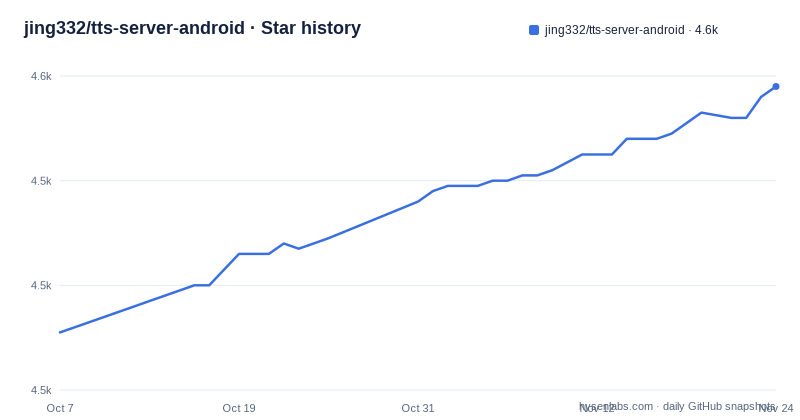
Star history
- jing332/tts-server-android4,558 ★ · +47
| Repository | 2026-10-07 | 2026-11-24 |
|---|---|---|
| jing332/tts-server-android | 4.5k | 4.6k |
47 Stars in the last 48 days, measured from the daily GitHub snapshot. Compare with other projects
Editorial analysis
A phone that answers text to speech requests over HTTP
The project description is worth reading literally. It is an Android system TTS application with a built-in Microsoft demo interface, support for custom HTTP requests, the ability to import other local TTS engines, and a simple narration and dialogue detection based on Chinese double quotation marks. Automatic retries, fallback configurations and text replacement are listed as further features.
The scale suggests it works. The repository has 4,508 stars and 430 forks, which is substantial for a utility of this kind, with 92 open issues. It is written in Kotlin, the default branch is `compose`, and the last push was 2026-09-24.
Configuration, retries and fallbacks are the actual feature
Once the endpoint shape is settled, the project's depth shows up in the configuration story, which is where most of the listed features live.
Custom HTTP requests are the general escape hatch. Instead of the built-in interface, you describe the request to a service you control, which is how you point the application at a self-hosted synthesiser, a different vendor, or a local server on your network. Automatic retry handles the case where a request fails transiently, which matters when the phone is on mobile data and the endpoint is not. Fallback configuration covers the harder case: when the primary configuration cannot serve a request, another one takes over, so a voice failure does not end the read-aloud session.
Text replacement is the quiet feature that matters most in practice. Novels, documentation and screenplays all contain abbreviations, symbols and transliterated words that a synthesiser mispronounces, and a global replacement list applied before synthesis is the cheapest way to fix them without editing the source text.
The narration detection feature is specific to Chinese. The application uses double quotation marks in the source text to distinguish narration from dialogue, and reads them with different voice treatment. That is a simple heuristic, but it is the kind of thing that is genuinely annoying to do by hand across a long book.
Reading rules turned into a scripting layer
The repository carries a `lib-script/` module, and the README's acknowledgements list a scripting engine and a code editor.
Two dependencies explain how that works. `gedoor/rhino-android` provides RhinoScriptEngine access through the JSR 223 interfaces on the Android JRE, and `Rosemoe/sora-editor` is listed as a code editor for Android.
Importantly, the rules layer and the engine layer are separate. A rule describes what should happen to a piece of text, and the built-in interface, a custom HTTP service, or an imported local engine decides who actually speaks it.
A Kotlin and Compose codebase split by responsibility
The repository tree is a Gradle multi-module Android project and the module names describe the architecture more clearly than any document would.
`lib-tts` is the speech side: interfaces, voices and the engines that implement them, which is the module that has to change when you add a new service. `lib-server` is the HTTP server that exposes the endpoint. `lib-script` holds the reading rules and the scripting engine integration. `lib-database` covers persistence, and `lib-common` holds what the rest of the project shares. `lib-compose` provides the shared UI components, and `app/` is the application module tying them together.
The split is sensible because it puts the compatibility-sensitive part, the HTTP contract, in its own module behind the speech interface. Adding an engine should not require touching the server, and the presence of a dedicated scripting module confirms that rules are meant to be a platform rather than a feature of one screen.
The build uses a version catalog, with dependency versions collected in `libs.versions.toml`, and there is a separate `build-logic/` module, which is the convention for encapsulating convention plugins. Gradle wrapper scripts are present, so a clone builds without installing Gradle yourself. `crowdin.yml` is the localisation configuration, matching the Crowdin badge in the README, so translation runs through Crowdin rather than through hand-edited resource files.
Two GitHub Actions workflows are declared as badges. One is the release workflow and one is the test workflow, so the CI story is visible from the README even though the details live in the workflow files.
Releases stopped in 2023 while development continued
The single most important practical fact about this project is the gap between its release feed and its development activity.
The most recent tagged release is version 0.9, published 2023-07-26. Before that came 0.8 in June 2023 and 0.6 in mid-June 2023. Nothing has been tagged in the more than three years since, while the last push to the repository was 2026-09-24. Those two facts are not in conflict, because the README explains the distribution model: stable builds come from the releases page, and development builds come from the Actions artifacts instead of from tags.
The README also links a QQ group and a set of Actions mirrors on a third-party file host, with a password given in the text. Mirrors exist for a reason, which is that GitHub Actions artifacts require a signed-in GitHub account to download. That is an unusual and slightly awkward arrangement, and it means the newest code is genuinely harder to obtain than the older tagged release.
Open issues sit at 92, which is a high absolute number against 4,508 stars and points to a project with a steady user base and an active support load. The CHANGELOG file is present in the tree, so per-change detail is available even when the tag history is not.
On licensing, the repository tree contains no licence file and the metadata reports no licence. If your use involves redistribution or embedding, it is worth asking or waiting for a licence file rather than assuming one.
Editorial conclusion
The problem this application solves is narrow and real: it is an Android TTS app with a built-in Microsoft demo endpoint, customizable HTTP requests, import of other local TTS engines, automatic retry, fallback configs and text replacement. What you give up for that convenience is visible in the numbers. The latest tagged release is 0.9 from 2023-07-26 while the last push was 2026-09-24, so the release feed is not where current work shows up, and there are 92 open issues against 4,508 stars. The repository also has no licence file in the tree and the metadata reports none, which is worth confirming before you redistribute anything. Treat it as an actively developed personal tool rather than a versioned library, and check the dev builds if you need current fixes.
Frequently asked questions
What problem does TTS Server for Android solve?
It is an Android TTS app with a built-in Microsoft demo endpoint, and it supports custom HTTP requests so you can point it at a different service or at something you host yourself, with automatic retries and fallback configurations when a request cannot be served.
Can I use a local TTS engine instead of the built-in interface?
Yes. Importing other local TTS engines is one of the listed capabilities of the project. The speech and engine layers are separated from the server layer in the module structure, so a locally provided voice and a remote HTTP service are alternatives that serve the same interface.
How does the app decide what is narration and what is dialogue?
For Chinese text, it uses the double quotation marks in the source to distinguish narration from spoken dialogue, and reads the two with different treatment.
Where do I get the newest version, given that the latest tag is from 2023?
The last tagged release is version 0.9 from 2023-07-26, but the repository continues to receive pushes, with the most recent on 2026-09-24. The README says stable builds come from the releases page while development builds come from GitHub Actions artifacts, which require a signed-in GitHub account, and it also lists third-party mirrors with a password in the README text.
Is TTS Server for Android open source?
The source is published, but the repository tree contains no licence file and the repository metadata reports no licence. The build scripts, module layout, Crowdin localisation setup and GitHub Actions workflows are all in the repository, so the code is available to read and build. Confirm the licence position directly with the author before redistributing.
Official sources
Add this badge to your README
If you maintain this project, the badge below links readers to this analysis and shows its maintenance status from the daily GitHub snapshot. Paste the markdown into your README; add ?metric=license or ?metric=stars to the image URL for a different field.

[](https://hysenlabs.com/projects/jing332-tts-server-android)Star history chart for your README
[](https://hysenlabs.com/projects/jing332-tts-server-android)Was this useful?