hyperresearch: an agent-driven research vault for Claude Code
Agent-driven research knowledge base. Agents collect, search, and synthesize web research into a persistent, searchable wiki.
At a glance
- What is it?
- hyperresearch installs a 16-step research pipeline into Claude Code and stores every source it reads in a persistent markdown-plus-SQLite vault. The design is unusual and the benchmark claim is self-reported, so the decision turns on whether you want a growing local corpus or a one-shot answer.
- Who is it for?
- Adopt hyperresearch if you already work inside Claude Code, your research repeats across sessions, and you want the corpus to accumulate rather than disappear into a chat log. Do not adopt it if you need a supported, stable release: pyproject.toml classifies it as Development Status 3 - Alpha, and the README's benchmark claim rests on the project's own DRACO benchmark page.
- Can I use it commercially?
- Yes. MIT is a permissive licence: you can use, modify and sell software built on it, as long as you keep its copyright and licence notices.
- Is it still maintained?
- Yes. The repository last received commits 3 days ago.
- What is it written in?
- Mainly Python, according to GitHub's language statistics.
Answers come from the project's GitHub data, last synced on November 15, 2026, and from our analysis. They are not legal advice.
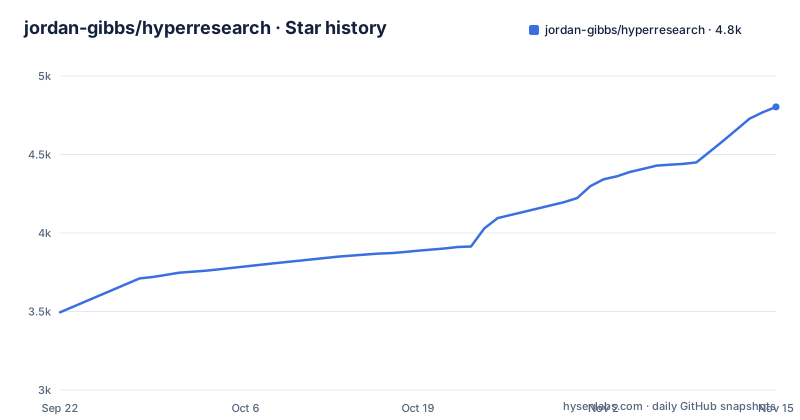
Star history
- jordan-gibbs/hyperresearch4,803 ★ · +1,308
| Repository | 2026-09-22 | 2026-11-15 |
|---|---|---|
| jordan-gibbs/hyperresearch | 3.5k | 4.8k |
1,308 Stars in the last 54 days, measured from the daily GitHub snapshot. Compare with other projects
Editorial analysis
What hyperresearch solves, and for whom
A chat session that answers a research question leaves nothing behind. The sources are gone when the window closes, the same paper gets fetched again next month, and there is no record of which claim came from which document. hyperresearch attacks that specific loss. The README describes a "persistent, searchable vault" in which "every source it reads lands," and states that each session starts smarter than the last because the next run reuses the vault before it fetches anything new.
The audience is people who already use Claude Code or OpenAI Codex. The package turns Claude Code into what the README calls a deep research agent, driven by a skill invoked as /hyperresearch; the README says it runs in OpenAI Codex too, and a hosted version needs no Claude Code or Codex install. The intended user is doing recurring, source-heavy work (literature reviews, competitive or policy research, anything where a citation has to be traceable) and is willing to trade wall-clock time for provenance.
The 16-step pipeline and how tiers and gears scale it
The README describes a tier-adaptive 16-step pipeline that takes one prompt and produces an adversarially-audited report with full source provenance.
The README names some of its stages: a width sweep, four critics that attack every draft in parallel, a tool-locked patcher that can only apply surgical edits, and a skeptical cite-checker that audits whether each cited source actually supports its sentence.
Scale varies by query. Bounded queries auto-route to a 5-step fast path, and opt-in dissertation runs (experimental) write 25K to 80K words across chapters, from 300 to 450 sources. The README sums up the range as scaling from 30 minutes to a dissertation.
Installing hyperresearch and running a first query
The README gives a two-command install from inside your project directory. The first installs the package from PyPI, the second wires the skill into Claude Code.
cd your-project
pip install hyperresearch && hyperresearch install
After that, the skill is reachable in Claude Code as /hyperresearch. The README's example invocation passes free text:
/hyperresearch <anything>Python version matters. The README states Python 3.11 to 3.14, and pyproject.toml encodes the same bound as requires-python = ">=3.11,<3.15".
There is a second install mode. The README says hyperresearch install --global makes /hyperresearch reachable from every Claude Code session anywhere, at the cost of roughly 15 lines in every session's system reminder. Per-project install keeps unrelated sessions clean. That is a real trade-off rather than a preference: the global mode taxes every unrelated session you run.
Optional extras exist for the search and crawling providers. pyproject.toml defines extras named crawl4ai, mcp, parallel, exa, tavily, watch, and all. The mcp extra is upper-bounded at mcp>=1.6,<2 with a comment explaining why: mcp 2.0 removed mcp.server.fastmcp, which hyperresearch/mcp/server.py builds every tool on, so without the bound a fresh install resolves 2.x and hyperresearch mcp dies on import while reporting the extra as missing. The parallel extra is kept separate at mcp>=1.8,<2 so that installing the Hyperresearch MCP server does not force an unrelated SDK upgrade.
The vault, the resume manifest, and what the cite-checker actually blocks
Two mechanisms carry most of the project's weight. The first is the vault: a searchable markdown-plus-SQLite store that the README says nothing is thrown away from. Because the next session reuses it before fetching anything new, the value of the tool depends on repetition. A single one-off query gets you a report and an unused vault.
The second is the cite-check. The README states that a skeptical cite-checker audits whether each cited source actually supports its sentence, and that hallucinated quotes and unacknowledged retractions are hard blocks at the gate. A related audit clusters derivative copies of the same source so that, in the README's phrasing, "five reprints of one press release argue with the weight of one source." The patcher is tool-locked so it can only apply surgical edits, which the README says means it physically cannot rewrite the report.
Paywalled papers get separate treatment. The README argues that a closed paper normally enters a vault as a 1,500-character abstract that a report then cites as though it had been read. hyperresearch asks Unpaywall, Europe PMC and CORE for a legal open-access copy and stores the full text instead, even when the publisher blocks the fetch. The README states every substitution is disclosed in the note, the frontmatter, and the CLI output. That disclosure is the part worth checking in practice, since a substituted full text is not the same artifact as the version of record.
Runs are resumable. Each run keeps a manifest, and the README gives run resume as the command that picks up at the exact step where a run died.
Where hyperresearch is the wrong tool
The clearest limitation is the host dependency. The pipeline needs an agent host: the README documents Claude Code and OpenAI Codex, and offers a hosted version for people who do not want to run it locally.
The second limitation is the benchmark claim itself. The README says hyperresearch is "#1 on the DRACO deep research benchmark, ahead of Claude Research, ChatGPT, Gemini and Perplexity," and points to the project's own benchmark page for method and per-task scores. Treat that as the project's own claim until you have read the method.
The third is maturity. pyproject.toml carries the classifier "Development Status :: 3 - Alpha" while the package version is 0.13.0. Alpha classifiers and a 0.x version line mean interfaces can move. Plan on being able to reconstruct what the installer touched before you run it.
Finally, cost. The README says the pipeline scales from 30 minutes to a dissertation. A question you would otherwise answer in a chat turn is not a good fit for a pipeline of that length. The README also notes the premier scale profile targets 100 to 130 sources in the width sweep alone, with citation chasing and gap-fill more than doubling what lands in the corpus. That is a lot of fetching for a question that does not need it.
How it differs from qualitative analysis software
People searching for hyperresearch alongside MAXQDA or asking about hyperresearch vs nvivo are comparing two different jobs. MAXQDA and NVivo are qualitative data analysis packages: you bring your own corpus (interview transcripts, field notes, documents you already collected), and the software gives you coding, memoing, retrieval and matrix queries over that fixed set. The corpus is an input.
hyperresearch inverts that. The corpus is an output. The pipeline fetches from the web, chases citations, fills gaps identified by a critic step, and writes what it finds into the vault. Its analysis steps (the contradiction graph, loci analysis, source tensions, the evidence digest) operate on material the tool itself assembled, and the deliverable is a report with citation-sentence verification rather than a coded dataset.
The practical consequence is that hyperresearch does not replace a QDA package for interview-based work, because the documented pipeline fetches its own sources rather than coding transcripts you bring. Conversely, MAXQDA and NVivo do not go and find sources for you. If your problem is "I have 40 interviews and need to code them," hyperresearch is the wrong tool. If your problem is "I need 250 sources on a question and a record of which one supports which sentence," the QDA packages are not addressing it.
Licence, maintenance and the cost of upgrading
The licence is MIT, declared in pyproject.toml as license = "MIT" and listed in the repository root as LICENSE. MIT is permissive: it allows commercial use, modification and redistribution provided the copyright notice and permission notice are retained. That is the general shape of the licence, not legal advice, and anything you build on top of the vault or the pipeline is your own compliance question.
On maintenance, the evidence is concrete rather than promotional. The last push to the default branch was on 2026-11-01. The repository is not archived. Recent releases are v0.11.1 on 2026-09-11, v0.12.0 on 2026-09-24 and v0.13.0 on 2026-10-27, with the version in pyproject.toml matching v0.13.0. That pace suggests rapid iteration, which cuts both ways: fixes arrive quickly, and so do breaking changes in a 0.x line classified as alpha.
Upgrade cost is mostly the dependency bounds. The mcp extra is pinned below 2.0 for a stated reason (the removal of mcp.server.fastmcp), and the parallel extra is pinned at a different floor. If you install with the all extra, you inherit those pins. The README's install flow is pip-based and does not describe a lockfile or a pinned set of transitive dependencies, so an upgrade can move more than the package version. CHANGELOG.md and docs/ exist in the repository root, which is where the upgrade notes would live.
Editorial conclusion
Adopt hyperresearch if you already work inside Claude Code, your research repeats across sessions, and you want the corpus to accumulate rather than disappear into a chat log. Do not adopt it if you need a supported, stable release: pyproject.toml classifies it as Development Status 3 - Alpha, and the README's benchmark claim rests on the project's own DRACO benchmark page. Before committing, verify three things: that your Python is 3.11 through 3.14, the range pyproject.toml allows; whether you want the per-project install or hyperresearch install --global, which the README says adds roughly 15 lines to every Claude Code session's system reminder; and what the premier scale profile actually costs you in wall-clock time, because the README says runs scale from 30 minutes to a dissertation.
Frequently asked questions
How do you use hyperresearch?
Install it from your project directory with pip install hyperresearch && hyperresearch install, then invoke the skill in Claude Code with /hyperresearch followed by your question. The README notes that a bounded factual query auto-routes to a 5-step fast path.
Does hyperresearch require Python 3.14?
No, but it supports it. The README states Python 3.11 to 3.14, and pyproject.toml encodes the bound as requires-python = ">=3.11,<3.15".
What happens if a hyperresearch run crashes partway through?
Each run keeps a manifest, and the README gives run resume as the command that picks up at the exact step where the run died. That avoids restarting the whole pipeline after a failure late in a multi-hour run.
Does hyperresearch lead a deep research benchmark?
The README says hyperresearch is #1 on the DRACO deep research benchmark, ahead of Claude Research, ChatGPT, Gemini and Perplexity, and links the project's own benchmark page for method and per-task scores. Read the method before treating it as settled.
Official sources
Add this badge to your README
If you maintain this project, the badge below links readers to this analysis and shows its maintenance status from the daily GitHub snapshot. Paste the markdown into your README; add ?metric=license or ?metric=stars to the image URL for a different field.

[](https://hysenlabs.com/projects/jordan-gibbs-hyperresearch)Star history chart for your README
[](https://hysenlabs.com/projects/jordan-gibbs-hyperresearch)Was this useful?