QuestionWechatApp: WeChat Question and Exam System
答题小程序,刷题小程序,微信小程序,考试小程序。毕业设计小程序,有前后端完整源码和数据库,易于二次开发。还可用于考试活动,企业内部考核,内部培训等职业考试刷题。
At a glance
- What is it?
- QuestionWechatApp is a JavaScript repository presented as a WeChat Mini Program for practice, timed exams, question banks, rankings, and administrative assessment. Its visible repository layout is frontend-oriented, while the README does not document how to obtain or run the claimed backend and database components.
- Who is it for?
- Adopt QuestionWechatApp as a starting point if you can modify its JavaScript pages and already have separate backend and database expertise. Do not treat it as deployment-ready based on the README alone.
- Can I use it commercially?
- Not without permission. GitHub finds no licence file in the repository, and without a licence all rights are reserved by default: you may read the code but not reuse it. Check the README, or ask the authors, before using it.
- Is it still maintained?
- Yes. The repository last received commits 3 days ago.
- What is it written in?
- Mainly JavaScript, according to GitHub's language statistics.
Answers come from the project's GitHub data, last synced on November 6, 2026, and from our analysis. They are not legal advice.
Star history
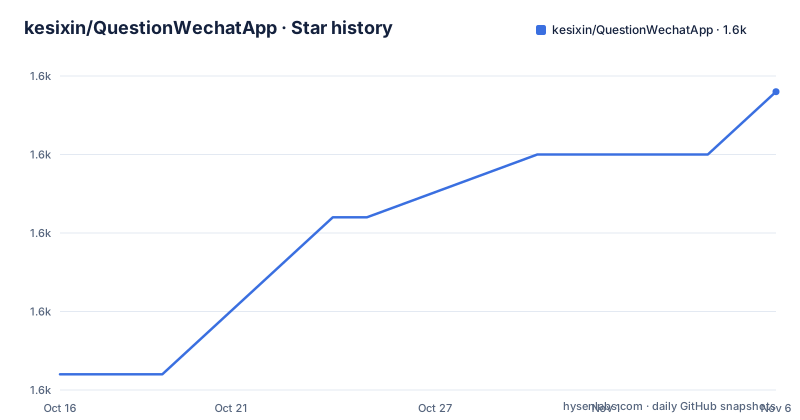
- kesixin/QuestionWechatApp1,637 ★ · +9
| Repository | 2026-10-16 | 2026-11-06 |
|---|---|---|
| kesixin/QuestionWechatApp | 1.6k | 1.6k |
9 Stars in the last 21 days, measured from the daily GitHub snapshot. Compare with other projects
Editorial analysis
QuestionWechatApp Targets WeChat-Based Training and Assessment
QuestionWechatApp addresses the operational problem of distributing questions and examinations through a WeChat Mini Program. Its documented use cases include public exam activities, internal company assessments, professional training, and graduation-project work. The intended operators need somewhere to maintain question banks, define activities, review participation, and let WeChat users answer questions. The intended participants need mobile access to practice mode, exam mode, answer records, wrong questions, favorites, and rankings.
The README describes two product lines under the QuestionWechatApp repository: 智慧考题宝 and 考题星. It also advertises related products and experience links, so those sections should not automatically be treated as a precise inventory of the code in this repository. The clearest repository-level evidence is the set of top-level files: `README.md`, `app.js`, `app.json`, `app.wxss`, `pages/`, `utils/`, `dist/`, `images/`, `project.config.json`, `project.private.config.json`, and `sitemap.json`. That is consistent with a WeChat Mini Program client.
There is an important scope mismatch. The repository description says it contains complete frontend and backend source code plus a database, but no backend directory, schema file, or database dump appears in the top-level entry list. Based on that layout, a potential adopter should assume the visible code is the Mini Program side until the missing components are produced and examined.
The Visible JavaScript Structure Supports a WeChat Client
The repository layout indicates a conventional WeChat Mini Program application structure. `app.json` is the central application configuration, `app.js` contains application-level JavaScript, and `app.wxss` supplies global styles. The `pages/` directory is where page-specific routing, templates, styles, and behavior would normally reside, while `utils/` holds shared JavaScript helpers. The exact files inside those directories are not shown, so finer claims about API clients, state handling, or authentication would be speculative.
The README supplies a useful functional model even where it does not prove which implementation is present. Practice can be sequential, random, category-specific, question-type-specific, or focused on frequently missed questions. Documented question types include single choice, multiple choice, true or false, fill-in-the-blank, multiple fill-in-the-blank, and short answer. The application distinguishes answering from memorization: answer mode can reveal the correct answer and help text after submission, while memorization mode exposes those items directly.
For simulated exams, the documented flow is configuration, random question selection, a countdown, navigation between questions, manual submission, scoring, and an automatic submission prompt when time expires. Records can resume an unfinished attempt or be cleared. Wrong answers from practice and exams can enter a separate collection, where users can answer again, view answers, or remove entries. This is a feature specification, not a confirmed implementation trace, but it explains the product model that the client code is intended to support.
QuestionWechatApp Administration Extends Beyond Answering
The administrative requirements are broader than a basic quiz interface. The README describes system users, permission groups, backend operation permissions, and operation logs. It also lists WeChat user management, approval status, departments, check-in records, feedback, configuration, and carousel management. These features suggest that the intended backend is an operational system for repeated assessments rather than a single exam with a static JSON question file.
Question-bank administration is the central data function. Administrators are said to manage categories, specialized topic groups, question lists, question types, scores, time limits, question counts, and imported images. Batch question import is explicitly documented. Assessment management adds participating departments, activity periods, question counts, durations, enabled question types, per-type scores, answer records, and record export. The 智慧考题宝 description additionally mentions points, activation codes, articles, check-in incentives, and access review.
Not every listed capability is proven to belong to this exact code version. The README combines feature catalogs for multiple named products, and the visible repository entries do not establish which server modules or database tables exist. There is also no release history in the repository to map those features to dated versions. An engineering decision should therefore distinguish three layers: features claimed in the README, files visible in the repository, and behavior that can be confirmed after installation and integration testing.
No Documented Setup Path for the Full QuestionWechatApp System
The README does not provide installation commands, dependency names, environment variables, database credentials, server startup instructions, or a configuration example. It also does not document an import procedure for the WeChat developer tool.
The first documented action is commercial and administrative rather than technical. The README says, "如需使用请添加作者联系方式," meaning users who need to use it should add the author's contact information. It then lists a personal WeChat account and QQ account. No public download package, release artifact, supported branch matrix, or installation guide is given. The repository is not archived, and its last push was on 2026-10-14, but recent repository activity does not resolve the absence of setup documentation.
A practical first-use review therefore has to stop before installation. Obtain the exact package or branch intended for use, identify the missing backend and database components, and ask for the configuration keys needed by `app.js` and the pages. Only after those materials are available can an engineer confirm whether WeChat development tools, a JavaScript runtime, the database engine, and the server deployment method form the actual stack.
The License Is Unresolved and Contact-Dependent
No license is identified for QuestionWechatApp. The README asks users to respect the original work and requires contact with the author if they want to use it, but a request to preserve authorship is not a substitute for a machine-readable open source license. The engineering implication is direct: the repository should not be treated as licensed under MIT, Apache-2.0, GPL, or another standard license merely because its source code is visible.
Before incorporating any code into a product, obtain the actual license text from the author and record which repository files it covers. This is especially important for a full-stack system containing a Mini Program, administrative interface, server code, database schema, images, and imported question content. Code permission does not automatically resolve rights to screenshots, logos, article text, or third-party question banks.
Upgrade cost is also uncertain. There are no GitHub releases, no documented version policy, and no stated compatibility matrix. The last push was on 2026-10-14, which indicates recent repository activity rather than evidence of a stable release process. There is no migration guide for changing question schemas, attempt records, permissions, or points systems. An adopter expecting packaged upgrades should treat contact and source clarification as part of the product acquisition process.
The Backend Gap Makes Adoption Conditional
The strongest limitation is not the number of quiz features. It is the mismatch between the full-system claim and the visible repository evidence. A user interface can display questions and activities, but scoring, random selection, resumable attempts, rankings, user approval, feedback, bulk import, and record export all imply shared state and server-side processing unless implemented entirely on-device. The visible layout does not show where that processing occurs.
This gap changes the deployment question. A developer interested in a lightweight offline study tool may find the JavaScript pages useful after inspection. A developer seeking an operational assessment platform should not assume the repository satisfies requirements for centralized question management, identity control, audit records, departmental assignment, or result export. The README does not document API contracts, authentication rules, failure handling, database transactions, or backup procedures.
The wrong-tool case is therefore clear. QuestionWechatApp, as documented, is a poor choice for a team that requires reproducible deployment solely from the visible repository or expects an established release channel. It is also unsuitable for procurement decisions that depend on a confirmed license. Those constraints outweigh the attractive feature list because the operational core cannot be located or evaluated from the repository entries.
A Static Quiz Client Is a Simpler Alternative
For a small project involving only a fixed set of questions, a static quiz client is a different approach with fewer integration points. Instead of a configurable exam backend, user departments, approvals, rankings, activity records, and a shared database, such a client can load questions from bundled data or a simple content file. It may still support answer checking, immediate feedback, progress state, and a results screen, but it does not imply centralized administration.
This alternative fits a graduation demonstration when the objective is to show pages, JavaScript logic, and a mobile interface rather than run a recurring organization-wide assessment. It reduces the number of unknown components because the documented QuestionWechatApp backend, database, deployment method, and license are all unresolved. It is easier to inspect and reproduce, although adding organization-wide controls later would require a separate design rather than treating the static version as a drop-in replacement.
A full platform is the better functional match when QuestionWechatApp's additional requirements matter: departments, approval, answer activities, rankings, exported records, points, activation codes, or administrative question management. In that case, the deciding evidence must be the actual backend source and database schema, not screenshots or the README's product catalog.
Editorial conclusion
Adopt QuestionWechatApp as a starting point if you can modify its JavaScript pages and already have separate backend and database expertise. Do not treat it as deployment-ready based on the README alone. The first verification should be whether the author can provide the claimed backend source, database schema, license, and exact configuration needed to run one complete practice or exam flow.
Frequently asked questions
What is QuestionWechatApp used for?
It is presented as a WeChat Mini Program for question practice, simulated exams, question banks, rankings, training, and internal assessments. The README describes use in examination activities, enterprise assessment, and professional training.
Does QuestionWechatApp include backend and database source code?
The repository description claims complete frontend and backend source plus a database, but the top-level entries show only Mini Program-oriented files and directories. The backend and database are therefore not confirmed by the visible layout.
How do I install and run QuestionWechatApp?
The README gives no installation commands, dependency list, environment variables, database setup, or server startup instructions. It directs prospective users to contact the author for access.
What question types does the documented quiz system support?
The 智慧考题宝 description lists single choice, multiple choice, true or false, fill-in-the-blank, multiple fill-in-the-blank, and short answer. The 考题星 description lists single choice, multiple choice, true or false, and fill-in-the-blank.
Can I use QuestionWechatApp under a standard open source license?
No license is identified in the repository information. Users should not assume a standard open source license and need to obtain explicit licensing terms from the author.
Official sources
Add this badge to your README
If you maintain this project, the badge below links readers to this analysis and shows its maintenance status from the daily GitHub snapshot. Paste the markdown into your README; add ?metric=license or ?metric=stars to the image URL for a different field.

[](https://hysenlabs.com/projects/kesixin-questionwechatapp)Star history chart for your README
[](https://hysenlabs.com/projects/kesixin-questionwechatapp)Was this useful?