Laravel Lumen Framework Core Architecture and Adoption Limits
The Laravel Lumen Framework.
At a glance
- What is it?
- Laravel Lumen Framework is the PHP kernel behind Laravel Lumen applications, not the application skeleton itself. It organizes common web services, while application setup and service configuration remain documented elsewhere.
- Who is it for?
- Adopt laravel/lumen-framework when you specifically intend to build a Lumen application and are prepared to use the separate application repository and official documentation. Do not install this package as a stand-alone project unless you are contributing to the framework kernel.
- Can I use it commercially?
- Yes. MIT is a permissive licence: you can use, modify and sell software built on it, as long as you keep its copyright and licence notices.
- Is it still maintained?
- Yes. The repository last received commits 9 days ago.
- What is it written in?
- Mainly PHP, according to GitHub's language statistics.
Answers come from the project's GitHub data, last synced on October 23, 2026, and from our analysis. They are not legal advice.
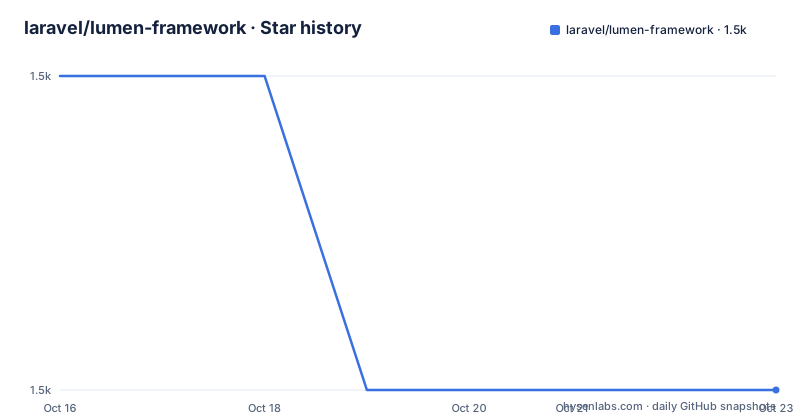
Star history
- laravel/lumen-framework1,509 ★ · -1
| Repository | 2026-10-16 | 2026-10-23 |
|---|---|---|
| laravel/lumen-framework | 1.5k | 1.5k |
-1 Stars in the last 7 days, measured from the daily GitHub snapshot. Compare with other projects
Editorial analysis
Why Lumen Framework Core Is a Separate Package
Laravel Lumen Framework provides the framework kernel used when building a PHP web application with Laravel Lumen. Its README explicitly says that the repository contains the core code of Laravel Lumen and directs developers who want to build an application to the separate main Lumen repository. That boundary matters because the framework package and an application starter serve different purposes.
The intended users are PHP developers who want Lumen's organization of common web infrastructure. The README identifies routing, database abstraction, queueing, and caching as recurring concerns handled by the framework. It does not say that all these services are enabled in the same way or by default. Their current configuration options must be checked in the official documentation at `https://lumen.laravel.com/docs`.
This separation affects adoption decisions. Installing the kernel alone does not demonstrate a complete Lumen application, because the README points application developers to another repository. A technical evaluation should inspect both projects and confirm how an application declares and receives the framework package before selecting a release.
Repository Boundaries for Framework Contributors
The repository layout identifies the expected boundaries of a PHP package. Implementation code appears under `src/`, configuration under `config/`, package resources under `resources/`, storage support under `storage/`, and automated tests under `tests/`. Package and test configuration are represented by `composer.json` and `phpunit.xml.dist`. This is consistent with the README's description of a framework kernel rather than a complete application starter.
The documentation does not provide an `artisan` entry point, application bootstrap example, or first-route file. It also does not describe individual classes, interfaces, service providers, or request lifecycle stages. Claims about the names or order of those components would therefore exceed what the README and repository layout establish. The supportable architectural description is limited to the package structure and the framework responsibilities named in the README.
This narrower boundary is relevant during review. Code under `src/` is reusable framework code, while application-level authorization, environment configuration, and deployment decisions require evidence from the application repository. The README does not state that using the kernel removes the need for normal application configuration.
Routing, Database, Queue, and Cache Responsibilities
The clearest statement of Lumen's runtime responsibilities is the README's list of common web-project tasks: routing, database abstraction, queueing, and caching. These concern distinct paths in an application. Routing directs requests to application handlers. Database abstraction places a framework-facing layer over data access. Queueing supports work that can be handled separately from the request, while caching provides a place for reusable application data.
The README does not document concrete handlers, adapters, drivers, serialization rules, or default implementations for these facilities. A team therefore cannot confirm from this page whether its preferred database driver, queue backend, cache store, or routing behavior is supported. It also cannot confirm whether each capability is loaded automatically. The linked Lumen documentation is the source to consult for current service configuration.
The abstraction is most relevant to applications that want standard web concerns organized behind one PHP framework. The boundary matters for narrowly scoped services as well. A command-only worker with no HTTP routing may receive more framework structure than it needs, but the repository publishes no size comparison or official rule for excluding Lumen.
Starting a Lumen Application Through Official Sources
This repository does not provide installation commands, a Composer invocation example, directory creation steps, or a first application command. Its README instead directs application developers to the main Lumen repository and links `https://lumen.laravel.com/docs` as the official documentation. Since the README gives no application setup command, this review does not invent one.
A first real use must therefore begin with the separate application repository identified by the README. Follow that repository's current setup instructions, then verify that the resulting application depends on `laravel/lumen-framework`. The official documentation should then be used to add a route and configure only the database, queue, or cache facilities required by the application.
This boundary does not mean setup is impossible. It prevents a specific evaluation error: cloning the framework kernel and treating its directories as a finished application would omit the application starter that the README says is needed. Contributors who want to work on Lumen itself can remain in this repository, inspect `composer.json` and `phpunit.xml.dist`, and consult the Laravel contribution guide linked by the README.
Framework Kernel Compared with Lumen Application Repository
The most relevant alternative approach is to begin with the separate Lumen application repository instead of treating `laravel/lumen-framework` as an application generator. This is not a competing framework. It is the repository boundary defined by the README itself.
The difference is practical. The main Lumen repository is presented as the place to build an application, while this repository contains framework core code. An application-first evaluation should begin with the application repository and return to this package to inspect framework behavior, package structure, tests, or dependency declarations. Starting directly with the kernel may produce an incomplete project shape because the README documents no application initialization flow here.
A full Laravel application is another possible architectural choice, but the README does not contain enough information for a feature-by-feature comparison. It only says that Lumen aims to ease common web-project tasks. Claims about excluded Laravel features, migration paths, or upgrade differences would require documentation not present in this repository.
Release History, Compatibility, and Upgrade Boundaries
The repository is not archived, and its last push was on 2026-10-14. The listed releases are `v11.2.0` from 2024-12-10, `v11.0.1` from 2024-10-01, and `v11.0.0` from 2024-04-09. The default branch is `11.x`, which aligns the branch with that release line, although the README does not publish a support schedule.
This is framework core code, so a package upgrade can affect several parts of every application that resolves it. The repository includes `tests/` and links a GitHub Actions build status, but the README does not describe the test matrix or compatibility policy. It also gives no migration command, rollback procedure, or framework upgrade guide. Application-level upgrade instructions would need to come from the separate Lumen repository or official documentation.
The project uses the MIT license. The README identifies `LICENSE.md` as the license file and states that Lumen is open source under the MIT license. The license includes permissions, conditions, warranty language, and liability terms. This is not legal advice. An organization should review the actual `LICENSE.md` and the dependencies declared in `composer.json`.
Editorial conclusion
Adopt laravel/lumen-framework when you specifically intend to build a Lumen application and are prepared to use the separate application repository and official documentation. Do not install this package as a stand-alone project unless you are contributing to the framework kernel. Before adoption, verify that your application skeleton resolves this package, that its service configuration meets your requirements, and that the selected release matches your PHP and Composer constraints.
Frequently asked questions
What is laravel/lumen-framework used for?
It contains the core PHP code of Laravel Lumen, including support for common web concerns such as routing, database abstraction, queueing, and caching. It is not the repository used to create a complete Lumen application.
How do I install laravel/lumen-framework to start a new project?
The README does not provide application installation commands. It directs users to the main Lumen repository for building an application and to `https://lumen.laravel.com/docs` for official documentation.
Can I build an application using only the laravel/lumen-framework repository?
The README presents this repository as framework core code rather than an application starter. It specifically directs application developers to the separate main Lumen repository.
Official sources
Add this badge to your README
If you maintain this project, the badge below links readers to this analysis and shows its maintenance status from the daily GitHub snapshot. Paste the markdown into your README; add ?metric=license or ?metric=stars to the image URL for a different field.

[](https://hysenlabs.com/projects/laravel-lumen-framework)Star history chart for your README
[](https://hysenlabs.com/projects/laravel-lumen-framework)Was this useful?