lazyprogrammer/machine_learning_examples: a course companion repo, not a library
A collection of machine learning examples and tutorials.
At a glance
- What is it?
- The repository is a folder-per-course collection of Python machine learning examples tied to paid Lazy Programmer courses. It is useful if you are enrolled and want the lecture code; it is the wrong tool if you need an installable package, a stable API, or a maintained dependency set.
- Who is it for?
- Adopt it only if you are taking a Lazy Programmer course and need the lecture examples: clone rather than fork, run git pull before each session, and map folders to courses using the 'Where to get the code' lecture. Do not adopt it as a dependency, a stable API, or a source of newer Tensorflow 2 material, because the README states that code for those courses lives in Google Colab instead.
- Can I use it commercially?
- Not without permission. GitHub finds no licence file in the repository, and without a licence all rights are reserved by default: you may read the code but not reuse it. Check the README, or ask the authors, before using it.
- Is it still maintained?
- Yes. The repository last received commits 48 days ago.
- What is it written in?
- Mainly Python, according to GitHub's language statistics.
Answers come from the project's GitHub data, last synced on November 15, 2026, and from our analysis. They are not legal advice.
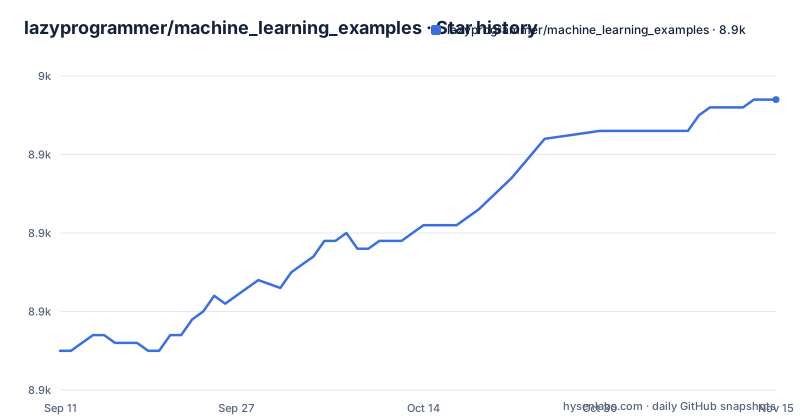
Star history
- lazyprogrammer/machine_learning_examples8,947 ★ · +32
| Repository | 2026-09-11 | 2026-11-15 |
|---|---|---|
| lazyprogrammer/machine_learning_examples | 8.9k | 8.9k |
32 Stars in the last 65 days, measured from the daily GitHub snapshot. Compare with other projects
Editorial analysis
A folder-per-course dump, not a package
The README states the rule directly: one folder equals one course. The repository has no setup.py, no pyproject.toml and no importable top-level package. What you get is a set of directories whose names correspond to courses, and the README tells you to identify the right folder by watching the 'Where to get the code' lecture, usually Lecture 2 or 3, inside the course. That mapping is deliberately kept out of the repository. If you are not enrolled, you cannot reliably tell which folder belongs to which topic, because the README maps folders to courses only through the course lectures. The repository description is equally plain: a collection of machine learning examples and tutorials. The repository has no published GitHub releases. The most recent push is dated 2026-09-28, so the tree is being touched.
Clone instead of fork, and why the README is emphatic about it
The README contains a section titled 'Why you should not fork this repo'. The reasoning given is that the author has noticed many out-of-date forks, updates courses constantly, and a fork will soon fall behind. The recommended workflow is to clone the repository and run git pull randomly and frequently. That is an unusual instruction for a public repository, and it reveals the intended usage model. This is not a project where you pin a commit and build on top of it. It is a moving set of teaching artifacts that the author edits in place, often in step with course revisions. If you fork, you inherit a snapshot and lose the updates. If you vendor the code into your own project, you take on the same problem. The practical implication is that anything you build by copying from these examples should be treated as a starting point that you own and pin yourself, not as an upstream you can track. The README does not describe a branch strategy, a tagging scheme, or a stability policy, so there is no signal about which commits are safe to rely on.
Tensorflow 2 and Colab: the code that is not in the repository
One of the more important constraints is buried in the README's opening note. It says that not all code from all courses is in the repository, and that some newer examples, described as most of Tensorflow 2.0, were done in Google Colab. A later section repeats this: beginning with Tensorflow 2, the author started using Google Colab, and for those courses the code is on Colab unless otherwise noted, with links provided in the course lectures. This matters because it splits the repository into two classes of material. Older course code lives here and can be cloned and pulled. Newer deep learning material may only exist as notebooks hosted elsewhere, reachable through lecture links rather than through the repository. If your goal is to study recent Tensorflow 2 examples, cloning this repository will not get you all of them. The README points you back to the course instructions for the details, which means the repository alone is not self-contained. That is a design choice consistent with a course business: the repository supports the lectures, not the other way around.
Getting it running: clone, pull, and find your folder
The commands implied by the README are minimal. Clone the repository, then pull periodically:
git clone https://github.com/lazyprogrammer/machine_learning_examples.git cd machine_learning_examples git pull
The README does not give a requirements.txt, a conda environment file, a pip install line, or a supported Python version. It also does not name the libraries each folder depends on, beyond the course titles mentioning Numpy, PyTorch, Tensorflow, Keras, and others on the deeplearningcourses.com page. There is no documented config key, no CLI entry point, and no test command. In practice you will open a folder, read the scripts, and install whatever they import. That is normal for tutorial code but worth stating plainly: the repository provides no dependency management, so reproducing an environment is your job. The README's only operational instruction is the clone-and-pull workflow, plus the pointer to the 'Where to get the code' lecture for folder mapping. If you are not in a course, start by listing the top-level directories and reading the file names, because nothing else will tell you what is inside.
No license declared, and what that means before you copy anything
The repository metadata does not include a license. That is a real constraint, not a formality. Without an explicit license, the default position under most copyright regimes is that no rights are granted beyond what the hosting platform's terms allow, which typically covers viewing and forking on that platform but not redistribution or incorporation into your own product. The README's own instruction to clone rather than fork does not change the licensing question. If you intend to reuse any of this code in a commercial project, a course project you publish, or a codebase you distribute, the absence of a license is the first thing to resolve, and that means asking the author rather than assuming. Nothing here is legal advice; the point is that there is no license identifier to check. For personal study alongside a course, the practical risk is low. For anything you ship, the missing license is a blocker until clarified.
Where this repo is the wrong tool
Several common use cases do not fit. If you want a maintained library with a stable API, semantic versioning, and release notes, this repository offers none of those; there are no published GitHub releases, and the README describes continuous in-place updates instead. If you want a benchmark suite with reproducible numbers, the repository is a set of examples, and the README makes no claims about accuracy, speed, or dataset results. If you want a curated curriculum you can follow without paying for a course, the README actively routes you to the courses for folder mapping and for Colab notebooks, so the repository is not designed to stand alone. If you want modern Tensorflow 2 code in a git checkout, the README says much of it is on Colab. And if you want to build on a fork and merge upstream changes later, the README explicitly advises against forking. The pattern is consistent: this repository is a companion artifact, and using it as a primary source creates friction the author has not tried to remove.
Alternatives and the actual difference in approach
The natural alternative for the same audience is the official documentation and tutorials of each framework, such as the TensorFlow tutorials or the PyTorch tutorials. The difference is structural rather than qualitative. Framework tutorials are versioned alongside the library, tested in CI, and updated when APIs change; they are organized by task, not by course. This repository is organized by course, which means a folder's contents reflect the order and emphasis of a specific lecture series, and the code may use idioms or library versions tied to when that course was recorded. If you want to learn a concept in the sequence a teacher designed, the course folders are the point. If you want code that keeps working across library upgrades, framework tutorials are the safer base. A second alternative is to work through the author's own deeplearningcourses.com material, since the README ties the repository to those courses and to the homepage at lazyprogrammer.me. That is not really an alternative to the repository; it is the context the repository assumes. The honest framing is that this repository competes with neither framework docs nor a textbook. It is supplementary material for a paid course, and it should be judged on whether it serves that role.
Maintenance cost and who should adopt it
The maintenance model is one person updating course folders over time, with the most recent push dated 2026-09-28 and no releases to pin. For a learner, the cost is low: clone, pull before each session, and accept that a folder may have changed since the lecture was recorded. For a team, the cost is different. There is no lockfile, no dependency manifest, and no license, so adopting this as a foundation means owning the environment, the upgrades, and the legal question yourself. The people who should use it are students enrolled in a Lazy Programmer course who want the lecture code locally, and engineers who want to read small, self-contained Python examples of a specific technique and are willing to install dependencies manually. The people who should not use it are anyone looking for a pip-installable package, a versioned dependency, a source of Tensorflow 2 notebooks that live on Colab, or code they can redistribute without clarifying rights. Before adopting, verify three things: which folder maps to your course by checking the 'Where to get the code' lecture, whether the specific example you need is in the repository or only on Colab, and whether a license has been added since this review, because at the time of writing the repository declares none.
Editorial conclusion
Adopt it only if you are taking a Lazy Programmer course and need the lecture examples: clone rather than fork, run git pull before each session, and map folders to courses using the 'Where to get the code' lecture. Do not adopt it as a dependency, a stable API, or a source of newer Tensorflow 2 material, because the README states that code for those courses lives in Google Colab instead. Verify the license first, since the repository does not declare one.
Frequently asked questions
What are some examples of machine learning in this repo?
The tree covers linear regression, logistic regression, artificial neural networks, convolutional networks, recurrent networks, support vector machines, naive Bayes, hidden Markov models, clustering and unsupervised learning, recommendation systems, Bayesian methods and A/B testing, reinforcement learning across six directory versions, and newer material in PyTorch, Keras and generative AI directories.
What is machine learning with an example here?
The collection is organised as one folder per course rather than by algorithm, so an example is a whole directory of code accompanying a lecture sequence. There is also a single top level script, best_fit_line.py.
Is ChatGPT an example of machine learning?
The repository contains an openai/ directory and lists a course on generative AI covering ChatGPT and OpenAI language models, along with a chatgpt_trading/ directory. Note the repository is teaching material rather than an implementation, and that newer course code was done in Google Colab instead, so some of it is not in this tree.
What types of machine learning does this repo show?
The directories map onto the main families: supervised learning with ann_class, cnn_class, logistic_regression_class and supervised_class, unsupervised learning with unsupervised_class through 3 and hmm_class, and reinforcement learning across rl, rl2, rl2v2, rl3, rl3v2 and rl4. The maths prerequisites for those sit in calculus, linear_algebra, matrix_calculus and probability.
Official sources
Add this badge to your README
If you maintain this project, the badge below links readers to this analysis and shows its maintenance status from the daily GitHub snapshot. Paste the markdown into your README; add ?metric=license or ?metric=stars to the image URL for a different field.

[](https://hysenlabs.com/projects/lazyprogrammer-machine-learning-examples)Star history chart for your README
[](https://hysenlabs.com/projects/lazyprogrammer-machine-learning-examples)Was this useful?