liKeYun_ylb: self-hosted group codes, short URLs and WeChat channel tracking on PHP 7.4
Yinliubao ('Traffic Magnet') is an efficiency tool for individuals and teams to promote and drive traffic via WeChat private-domain traffic. It reduces labor costs and resource/traffic loss. Fully open-source, free, commercially usable and freely extensible - helps you run marketing campaigns, lower operating costs and boost efficiency.
At a glance
- What is it?
- liKeYun_ylb is a self-hosted PHP tool for managing WeChat private-domain marketing traffic. It covers group codes, channel tracking and short URLs from one admin panel, but domain detection requires Baota cron jobs and several advertised features are sold as separate paid plugins.
- Who is it for?
- liKeYun_ylb suits a Chinese marketing team that self-hosts PHP and uses Baota panel for server management. The core free download covers group codes, customer service codes, channel codes, short URLs and Taobao affiliate pages, and version 2.4.6 added domain polling and OS-level channel tracking.
- Can I use it commercially?
- Yes. MIT is a permissive licence: you can use, modify and sell software built on it, as long as you keep its copyright and licence notices.
- Is it still maintained?
- Yes. The repository last received commits 5 days ago.
- What is it written in?
- Mainly JavaScript, according to GitHub's language statistics.
Answers come from the project's GitHub data, last synced on November 7, 2026, and from our analysis. They are not legal advice.
Star history
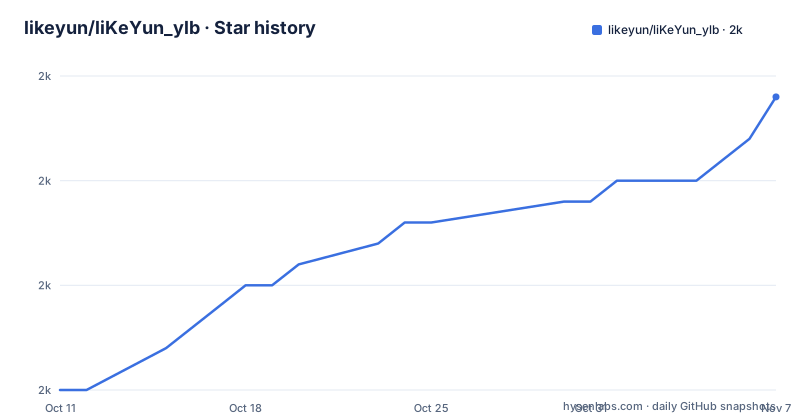
- likeyun/liKeYun_ylb2,034 ★ · +14
| Repository | 2026-10-11 | 2026-11-07 |
|---|---|---|
| likeyun/liKeYun_ylb | 2k | 2k |
14 Stars in the last 27 days, measured from the daily GitHub snapshot. Compare with other projects
Editorial analysis
Eight code and link types managed from a single /console/index/ panel
The project generates eight distinct output types for directing people into a WeChat account or group: group live codes (群活码), customer service codes (客服码), channel codes (渠道码), short URLs (短网址), Taobao affiliate landing pages (淘宝客中间页), WeChat external links (微信外链), Douyin cards (抖音卡片) and WeChat share cards (微信分享卡片). The admin panel sits at /console/index/ and is the single management point for all of them.
Version 2.4.6 merged the group live code, customer service code and channel code into a single live code tab (活码) rather than keeping them as three separate menus. The underlying code types still work differently, but operators now reach all three from one location. A backend screenshot appears in the project repository but no tab walkthrough or initial configuration sequence is documented anywhere in the written material.
A browser-based installer at /install/ that expects PHP 7.4 on Linux
Installation does not use a package manager or container image. After uploading the project files to a server, open the install path in a browser to start the setup wizard:
http://域名/install/The installation notes say to delete /install/ once the wizard finishes. On a Linux server, that URL resolves to the actual domain name followed by /install/.
Linux is the preferred platform. Windows servers may have compatibility issues or instability, according to the documentation, without any specification of what breaks. The tech stack is PHP 7.4.0 on the backend, jQuery 3.6.0 and Bootstrap 4.0 on the frontend. No PHP extension requirements and no minimum database version appear anywhere in the project. The repository root holds these top-level entries: FrameBridge/, common/, console/, install/, s/, static/, wailian/ and index.html. Starting with 2.4.6, the project is gradually replacing a custom database abstraction class (DbClass.php) with native PHP PDO operations. The 2.4.6 update notes describe this as an ongoing process with no completion target given.
Short URL domain polling and how the Baota cron handles block detection
Short URLs in version 2.4.6 gained domain polling. When WeChat's link-risk system marks a domain as dangerous, the rotation moves traffic to the next domain in the pool, keeping the short URL functional. The update notes for 2.4.6 describe this feature as "短网址轮询域名" with no further detail on pool size or the switching logic.
A separate domain detection task in the configuration center monitors specified domains for WeChat blocking and sends a notification when one is flagged. This detection does not trigger on its own in the free version. The documentation makes plain that the free open-source build does not include scheduled domain detection. Running checks automatically requires creating a cron job in the Baota panel (宝塔面板), a server management tool for PHP hosting on Linux. Anyone operating on a server without Baota would need to arrange cron scheduling through another method. The anti-block and anti-ban plugin for WeChat and QQ (微信QQ防红防封插件) was distributed as a free download in 2.4.6 with a direct link in the update notes, but no documentation about how it integrates with the main tool appears in the project.
What version 2.4.6 changed in code management, OS tracking and affiliate parsing
Group live codes in 2.4.6 gained stream splitting (群活码并流), a mechanism for distributing incoming users across multiple WeChat groups rather than funneling all of them into one. Channel codes added OS-level tracking, so the admin panel now records whether a scan came from Android or iOS. Long-press count recording was added to group live codes and customer service codes, capturing how many users long-pressed an image QR code rather than scanning it directly with a camera.
The Taobao affiliate feature changed its data-entry method. Earlier versions called an external API automatically. Version 2.4.6 replaced that with text-based parsing (文案解析), where the operator supplies formatted product text instead of letting the tool fetch data through an API. The update notes cover this change in one line with no example of the expected text format and no explanation of what the old API endpoint was. Page authorization was also added, letting administrators control which user groups can access specific pages within the panel.
The WeChat external link was extracted into a paid plugin in 2.4.6
The WeChat external link feature (微信外链) was part of the core tool in earlier versions but was separated into a paid plugin in 2.4.6. The update notes include the entry "外部跳微信抽离为插件" (external WeChat jump separated into a plugin). It is now sold on ifdian.net. The feature creates a link that, when clicked from outside WeChat on platforms including Xiaohongshu, Weibo, Douyin, Bilibili or a regular browser, opens WeChat and displays a QR code for the user to scan.
Other paid plugins cover a group entry payment gate, a dialog-style landing page, a complaint form page, a domain detection task plugin separate from the free config-center version, a user account expiry and registration code system, and a WeChat appreciation payment system. Custom feature development and paid deployment assistance are available through the author's WeChat contact. The Douyin round QR code is listed as a custom service requiring a separate WeChat contact (likeyun_tk). No plugin prices are stated in the documentation.
Upgrade steps live in a Feishu document and support runs through WeChat, not GitHub
Version upgrade documentation lives at an external Feishu document rather than anywhere in the repository. The project links to it and says nothing else about the process: no file list to update, no database migration steps, no rollback procedure. Daily-use documentation points to a Tencent Docs page, which the project describes as including a beginner-level tutorial.
Community support runs through WeChat groups rather than GitHub issues. Fifteen groups are listed as active, accessed by adding the author's WeChat contact (cbzqx22). No GitHub issue tracker or public forum appears in the project. Bug reports and feature requests leave no public record, which matters when evaluating whether a known problem was fixed before adopting a specific version. Anyone who opens a GitHub issue is not directed to it by anything in the documentation.
The top feature list advertises the WeChat external link as core, but the 2.4.6 update moved it to a paid plugin
The 特色功能 (featured functions) section near the top of the README lists eight types that the tool generates: group live codes, customer service codes, channel codes, short URLs, Taobao affiliate landing pages, WeChat external links, Douyin cards and WeChat share cards. These appear as the core capabilities of the free download. A reader who stops there would count all eight as built-in.
However, the 2.4.6 update notes contain the entry "外部跳微信抽离为插件" (external WeChat jump separated into a plugin), confirming that WeChat external links moved to a paid purchase in that version. The feature list at the top of the document was not updated. No paid notation appears next to the entry. Reading the full 2.4.6 update section is the only way to find out. Douyin cards (抖音卡片) appear in the same eight-item top list, while elsewhere in the documentation, Douyin round QR codes (抖音圆码) are described as a separate custom service. Whether the Douyin card in the feature list and the Douyin round QR code described later refer to the same feature or to distinct products is not explained anywhere.
Editorial conclusion
liKeYun_ylb suits a Chinese marketing team that self-hosts PHP and uses Baota panel for server management. The core free download covers group codes, customer service codes, channel codes, short URLs and Taobao affiliate pages, and version 2.4.6 added domain polling and OS-level channel tracking. Skip it if you need built-in cron scheduling, a documented PHP extension list, container-based deployment, or WeChat external links without a separate purchase. Before deploying, confirm your server runs PHP 7.4 and decide which paid plugins your workflow requires, because discovering a gap after setup requires an extra purchase.
Frequently asked questions
How do I install liKeYun_ylb on a server?
Upload the project files to a Linux server and open /install/ in a browser to run the setup wizard. After the wizard completes, delete the /install/ directory from the server.
Does liKeYun_ylb include the WeChat external link feature in the free version?
No. Starting with version 2.4.6, the WeChat external link was separated into a paid plugin sold on ifdian.net. Earlier versions included it in the core download.
What PHP version does liKeYun_ylb require?
The tech stack specified in the project is PHP 7.4.0. No required PHP extensions or minimum database version are documented.
Does liKeYun_ylb support Windows servers?
The documentation recommends Linux and notes that Windows servers may have compatibility issues or instability. No specific incompatibilities are listed.
Does automatic domain detection require Baota panel?
Yes, for scheduled operation. The free version includes a domain detection task in the configuration center, but running it on a timer requires a cron job set up in the Baota panel. Without Baota, you would need a separate cron solution.
Official sources
Add this badge to your README
If you maintain this project, the badge below links readers to this analysis and shows its maintenance status from the daily GitHub snapshot. Paste the markdown into your README; add ?metric=license or ?metric=stars to the image URL for a different field.

[](https://hysenlabs.com/projects/likeyun-likeyun-ylb)Star history chart for your README
[](https://hysenlabs.com/projects/likeyun-likeyun-ylb)Was this useful?