Miraheze's Puppet Configuration: A Volunteer-Run Wiki Farm's Infrastructure as Code
Production Puppet code
At a glance
- What is it?
- Miraheze/puppet is the production Puppet codebase for a non-profit wiki farm. It shows how a volunteer team manages MediaWiki hosting at scale, but it is not a general-purpose tool and requires careful review before reuse.
- Who is it for?
- Adopt this repository if you run a MediaWiki farm and want a proven, GPL-3.0-licensed starting point for Puppet-managed infrastructure, especially if you align with Debian Trixie and Wikimedia-derived practices. Do not adopt it if you need a plug-and-play solution, lack Puppet expertise, or require support for other distributions.
- Can I use it commercially?
- Yes, with conditions. GPL-3.0 is a copyleft licence: if you distribute software that includes it, you must release that software's source code under the same licence. Running it internally without distributing it does not trigger that obligation.
- Is it still maintained?
- Yes. The repository last received commits 2 days ago.
- What is it written in?
- Mainly Ruby, according to GitHub's language statistics.
Answers come from the project's GitHub data, last synced on October 20, 2026, and from our analysis. They are not legal advice.
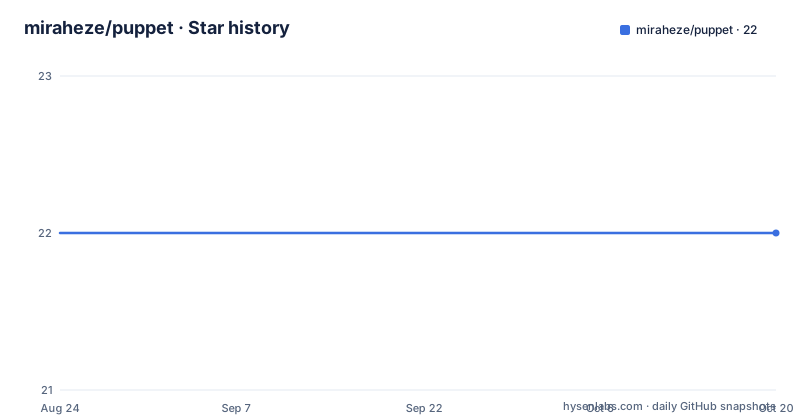
Star history
- miraheze/puppet22 ★ · +0
| Repository | 2026-08-24 | 2026-10-20 |
|---|---|---|
| miraheze/puppet | 22 | 22 |
0 Stars in the last 57 days, measured from the daily GitHub snapshot. Compare with other projects
Editorial analysis
What This Repository Actually Is
Miraheze/puppet is the production Puppet configuration for Miraheze, a non-profit wiki farm that provides free MediaWiki hosting. The farm is operated by the WikiTide Foundation and powered entirely by volunteers. This repository is the infrastructure-as-code that defines how their servers are configured. It is not a standalone application or a library; it is a set of Puppet manifests, modules, and data that describe a specific production environment. The README makes this clear: it contains 'our production Puppet configuration.' If you are looking for a generic Puppet module to manage MediaWiki, this is not that. It is a concrete, opinionated setup for one organization's needs. The target audience is engineers who want to see how a real, volunteer-run wiki farm manages its infrastructure, or who are considering contributing to Miraheze itself.
How It Works: Puppet Manifests and Modules
The repository is written in Ruby, which is the language of Puppet's DSL. The code defines the desired state of servers: packages, services, files, and configurations. The README notes that the code is a mix of hand-written code, code from the PuppetLabs Forge, and code from the Wikimedia Foundation. This means the repository is not a single coherent framework but an assembly of different sources. The presence of Wikimedia Foundation code is significant because Wikimedia runs one of the largest MediaWiki deployments in the world, so their Puppet patterns are likely battle-tested. However, the README also says that attributions 'should exist in module directories if code is fully unmodified or slightly.' This implies that some modules may have been modified and the attribution may be incomplete. The data flow is typical of Puppet: the master (or in modern setups, the server) compiles catalogs from manifests and serves them to agents, which enforce the desired state. The repository does not document the architecture beyond that, so you would need to inspect the actual manifests to understand the node classification and hiera data.
Getting It Running: Prerequisites and Commands
The README gives only one concrete instruction: 'This works out of the box as long as Puppet is installed on the local machine.' That is a notable claim, because most Puppet repositories require a master, a hiera configuration, and a specific directory structure. The README also states that all code is tested and developed on Debian Trixie and is run in production on Debian Trixie. So, to run it, you would need a Debian Trixie system with Puppet installed. The exact Puppet version is not specified. You would clone the repository, install Puppet, and then run `puppet apply` on the manifests, but the README does not give a specific command. This is a limitation: the 'out of the box' claim is vague. You would need to inspect the repository's structure to find the main manifest or the site.pp file. For a production environment, you would also need to configure a Puppet server and agents, which is beyond the README's scope.
A Real Limitation: It Is Tied to Debian Trixie and a Specific Stack
The most obvious limitation is the hard dependency on Debian Trixie. The README says the code is 'tested and developed' on that release and 'run in production' on it. That means the manifests likely use package names, service names, and paths that are specific to that distribution. If you run on Ubuntu, CentOS, or an older Debian, you will likely encounter failures. Another limitation is that this is a production configuration for a specific wiki farm. It includes custom modules for MediaWiki, but also for other services that Miraheze runs, such as database servers, caching, and possibly mail. You cannot simply drop this into your own environment without heavy customization. The README acknowledges that the code is an assortment, and it is not a modular, reusable product. For a small team without Puppet experience, this repository would be a poor starting point because it is not documented beyond the README. You would need to reverse-engineer the manifests.
Alternative: Building Your Own Puppet Modules vs. Using This as a Reference
The natural alternative to adopting this repository is to write your own Puppet configuration from scratch, using the PuppetLabs Forge modules as building blocks. The Forge is a public registry of reusable Puppet modules, and the README indicates that this repository reuses Forge code. The difference is that Forge modules are designed to be generic and configurable via parameters, whereas this repository is a specific, opinionated implementation. If you need to manage a MediaWiki farm, you could start with the official MediaWiki module or the `puppetlabs/apache` module, and configure it to your needs. That approach gives you control and avoids inheriting Miraheze's specific choices. However, you lose the benefit of seeing how a real farm handles edge cases. Another alternative is to use a configuration management tool other than Puppet, such as Ansible, which uses a different model (push-based, no agent) and might be simpler for a small team. But the README does not mention any such comparison, so this is a general observation.
Maintenance and Upgrade Cost
The README does not provide any information about release cycles, versioning, or upgrade procedures. There are no recent releases listed, and the last push is unknown. This means the repository is maintained as a living tree, not as a versioned product. The maintenance cost is tied to the Debian Trixie lifecycle; when that release reaches end-of-life, the code will likely need updates to run on a newer version. The README mentions that code is reused from the Wikimedia Foundation, which is actively maintained, but the integration in this repository may lag behind upstream changes. The GPL-3.0 license means you can use and modify the code, but if you distribute modifications, you must share them under the same license. The README also asks for attribution if you reuse unmodified or slightly modified code, which is a practical obligation beyond the legal license. For an adopter, the cost is in understanding the code and keeping it aligned with your own infrastructure changes.
Security and Contribution Process
The README has a dedicated section on security vulnerabilities. It instructs you not to post vulnerabilities publicly, but to email [email protected] or create a security-related task on their Phorge tracker. This is a responsible disclosure policy, and it is a positive sign for a volunteer project. The contribution process is simple: pull requests are welcome. The issue tracker is on Phorge, not on GitHub, which is a notable difference from many open source projects. If you are used to GitHub issues, you will need to create an account on their instance. The security policy is specific to Miraheze, and if you fork the repository for your own use, you must set up your own security reporting process. The README does not describe any automated testing or CI, so the quality of contributions is maintained by review, which is typical for a small team.
Editorial conclusion
Adopt this repository if you run a MediaWiki farm and want a proven, GPL-3.0-licensed starting point for Puppet-managed infrastructure, especially if you align with Debian Trixie and Wikimedia-derived practices. Do not adopt it if you need a plug-and-play solution, lack Puppet expertise, or require support for other distributions. Before using it, verify the current state of the code, check the attribution notes for unmodified modules, and review the security policy to understand how to report issues. The repository is a snapshot of one organization's setup, not a product, so treat it as a reference and adapt it to your own environment.
Frequently asked questions
What is a puppet, and is miraheze/puppet about puppets?
The marionette sense is not what this repository is. miraheze/puppet is the production Puppet configuration of Miraheze, a 501(c)(3) non-profit wiki farm operated by the WikiTide Foundation that provides free MediaWiki hosting.
How do I install Puppet on Ubuntu for miraheze/puppet?
The repository does not document an install step. It states only that the configuration works out of the box as long as Puppet is installed on the local machine, and that all code is tested and developed on Debian Trixie and run in production there.
How do I install a Puppet agent using miraheze/puppet?
Nothing here covers agent installation. What the repository contains is the server side configuration code for a volunteer operated wiki farm, with no command, no Puppet version, and no module inventory in the documentation.
How do I install a Puppet server with miraheze/puppet?
That is not the subject of the repository. miraheze/puppet is configuration code, licensed under the GNU General Public License Version 3 with the full text in LICENSE.md, and built from hand written code plus PuppetLabs Forge and Wikimedia code.
Official sources
Add this badge to your README
If you maintain this project, the badge below links readers to this analysis and shows its maintenance status from the daily GitHub snapshot. Paste the markdown into your README; add ?metric=license or ?metric=stars to the image URL for a different field.

[](https://hysenlabs.com/projects/miraheze-puppet)Star history chart for your README
[](https://hysenlabs.com/projects/miraheze-puppet)