Paper-Rebuttal-Tips: 28 rebuttal scenarios for AI conference authors, each with a bad answer and a recommended one
A repository curated by the MLNLP community to help with paper rebuttals.
At a glance
- What is it?
- Paper-Rebuttal-Tips is an MLNLP community collection of 28 rebuttal scenarios for AI and LLM conference submissions, each showing the reviewer's objection, a bad answer, a recommended answer and the key point. It is opinionated experience, not rules, and it tells you to check your venue's own instructions.
- Who is it for?
- Read Paper-Rebuttal-Tips if you have reviewer comments in front of you and a short window to answer, and read the bad-answer column first, since recognising your own draft in it is faster than reading advice about what to do. Do not treat it as authoritative for your venue, because the repository says outright that rules on word limits, new experiments and external links differ by conference and that you should follow the official instructions.
- Can I use it commercially?
- The repository metadata does not identify a licence. Check the project’s published terms and any component-specific licences before reuse.
- Is it still maintained?
- Yes. The repository last received commits 49 days ago.
- What is it written in?
- GitHub does not report a main language for this repository.
Answers come from the project's GitHub data, last synced on November 24, 2026, and from our analysis. They are not legal advice.
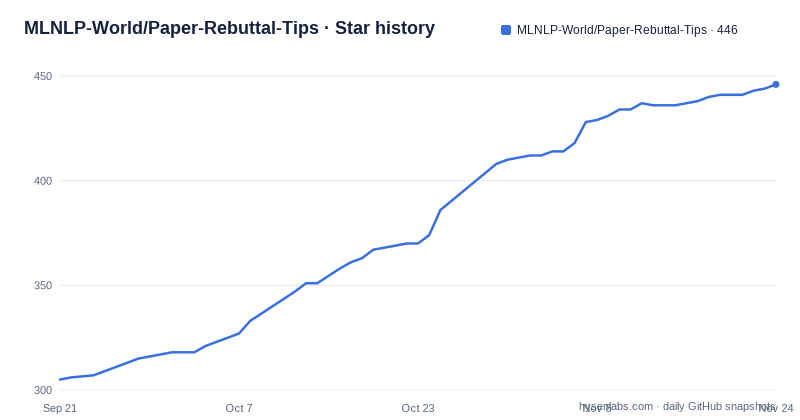
Star history
- MLNLP-World/Paper-Rebuttal-Tips446 ★ · +141
| Repository | 2026-09-21 | 2026-11-24 |
|---|---|---|
| MLNLP-World/Paper-Rebuttal-Tips | 305 | 446 |
141 Stars in the last 64 days, measured from the daily GitHub snapshot. Compare with other projects
Editorial analysis
What it is, and the moment it is for
Paper-Rebuttal-Tips is a curated repository from the MLNLP community for one narrow moment in a research career: writing the author response to reviewers after an AI or large model conference submission. The framing in the README is deliberately corrective. A rebuttal is not simply refuting reviewers. It is reorganising evidence, clarifying misunderstandings and supplementing experiments inside a very short space, so that the area chair and the reviewers can see the paper is still worth accepting. The slogan states the standard as Respect plus Evidence plus Clarity. The audience is specific: authors submitting to AI and LLM venues who have reviewer comments in front of them and limited words to answer in.
Four parts per tip, and why the bad answer matters
Every one of the 28 tips is built from the same four parts. First the reviewer's question or objection, phrased as a typical review comment. Then a bad answer, which is the useful column: the reply that is easy to write and likely to make things worse. Then a recommended answer, which is the response strategy the repository argues for. Then a key point that summarises the takeaway. Putting the bad answer next to the recommended one is the design decision that makes the collection worth reading, because most rebuttal advice only describes what to do and never shows the version that loses the reviewer.
Three groups, and where most of the tips sit
The 28 tips are grouped into three areas, and the distribution tells you where rebuttals actually go wrong. Tips 1 to 7 cover novelty, motivation, theory and boundaries: whether the method is worth doing, how it differs from existing work in substance, and where its limits sit. Tips 8 to 12 cover writing, clarity, related work and communication: unclear expression, thin related work, reviewers who misread the method, and low-quality negative reviews. Tips 13 to 28 cover experiments and evaluation evidence, which is more than half the collection and includes comparison against strong baselines, small improvement margins, unfair experimental setups, insufficient ablations, complexity and compute overhead, experiments too large for the rebuttal window, small datasets, generalisation, statistical significance, training data leakage risk, hyperparameter sensitivity, metric choice, missing human evaluation, and the absence of direct evaluation of intermediate results or generation quality.
Getting it locally and reading it
There is no software here, so getting it is a clone and a read. The repository holds a README and a pics directory, and nothing else.
git clone https://github.com/MLNLP-World/Paper-Rebuttal-Tips.gitOpen README.md in any Markdown renderer and the tips appear as collapsible sections, each wrapping one image at pics/tips/tip_NN.svg. Because each tip is a rendered image rather than prose, you read it in the browser or an image viewer rather than in an editor, and you cannot grep the collection for a phrase. The README also links a resource collection section and an organisers list, and it carries a version badge of v1.0.0.
The disclaimer sets the boundary
The disclaimer is the most important section, and it is worth reading before you copy anything. The repository states that all the tips are for reference only, that correctness is not guaranteed, and that they will not fit every conference, every field or every review scenario. It spells out why: rebuttal rules differ by venue, including word limits, whether new experiments are permitted, and whether external links are allowed, and it tells you to follow the official conference instructions instead. The provenance is stated plainly too: the content comes from the authors' personal experience, material gathered from the internet, accumulated practice in their own research group, and advice from senior researchers around them.
Language, images and the licence gap
Three limits are worth knowing before you invest time. The collection is written in Chinese, including the tip images, so it serves readers of Chinese rather than a general audience. The tips are delivered as SVG images, which means no text search, no diffing between versions, and no easy translation workflow. And the repository metadata declares no licence, so the default position under copyright applies to the text and images until the maintainers state otherwise, which matters if you plan to reuse the figures. The last push was on 2026-07-15, so this is a snapshot rather than something being actively extended.
Your venue's own instructions are the other source
The comparison that matters is with the author response instructions each conference publishes for its own cycle. Those are authoritative for your venue: they tell you the word limit, whether you may add experiments, whether you may link to external material, and when the response closes. They will not tell you how to answer, because guidance documents describe rules rather than strategy. This repository is the opposite: it is cross-venue pattern recognition with side-by-side bad and recommended answers, and it carries no authority for any specific conference. Use the official instructions for what is allowed and this collection for how to spend the words.
How it is maintained, and how to treat it
The repository is explicitly a community artifact. A badge marks pull requests as welcome, and the README invites issues and pull requests for anything questionable, which is the right posture for a collection built from personal experience. There is an organisers list section crediting the people behind it, and a resource collection section alongside the tips. Since the material is opinionated rather than verified, the practical way to treat it is as a second opinion on a draft: read the bad-answer column for the scenario you are facing, check whether your draft resembles it, and then confirm the specific rule, such as whether a new experiment is permitted, against your venue's own instructions before you commit to it.
Editorial conclusion
Read Paper-Rebuttal-Tips if you have reviewer comments in front of you and a short window to answer, and read the bad-answer column first, since recognising your own draft in it is faster than reading advice about what to do. Do not treat it as authoritative for your venue, because the repository says outright that rules on word limits, new experiments and external links differ by conference and that you should follow the official instructions. It is in Chinese, the tips are images you cannot search, and the repository declares no licence, so use it as a second opinion on a draft rather than as material to republish.
Frequently asked questions
How to write a paper rebuttal?
The repository defines it as reorganising evidence, clarifying misunderstandings and supplementing experiments in a very short space, so the area chair and reviewers see the paper is still worth accepting, rather than simply refuting the reviewers. Its stated formula is Respect plus Evidence plus Clarity.
What are some good rebuttal examples?
The collection is 28 examples, each built from four parts: the reviewer's question or objection, a bad answer that shows the trap, a recommended answer, and the key point. They are grouped into novelty and motivation, writing and communication, and experiments and evaluation evidence.
What is a good way to start a rebuttal?
The repository gives no sentence templates or opening formulas. The closest guidance is the tip on general strategy, which advises acting rather than only promising, so the opening should lead with what you have done rather than what you intend to do.
Official sources
Add this badge to your README
If you maintain this project, the badge below links readers to this analysis and shows its maintenance status from the daily GitHub snapshot. Paste the markdown into your README; add ?metric=license or ?metric=stars to the image URL for a different field.

[](https://hysenlabs.com/projects/mlnlp-world-paper-rebuttal-tips)Star history chart for your README
[](https://hysenlabs.com/projects/mlnlp-world-paper-rebuttal-tips)Was this useful?