LightLLM: A Python-First Serving Framework That Prizes Kernel Sharing and Research
LightLLM is a Python-based LLM (Large Language Model) inference and serving framework, notable for its lightweight design, easy scalability, and high-speed performance.
At a glance
- What is it?
- LightLLM is a Python-based LLM inference and serving framework with Apache-2.0 licensing and a design that emphasizes modularity and token-level KV cache management. This review examines its architecture, setup, performance claims, and limitations.
- Who is it for?
- LightLLM suits researchers and engineers who need a Python-native, modular serving framework and who value the ability to extend or borrow kernels for experiments. It is less appropriate for teams that require a stable, production-hardened system without the willingness to debug or adapt, since the documentation is still developing and the performance numbers come from release blogs, not independent benchmarks.
- Can I use it commercially?
- Yes. Apache-2.0 is a permissive licence: you can use, modify and sell software built on it, as long as you keep its copyright and licence notices.
- Is it still maintained?
- Yes. The repository received new commits within the last day.
- What is it written in?
- Mainly Python, according to GitHub's language statistics.
Answers come from the project's GitHub data, last synced on November 15, 2026, and from our analysis. They are not legal advice.
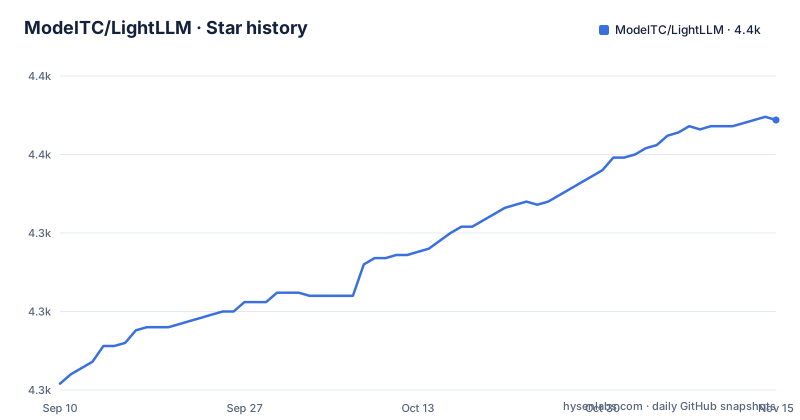
Star history
- ModelTC/LightLLM4,361 ★ · +84
| Repository | 2026-09-10 | 2026-11-15 |
|---|---|---|
| ModelTC/LightLLM | 4.3k | 4.4k |
84 Stars in the last 66 days, measured from the daily GitHub snapshot. Compare with other projects
Editorial analysis
What LightLLM Is For and Who Should Care
LightLLM is a Python-based framework for serving large language models, aimed at inference workloads where low latency and high throughput matter. The README positions it as lightweight, easy to scale, and fast, drawing on ideas from FasterTransformer, TGI, vLLM, and FlashAttention. The intended audience is twofold. First, production engineers who want a serving stack that is not a black box and that can be tuned at the token level. Second, researchers who need a base for experiments: the README explicitly says the pure-Python design and token-level KV cache management make it easy to use as a research platform. That is a meaningful distinction. Unlike many inference engines that hide internals behind C++ extensions, LightLLM keeps the control flow in Python, which lowers the barrier for modification but also raises questions about performance overhead, a trade-off the documentation does not fully address.
The Mechanism: Token-Level KV Cache and Modular Kernels
The core architectural idea is token-level KV cache management. Instead of managing cache in chunks or per request, LightLLM operates at the granularity of individual tokens. This is a specific design choice that enables finer control over memory reuse and prefix sharing. The README also mentions KC Cache, which appears to be a typo or shorthand for KV Cache, but the concept is consistent. The framework leverages OpenAI Triton for custom kernels, and it integrates with FlashAttention. The result is a system where the serving logic is Python-driven, but the heavy compute is delegated to optimized kernels. A November 2025 tech blog entry announces support for prefix KV cache transfer between DP rankers, which suggests a data flow where the KV cache can be moved across data-parallel processes, a feature aimed at multi-GPU or multi-node serving. The README states that vLLM, SGLang and Aphrodite use some of LightLLM's kernels. The architecture is not monolithic; it is a collection of components that can be reused.
Getting It Running: Installation and Quick Start
The README points to a dedicated installation guide and quick start in the documentation, but it does not provide the actual commands in the repository description. Based on the README, the intended path is to visit the readthedocs pages for installation and then run the quick start example. The documentation is split into English and Chinese versions, which is helpful for a global audience. The repository also has a Docker publish workflow, so an official Docker image is likely available, though the exact image name is not given. For a Python-based framework, installation likely involves pip or a source checkout, but the README does not specify. This lack of inline setup instructions is a real friction point. A user must leave the README and navigate to external docs, which may be acceptable for a framework of this complexity but is not ideal for quick evaluation.
Performance Claims and Their Evidence
The README makes a striking claim: v1.0.0 achieved the fastest DeepSeek-R1 serving performance on a single H200 machine. That is a strong statement, and the README's Performance section points to release blogs for details. This is a limitation. As an engineer, you cannot verify that claim without going to the blog and even then you would need to trust the authors' setup. The v1.1.0 release blog is also referenced for performance, but again, the data is external. What is verifiable is that the project has been accepted for publication in venues like ASPLOS 2025 for a request scheduler and ACL 2025 for constrained decoding, which suggests that the underlying techniques have undergone peer review. That is a form of evidence, but it does not directly prove serving speed. The gap between research acceptance and production performance is significant.
A Genuine Limitation: Python Overhead and Complexity
The pure-Python design is a double-edged sword. While it aids research and customization, it also introduces potential performance bottlenecks. The README acknowledges the framework's speed, but it does not explain how Python-level scheduling and cache management avoid slowing down the critical path. In practice, many high-performance systems move as much logic as possible into C++ or CUDA to reduce interpreter overhead. LightLLM chooses the opposite approach. This is a design trade-off that users must accept. For workloads that require extreme throughput, a Python-driven control plane might become the limiting factor, even if the kernels are optimized. The framework also depends on OpenAI Triton, which means it inherits Triton's compatibility constraints with different GPU architectures and CUDA versions. The README does not list hardware requirements, which is an omission for a serving framework.
The Wrong Tool for Some Jobs
LightLLM is not a fit for every serving scenario. The README lists vLLM and SGLang as projects that use some of LightLLM's kernels, but those projects are separate and have their own release cycles. LightLLM's own release history is sparse: v1.0.1 in March 2025, v1.1.0 in September 2025, and v1.2.0 in August 2026. That is roughly three releases in a year and a half. For a framework that is still evolving, this cadence is reasonable, but it also means that features are changing. If you are looking for a long-term stable API, this is a risk.
Alternatives and How They Differ
The README names vLLM, SGLang and Aphrodite as projects that use some of LightLLM's kernels, and lists vLLM and SGLang, along with Faster Transformer, Text Generation Inference, flashinfer, Flash Attention and OpenAI Triton, among the projects the authors learned from. What LightLLM itself emphasizes is its pure-Python design and token-level KV cache management, which the README says make it easy to use as the basis for research projects, backed by a list of academic works built on it, including ParrotServe (OSDI'24), SLoRA (MLSys'24) and LoongServe (SOSP'24).
Maintenance, Licensing, and Upgrade Path
The repository is licensed under Apache-2.0, which is permissive for commercial use, but you should read the license text for any patent clauses. The README does not specify a maintenance policy, but the last push was November 2026, which is recent, and the project is not archived. There is a Discord server for community support, which is a sign of active engagement. The documentation is hosted on readthedocs, and there is a Docker workflow, so CI/CD is in place. However, the README does not provide a migration guide between versions. For a project that is still releasing new features, like the prefix KV cache transfer between DP rankers announced in November 2025, you should expect to re-read release notes carefully. The upgrade cost is not zero, especially if you have customized kernels or rely on internal APIs. Given that the framework is Python-based, you may need to update Python dependencies, and Triton versions can be finicky. Plan to allocate time for testing after each upgrade.
Editorial conclusion
LightLLM suits researchers and engineers who need a Python-native, modular serving framework and who value the ability to extend or borrow kernels for experiments. It is less appropriate for teams that require a stable, production-hardened system without the willingness to debug or adapt, since the documentation is still developing and the performance numbers come from release blogs, not independent benchmarks. Before adopting, verify that your target models and hardware are supported, test the installation with your specific CUDA and Triton versions, and review the latest release notes for breaking changes. The framework's strength lies in its transparency and its track record of influencing other projects, not in being a turnkey solution.
Frequently asked questions
Which platforms does LightLLM support?
setup.py declares python_requires >=3.10 and lists only Programming Language :: Python :: 3 and Operating System :: Linux as classifiers, and triton is a runtime dependency, so the distribution claims Linux with Python 3.10 or newer.
Does LightLLM's package metadata name a license?
No. The setup() call has no license argument, and the repository states that it is released under the Apache-2.0 license in prose, so the license lives in LICENSE and in the README rather than in the package metadata.
Why does LightLLM's requirements.txt use an extra index URL?
Because the FlashInfer cubin wheels are published on the official FlashInfer index, so the file adds `--extra-index-url https://flashinfer.ai/whl`.
Which other projects use LightLLM kernels?
vLLM, SGLang, and Aphrodite are each listed as using some LightLLM kernels. Projects built on LightLLM include ParrotServe from Microsoft, OmniKV from Ant Group, LoongServe from Peking University, S-LoRA, and LazyLLM.
How are LightLLM's version tags spaced?
The recent tags are v1.2.0 on 2026-08-10, v1.1.0 on 2025-09-03, and v1.0.1 on 2025-03-03, and setup.py declares version 1.2.0. The news section still ends at the v1.1.0 release.
Official sources
Add this badge to your README
If you maintain this project, the badge below links readers to this analysis and shows its maintenance status from the daily GitHub snapshot. Paste the markdown into your README; add ?metric=license or ?metric=stars to the image URL for a different field.

[](https://hysenlabs.com/projects/modeltc-lightllm)Star history chart for your README
[](https://hysenlabs.com/projects/modeltc-lightllm)Was this useful?