BentoML: A Python-Native Serving Framework for AI Models and Multi-Model Pipelines
The easiest way to serve AI apps and models - Build Model Inference APIs, Job queues, LLM apps, Multi-model pipelines, and more!
At a glance
- What is it?
- BentoML turns Python inference scripts into REST APIs, packages them as Docker-ready Bentos, and adds batching and model composition. This review covers its mechanism, workflow, and where its abstractions may cost you.
- Who is it for?
- Adopt BentoML if you are a Python team that wants to turn PyTorch, Transformers, or custom models into REST APIs with minimal boilerplate, and you value reproducible Docker images and deployment with Docker containers or Kubernetes. Do not adopt it if you need fine-grained control over low-level inference runtimes or if your serving logic is already deeply tied to a specific framework like Triton or Ray Serve.
- Can I use it commercially?
- Yes. Apache-2.0 is a permissive licence: you can use, modify and sell software built on it, as long as you keep its copyright and licence notices.
- Is it still maintained?
- Yes. The repository last received commits 12 days ago.
- What is it written in?
- Mainly Python, according to GitHub's language statistics.
Answers come from the project's GitHub data, last synced on November 14, 2026, and from our analysis. They are not legal advice.
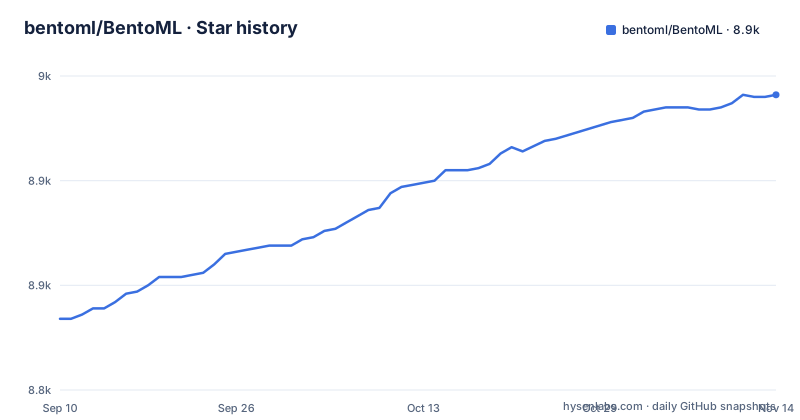
Star history
- bentoml/BentoML8,941 ★ · +107
| Repository | 2026-09-10 | 2026-11-14 |
|---|---|---|
| bentoml/BentoML | 8.8k | 8.9k |
107 Stars in the last 65 days, measured from the daily GitHub snapshot. Compare with other projects
Editorial analysis
What BentoML actually solves
BentoML addresses a specific pain: taking a trained model and exposing it as an HTTP endpoint without hand-writing Flask or FastAPI glue, managing dependency versions, or manually crafting Dockerfiles. The README frames it as a Python library for building online serving systems. It is for engineers who have a model inference script and want to move it to production with a standard artifact. The project also targets multi-model systems, where several models need to be composed into a single inference graph. It is not a training framework and not a general-purpose web server. It sits between your model code and the deployment infrastructure, standardizing how the model is packaged and served.
The Bento artifact and its build workflow
The central concept is the Bento, a standardized deployable artifact. According to the README, running bentoml build packages the necessary code, models, and dependency configs into that artifact. The build reads a service.py file and a configuration that includes an image definition. In the example, the image is specified with bentoml.images.Image(python_version="3.11").python_packages("torch", "transformers"), which tells the build system which Python version and which pip packages to include. This is a declarative approach: you do not write a Dockerfile by hand. Instead, BentoML generates the container image when you run bentoml containerize summarization:latest. That command produces a Docker image you can run with docker run --rm -p 3000:3000 summarization:latest. The artifact is meant to be reproducible, tying together code, model versions, and dependencies in one unit. This workflow is the core value proposition: one command to build, one command to containerize.
How the service API is defined
You define a service as a Python class decorated with @bentoml.service. The decorator accepts the image configuration. Inside the class, you load your model in __init__, typically on GPU if available. Inference methods are decorated with @bentoml.api. The README shows a batchable=True flag, which indicates that the method can accept a list of inputs and process them together. This is a key mechanism for maximizing GPU utilization: instead of one request causing one forward pass, the framework can accumulate requests and process them in a batch. The method signature uses type hints, such as list[str], and the README presents standard Python type hints as how an inference script becomes a REST API. The client side is equally simple: a SyncHTTPClient object lets you call the remote method as if it were a local function. The example shows client.summarize([...]) returning a list of strings. This hides HTTP details and gives you a typed, Pythonic interface.
Running and deploying: local to cloud
The README gives a clear path from local development to production. After installing bentoml with pip, you run bentoml serve to start a production HTTP server on localhost:3000. That command reads the service:Summarization entry point from the current directory. You can test it in a browser or with the Python client. For deployment, you first build a Bento, then containerize it. The Docker route is self-contained: you can run the image anywhere Docker runs. The README also says you can deploy to production with Docker containers or Kubernetes.
Optimization features and their limits
The README claims built-in serving optimization like dynamic batching, model parallelism, multi-stage pipeline, and multi-model inference-graph orchestration. Dynamic batching is the most concrete: the batchable=True decorator enables it. But the README does not specify how the batch window is configured, such as max batch size or max latency. That is a real gap. You must read the advanced documentation to understand the tuning parameters. Model parallelism and multi-model composition are mentioned in the advanced topics links. This means the framework likely supports complex setups, but the default experience is single-model, single-process. If you need to split a large model across multiple GPUs or chain several models with intermediate processing, you will need to learn additional abstractions beyond the basic service class. The README does not give a concrete example of such a pipeline, only links to model composition and workers documentation.
Where BentoML is the wrong tool
BentoML is a high-level framework. It abstracts away the serving infrastructure, but that abstraction can conflict with low-level requirements. If you need to customize the HTTP routing, add middleware, or integrate with an existing ASGI application, you may find the framework restrictive. The service class model is opinionated: every endpoint is a method on a class, and the type hints drive the API. That is elegant for standard cases but can be awkward for streaming responses, websockets, or complex request lifecycle logic. Also, the framework assumes your model can be loaded into a Python process. If your model runs in a separate runtime, such as a TensorRT engine or a custom C++ server, you would have to wrap it in a Python shim, which adds overhead. For teams that already use Kubernetes and have their own serving patterns, the Bento artifact might duplicate existing deployment logic rather than simplify it.
Alternatives and how they differ
The most direct alternative is Ray Serve, which also provides Python-native model serving with batching and deployment graphs. Ray Serve is more general: it can serve any Python function or class, not just models, and it integrates with the broader Ray ecosystem for distributed computing. BentoML is more focused on the packaging and deployment story, with the Bento artifact and generated Docker images. Another alternative is Triton Inference Server, which is not Python-native. Triton is a C++ server that supports multiple frameworks and provides high-performance inference with dynamic batching at the framework level. You would need to export your model to a format Triton understands, such as ONNX or TensorRT. BentoML keeps your model in Python, which is easier for prototyping. The choice depends on whether you prioritize Python simplicity (BentoML) or infrastructure performance and flexibility (Triton).
Licence, maintenance, and upgrade considerations
BentoML is licensed under Apache-2.0, which is permissive for commercial use. The repository is not archived, and recent releases are v1.4.38 in April 2026, v1.4.39 in May, and v1.4.40 in October, and the last push was on 2026-11-02. That indicates active maintenance. Upgrading between minor versions could introduce breaking changes in the service API or the build configuration. The README shows a simple example, but real projects often use custom images, custom Python packages, and system dependencies. The image configuration with python_packages only covers pip packages. If you need apt packages or custom binaries, you must extend the image definition, and the README does not show how. You should plan to read the documentation for image customization. The core library and the Docker deployment path are open source under Apache-2.0.
Editorial conclusion
Adopt BentoML if you are a Python team that wants to turn PyTorch, Transformers, or custom models into REST APIs with minimal boilerplate, and you value reproducible Docker images and deployment with Docker containers or Kubernetes. Do not adopt it if you need fine-grained control over low-level inference runtimes or if your serving logic is already deeply tied to a specific framework like Triton or Ray Serve. Before committing, verify that the batchable API decorator matches your model's actual request patterns, and test the Bento build process with your custom dependencies, especially non-Python system libraries. The project is actively maintained with Apache-2.0 licensing, but you should still review the generated Dockerfile and the service configuration for your own security and compliance needs.
Frequently asked questions
What is BentoML?
A Python library for building online serving systems aimed at AI applications and model inference. It turns a model inference script into a REST API server using standard Python type hints, manages environments and model versions through a config file, generates Docker images, and provides serving features such as dynamic batching, model parallelism and multi-model inference graphs.
What is BentoML used for?
Serving models and AI applications in production. A class is declared as a service, each endpoint is a method with a decorator and ordinary type hints, and the running server exposes those methods over HTTP. The documented flow is to define the service, serve it locally, package it into a deployable artifact, generate a container image from that artifact, and run it.
What does BentoML do with my model code?
It treats your inference script as the implementation of an HTTP endpoint rather than as a script you call. You declare the runtime in the service decorator, marking endpoints batchable where the server may combine calls, and the annotations on your methods define the request and response shapes. Local runs need the heavy dependencies installed in your own environment, while the built artifact carries them.
How do I install BentoML?
With pip install -U bentoml, which the documentation marks as requiring Python 3.9 or newer. To run the example locally you also install the model libraries yourself, since the service decorator describes the runtime for the built artifact rather than your local environment.
How do I deploy an AI model with BentoML?
Run the build command to package your code, models and dependency configuration into a Bento, the framework's standardised deployable artifact. Ensure Docker is running, generate an image from the named artifact with the containerize command, then run that image.
Is BentoML free?
The library is open source under the Apache license and installs from the package index with no account required, and nothing in the local serving or container path needs credentials.
Official sources
Add this badge to your README
If you maintain this project, the badge below links readers to this analysis and shows its maintenance status from the daily GitHub snapshot. Paste the markdown into your README; add ?metric=license or ?metric=stars to the image URL for a different field.

[](https://hysenlabs.com/projects/bentoml-bentoml)Star history chart for your README
[](https://hysenlabs.com/projects/bentoml-bentoml)Was this useful?