SNESRecomp: A Static Recompiler That Turns SNES ROMs Into Native Code
Super Nintendo (SNES) game static recompiler ecosystem · Part of the R.A.I.D. community
At a glance
- What is it?
- SNESRecomp translates 65816 machine code into C, compiles it to a native executable, and links it against a shared hardware runtime. It is an alpha-stage project with three playable commercial games and a clear list of unsupported cartridge chips.
- Who is it for?
- Adopt SNESRecomp if you want to build a native, moddable port of a SNES game that uses one of the supported cartridge mappings (LoROM, HiROM, SA-1, Cx4, Super FX, DSP-1) and you are comfortable with alpha-quality tooling. Do not adopt it if you need a drop-in emulator for arbitrary SNES titles, or if your target uses S-DD1, SPC7110, DSP-2/3/4, or any of the listed unsupported chips.
- Can I use it commercially?
- Check first. The repository uses a licence we do not classify automatically, so read its LICENSE file before any commercial use.
- Is it still maintained?
- Yes. The repository received new commits within the last day.
- What is it written in?
- Mainly Python, according to GitHub's language statistics.
Answers come from the project's GitHub data, last synced on October 23, 2026, and from our analysis. They are not legal advice.
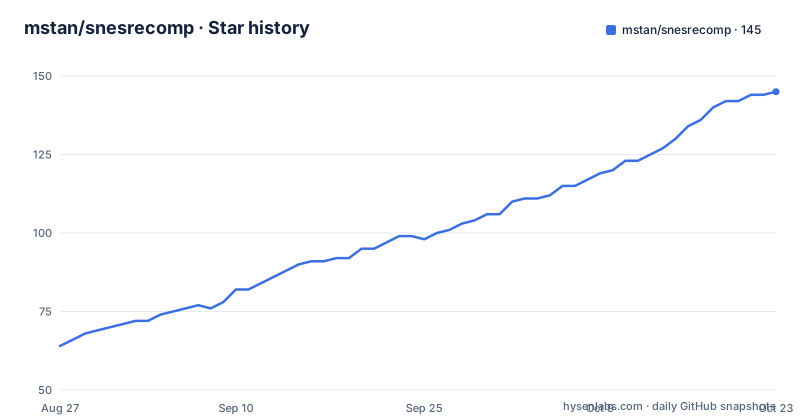
Star history
- mstan/snesrecomp145 ★ · +81
| Repository | 2026-08-27 | 2026-10-23 |
|---|---|---|
| mstan/snesrecomp | 64 | 145 |
81 Stars in the last 57 days, measured from the daily GitHub snapshot. Compare with other projects
Editorial analysis
The Problem: Emulation Overhead vs. Native Ports
Full-system emulators for the SNES interpret or dynamically recompile the 65816 CPU on every frame. That approach is flexible, but it leaves the game code running inside a virtual machine, which makes deep modifications like true widescreen rendering or custom camera logic awkward. SNESRecomp takes a different path: it statically translates the game's 65816 machine code into C, then compiles that C into a native executable. The result is game logic that runs as native code, not inside an emulator. The intended audience is developers who want to produce a playable, distributable port of a specific SNES game, with modern features like widescreen, save states, and MSU-1 audio. It is not aimed at people who just want to play a ROM on their PC; it is a toolchain for building a port.
The Four-Stage Pipeline: From ROM to Native Executable
The README describes a four-step process. First, an analyzer discovers code in the ROM. It follows control flow, tracks the 65816 M/X width state (the CPU's accumulator and index register widths), and resolves direct and indirect dispatch where it can. Second, an emitter translates the discovered 65816 functions into portable C. Third, a normal C compiler builds that C output together with a shared runner and game-specific integration code. Fourth, at runtime, any code that could not be resolved statically falls through to an interpreter tier. That interpreter is a safety net: it prevents unresolved or dynamically reached code from becoming a correctness hole. This hybrid design means the original game logic remains the source of truth, but the CPU portion runs natively. The runtime models the PPU, APU, DSP, DMA, cartridge mapping, and supported enhancement chips.
Getting Started: What You Need to Build a Port
The repository is a framework, not a single binary you run. The v0.2.0-alpha release is described as a self-contained ROM-to-source CLI, which suggests you can point it at a ROM and get C source out. But the README is clear that each game needs its own analysis configuration and integration code. The companion game repositories (SuperMarioWorldRecomp, ZeldaAlttPSNESRecomp, MegaManXSNESRecomp) pin a known framework revision and ship their own ROM-free releases. To build a new game, you would clone one of those as a template, or start from the framework and write the integration layer yourself. The exact commands are not in the provided material, so you must read the game repositories for build instructions. The framework accepts headerless .sfc and copier-headered .smc images for standard LoROM and HiROM, which is useful for testing with your own dumps.
Supported Hardware: What the Runtime Actually Models
The cartridge mapping and enhancement chip support is the heart of the project. Standard LoROM and HiROM, with FastROM variants, are supported, including battery-backed SRAM mapping. The Capcom Cx4 chip (used in Mega Man X2 and X3) has instruction-level support, and its internal data ROM is synthesized, so no separate firmware file is needed. The Super FX / GSU chip is supported, with Star Fox as the current development validation target. The DSP-1 / DSP-1B is supported for Super Mario Kart, with a firmware-free command model. The SA-1 chip is supported for Super Mario RPG, with a long list of implemented features: ROM-bus arbitration, Super MMC banking, IRAM/BW-RAM, timers, DMA, and variable-bit reading. MSU-1 is supported but opt-in: the extension's registers and data channel are implemented, but a game must integrate its own MSU-1 driver. This is a significant amount of hardware modeling, but it is not universal.
The Long List of Unsupported Chips and Mappings
The README is unusually honest about what does not work. ExLoROM, ExHiROM, and other custom mappings are not supported yet. The DSP-2, DSP-3, and DSP-4 chips are not supported, even though they use the same NEC family interface as the DSP-1. The S-DD1 decompression chip is not supported, which rules out games like Star Ocean and Street Fighter Alpha 2. The SPC7110 and its RTC are not supported. OBC-1, ST010, ST011, ST018, and S-RTC are all absent. BS-X, Sufami Turbo, and Super Game Boy adapters are outside the current mapper model. Worse, the README warns that some unsupported cartridges may load as plain LoROM or HiROM images because header detection gets that far, but their unmodeled register windows will still prevent correct execution. This is a real failure mode: you might think a game is running, but it will crash or behave incorrectly because a coprocessor is silently ignored.
Validation and Quality: What the Tests Actually Prove
The project does not rely on vague claims. For the DSP-1, the README mentions unit and differential command gates, a deterministic one-player race that matches Snes9x WRAM/DSP behavior and framebuffer output within renderer rounding, and a canonical 36,000-frame LLE/HLE attract qualification. For the SA-1, an 18,000-frame attract-loop qualification passes without runtime, logic-activity, video-activity, or audio-activity failures. These are concrete, reproducible validation methods. However, the game status table is more cautious. Super Mario World is believed playable end to end. A Link to the Past is playable through the early dungeon. Mega Man X is fully playable, with experimental true-widescreen mods. The difference between a 36,000-frame attract test and a human playing through the entire game is significant. Attract loops exercise the CPU and hardware deterministically, but they do not cover every player input path. The status table reflects that gap.
Game-Specific Integration vs. Framework Improvements
A key architectural decision is that the framework is game-agnostic, but each game supplies its own analysis configuration and integration code. The README states that improvements to the CPU and hardware model benefit every project. That is the upside: fix a bug in the SA-1 core, and Super Mario RPG benefits, but also any future SA-1 game you port. The downside is that the heavy lifting for a new game is not just running the analyzer. You must configure the analysis for that game's specific code layout, handle any game-specific quirks in the integration layer, and validate the result. The companion repositories pin a known framework revision, which means you cannot just pull the latest framework and expect your game to build. You must track which revision your game was built against. This is a maintenance cost that the README acknowledges by calling the projects alpha.
The Alternative: Full-System Emulation and Dynamic Recompilation
The obvious alternative is a full-system emulator like Snes9x, which uses dynamic recompilation or interpretation. The difference in approach is fundamental. An emulator models the entire console in software, so it can run almost any SNES game without per-title work. It does not need to statically resolve code paths, and it handles unsupported chips by either implementing them or refusing to run. But an emulator runs the game as a guest, which makes deep modifications like true widescreen rendering much harder. SNESRecomp's static approach gives you native code and the ability to change the game's logic, but it requires per-game analysis and integration. Another alternative is manual decompilation or reverse engineering, where you rewrite the game's logic in C from scratch, which gives total control but is far more labor-intensive. SNESRecomp sits between those: it automates the translation but still requires human configuration and validation.
Licensing and Legal Caveats
The repository license is listed as NOASSERTION, which is not a standard open-source license identifier. That means you cannot assume any particular usage rights. The README says the projects are ROM-free, meaning the releases do not include the original game ROM, but the recompiled source is derived from the game's machine code. That derivation raises copyright questions that the project does not address in the provided material. If you plan to distribute a port, you need to understand the legal status of the original game and the generated code. The license situation is a genuine obstacle for commercial use. The project is part of the R.A.I.D. community, which may have its own norms, but the NOASSERTION license gives you no formal permission. Treat this as a research and hobby tool unless you get legal advice for your specific case.
Editorial conclusion
Adopt SNESRecomp if you want to build a native, moddable port of a SNES game that uses one of the supported cartridge mappings (LoROM, HiROM, SA-1, Cx4, Super FX, DSP-1) and you are comfortable with alpha-quality tooling. Do not adopt it if you need a drop-in emulator for arbitrary SNES titles, or if your target uses S-DD1, SPC7110, DSP-2/3/4, or any of the listed unsupported chips. Before starting, verify that your specific ROM revision is covered by the companion game repository's validation status, because the framework's mapper support does not guarantee a playable port. Check the game repositories for current build instructions and known limitations, and review the runner notes for your chip (for example, runner/src/snes/CX4_NOTES.md or SA1_NOTES.md) to see what is qualified.
Frequently asked questions
What does SNESRecomp do with a ROM?
It is a general-purpose static recompiler for the Super Nintendo that translates 65816 machine code into C, compiles it into a native executable and links it against a shared SNES hardware runtime, so the game CPU runs as native code instead of inside a full-system emulator.
Is SNESRecomp an emulator, and which cartridges does it support?
The text says it is not a drop-in emulator, and that a supported row means the analyzer and shared runner understand that cartridge mapping or chip. Standard LoROM and FastROM, standard HiROM, Capcom Cx4, Super FX, DSP-1 and SA-1 are supported, MSU-1 is supported but opt-in, S-DD1 is experimental, and ExLoROM, ExHiROM, DSP-2 to DSP-4, SPC7110 and the cartridge adapters are not supported yet.
Which games are playable in the SNESRecomp ecosystem?
Each game lives in its own repository and pins a known framework revision. Super Mario World is believed playable end to end with 4:3, fixed 16:9, Adaptive View and MSU-1 audio, Zelda: A Link to the Past is playable through the early dungeon, and Mega Man X is the one described as fully playable with an experimental true-widescreen mod and Windows, macOS and Linux builds.
Why does an unsupported cartridge still load as a plain LoROM or HiROM image?
Some unsupported cartridges get far enough through header detection to be treated as a plain LoROM or HiROM image, and then their unmodeled register windows still prevent correct execution. The rule the text states is that chips and mapping schemes not listed as supported should be assumed unsupported.
What does the SNESRecomp repository contain besides the runtime?
The primary language is Python and the tree holds both recompiler/ and recompiler-rs/, alongside runner/, host/, lib/, cosim/, fuzz/, tests/, tools/ and third_party/. A top-level snesrecomp_cli.py matches the v0.2.0-alpha release note for a self-contained ROM-to-source CLI, and the root carries engineering notes in files such as DEVELOPMENT.md, SNES_COSIM.md and SNES_ACCURACY_BURNDOWN.md.
Official sources
Add this badge to your README
If you maintain this project, the badge below links readers to this analysis and shows its maintenance status from the daily GitHub snapshot. Paste the markdown into your README; add ?metric=license or ?metric=stars to the image URL for a different field.

[](https://hysenlabs.com/projects/mstan-snesrecomp)Star history chart for your README
[](https://hysenlabs.com/projects/mstan-snesrecomp)Was this useful?