nanodbc: A Minimal C++ Wrapper for the ODBC C API
A C++ wrapper for the C ODBC API
At a glance
- What is it?
- nanodbc is a small, pimpl-based C++ library that wraps the verbose and brittle C ODBC API. It targets developers who want concise database code without extra dependencies, but its minimalism means you must accept its limits.
- Who is it for?
- Adopt nanodbc if you need a small, dependency-free C++ wrapper for ODBC and can meet its C++17 minimum for version 3.0 or C++14 for 2.x. Skip it if you need features beyond what raw ODBC offers, such as connection pooling or async I/O, or if you cannot install unixODBC/iODBC and a SQLite driver for tests.
- Can I use it commercially?
- Yes. MIT is a permissive licence: you can use, modify and sell software built on it, as long as you keep its copyright and licence notices.
- Is it still maintained?
- Yes. The repository last received commits 1 day ago.
- What is it written in?
- Mainly C++, according to GitHub's language statistics.
Answers come from the project's GitHub data, last synced on October 24, 2026, and from our analysis. They are not legal advice.
Star history
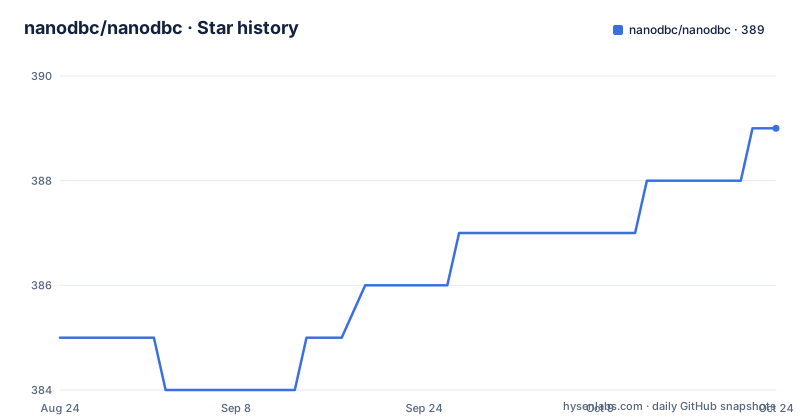
- nanodbc/nanodbc389 ★ · +4
| Repository | 2026-08-24 | 2026-10-24 |
|---|---|---|
| nanodbc/nanodbc | 385 | 389 |
4 Stars in the last 61 days, measured from the daily GitHub snapshot. Compare with other projects
Editorial analysis
The Problem: ODBC's C API Is Verbose and Brittle
The C ODBC API is notoriously difficult to use directly. It requires managing handles, binding parameters, and handling return codes with a lot of boilerplate. nanodbc addresses this by providing a C++ wrapper that hides most of that complexity. The README describes the native API as "exorbitantly verbose, ridiculously complicated, and fantastically brittle." The library is aimed at C++ developers who need to talk to databases through ODBC without writing that low-level code themselves. It is not for developers who want a full ORM or a database abstraction layer; it is for those who want a thin, modern C++ interface to ODBC.
Design: Pimpl Idiom and Minimalism
nanodbc uses the pimpl idiom for all complex objects. This separates interface from implementation, gives value semantics, and keeps the public header clean. The `nanodbc.h` header includes only standard C++ headers, which is a deliberate choice to avoid pulling in extra dependencies. The library's philosophy is to be "as minimal as possible." That means no features beyond what ODBC itself supports. If you need connection pooling or asynchronous operations, you will have to write supporting ODBC code yourself, because nanodbc does not add such features. This is a trade-off: you get a small, focused library, but you cannot expect it to extend ODBC's capabilities.
Getting It Running: Build and Test Setup
The README describes a straightforward build process. You can create a build directory, run `cmake ..` from it, and then `make nanodbc` to build the library. `make tests` builds the test programs, and `make test` runs them. The tests require unixODBC or iODBC to be installed and discoverable by CMake. On macOS, you can install unixODBC via Homebrew with `brew install unixodbc`. The tests also need a SQLite ODBC driver, registered in `odbcinst.ini` as `SQLite3` on Unix-like systems or as `SQLite3 ODBC Driver` on Windows. The README shows an example `odbcinst.ini` section for macOS with paths under `/usr/local/lib`. You can override the SQLite connection string by setting `NANODBC_TEST_CONNSTR_SQLITE`, and each test suite reads its own `NANODBC_TEST_CONNSTR_<DB>` variable, falling back to `NANODBC_TEST_CONNSTR`. The tests write a `nanodbc.db` file in the working directory and remove it afterwards.
C++ Standard Requirements and Versioning
nanodbc's versioning is tied to C++ standards. Versions before 2.12 require C++11, versions 2.12 through 2.x require C++14, and version 3.0 and later require C++17. The README says to pick the version whose minimum your project can meet, and that anything newer than the minimum also works. CI builds against both C++17 and C++20. This is a practical approach, but it means that if you are stuck on an older compiler, you must stay on an older nanodbc release. The release notes are supposed to clarify required features, but the README does not detail them. You should check the release notes for your chosen version to confirm your compiler supports the required standards.
A Real Limitation: No Features Beyond ODBC
The most significant limitation is stated in the philosophy: "No features unsupported by existing ODBC API calls." That means nanodbc will not give you connection pooling, retry logic, or any high-level convenience that is not a direct wrapper of an ODBC call. If your application needs those, you will have to implement them on top of nanodbc or raw ODBC. The README also says, "I can't guarantee you'll never have to write supporting ODBC code," though the author notes they never had to. This is a candid admission that the library is not a complete solution for every ODBC use case. For complex data access patterns, you may find yourself fighting the abstraction rather than being helped by it.
Alternative: Raw ODBC or a Larger Wrapper
The obvious alternative is to use the C ODBC API directly. That gives you full control and no dependency on nanodbc, but it forces you to write the verbose code nanodbc eliminates. Another alternative is a larger C++ database library like SOCI or ODB, which provide higher-level abstractions, object-relational mapping, and more features. The difference is approach: nanodbc stays close to ODBC, while those libraries add their own layers of abstraction, which can be more convenient but also introduce more dependencies and complexity. If you need only a thin wrapper, nanodbc is a fit. If you want more, you should look elsewhere.
Maintenance and License Implications
nanodbc is released under the MIT license, which is permissive and allows commercial use with attribution. The repository is not archived, and the last push was in August 2026, with recent releases including v3.0.0, v2.20.0, and v2.19.0. The README does not discuss upgrade costs in detail, but the semantic versioning policy means you can expect breaking changes in major releases. The pimpl design and clean header should make upgrades relatively contained, but you will need to recompile and possibly adjust code if you move from 2.x to 3.0, given the C++17 requirement. The tests are vendored with Catch2, so building them does not require network access, which is a nice touch for offline environments.
Editorial conclusion
Adopt nanodbc if you need a small, dependency-free C++ wrapper for ODBC and can meet its C++17 minimum for version 3.0 or C++14 for 2.x. Skip it if you need features beyond what raw ODBC offers, such as connection pooling or async I/O, or if you cannot install unixODBC/iODBC and a SQLite driver for tests. Before adopting, verify your ODBC driver manager's compatibility with nanodbc's use of standard ODBC calls, and confirm that your target platforms have the required C++ standard support. Check the release notes for each version to see if your compiler's C++ features are sufficient.
Frequently asked questions
What C++ standard does nanodbc require?
It depends on the line: below 2.12 needs C++11, 2.12 through 2.x needs C++14, and 3.0 or newer needs C++17. Anything above the minimum also works, and CI builds every supported compiler against both C++17 and C++20.
Does nanodbc add features that ODBC does not have?
No, and that is the stated scope. There are no dependencies beyond standard C++ and typical ODBC headers, and no features unsupported by existing ODBC API calls. The author notes he cannot guarantee you will never need to write supporting ODBC code.
How do I run the nanodbc tests?
Configure with CMake, then `make tests` and `make test`. You need unixODBC or iODBC discoverable by CMake, plus SQLite and a SQLite ODBC driver registered in odbcinst.ini as `SQLite3` on Unix-like systems or `SQLite3 ODBC Driver` on Windows.
Where do the nanodbc tests put their database?
In the working directory as `nanodbc.db`, which they remove afterwards. You can override the whole connection string with `NANODBC_TEST_CONNSTR_SQLITE`, and each suite also reads its own `NANODBC_TEST_CONNSTR_<DB>` variable with `NANODBC_TEST_CONNSTR` as the fallback.
Can I test nanodbc against several databases without installing any server?
Yes. The development compose file runs the database servers as containers only, so `docker compose up -d` starts them and `docker compose run --rm nanodbc` opens a shell in the build container with drivers configured. Server versions are overridable so a CI-covered version can be reproduced locally.
Official sources
Add this badge to your README
If you maintain this project, the badge below links readers to this analysis and shows its maintenance status from the daily GitHub snapshot. Paste the markdown into your README; add ?metric=license or ?metric=stars to the image URL for a different field.

[](https://hysenlabs.com/projects/nanodbc-nanodbc)Star history chart for your README
[](https://hysenlabs.com/projects/nanodbc-nanodbc)Was this useful?