NTHW is a folder tree of Markdown link lists with a count nobody can audit
Not The Hidden Wiki - The largest repository of links related to cybersecurity
At a glance
- What is it?
- notthehiddenwiki/NTHW is a GitHub repository of curated cybersecurity links, split by topic into articles, tools and videos files. It borrows the Hidden Wiki name but is a plain Markdown index, and its claims about size and safety rest on the maintainer's word.
- Who is it for?
- Use NTHW as a starting index when you want certificate notes, compliance links or Blue Team and Red Team reading lists in one repository. Do not treat it as a vetted source: no link in it is checked by anything you can run, and the license is unasserted.
- Can I use it commercially?
- Check first. The repository uses a licence we do not classify automatically, so read its LICENSE file before any commercial use.
- Is it still maintained?
- Yes. The repository received new commits within the last day.
- What is it written in?
- GitHub does not report a main language for this repository.
Answers come from the project's GitHub data, last synced on November 25, 2026, and from our analysis. They are not legal advice.
Star history
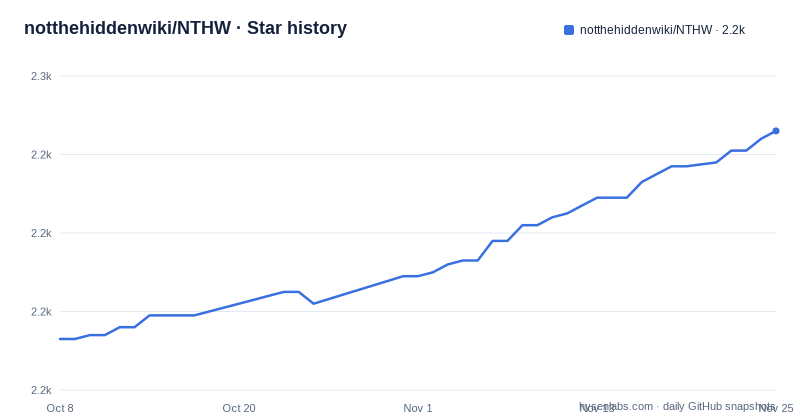
- notthehiddenwiki/NTHW2,246 ★ · +53
| Repository | 2026-10-08 | 2026-11-25 |
|---|---|---|
| notthehiddenwiki/NTHW | 2.2k | 2.2k |
53 Stars in the last 48 days, measured from the daily GitHub snapshot. Compare with other projects
Editorial analysis
The Hidden Wiki name sits on a GitHub repository, not a hidden service
Searches around this project mix its name with onion addresses and phrases like Hidden Wiki 2026. The repository itself is a set of Markdown files on GitHub, on a default branch called nthw, with the homepage at notthehiddenwiki.com. The description calls it the largest repository of links related to cybersecurity, and the README opens with the line that there are already 5497 links on the wiki.
That figure is a hand-written sentence in the README. Nothing in the repository tree shows a script that counts links or checks them, so the number is the maintainer's claim and can drift from the files. A reader who wants to know the true size has to count entries in the topic folders.
The naming matters for safety expectations. A GitHub Markdown index carries none of the risk of browsing an anonymous directory of hidden services, but it also makes no promise about where its outbound links lead.
Each topic folder splits into articles, tools and videos
The top level is a list of subject directories: AI, Academy, Ambassadors, Android, AppSec, Automation, Blue Team, Bug Bounty, CTF Platforms, Collaborations, Computer Networks, Cryptography, DevSecOps, Hardware, Infrastructure, Learning Paths, Misc, Notes, Podcasts, Privacy, Programming, Project Management, Radio Frequency, Red Team and Z3S Links. Inside a topic the pattern repeats. AppSec has articles.md and threats.md. Artificial Intelligence has articles.md, tools.md and videos.md. Automation has the same three.
Blue Team goes one level deeper, with Forensics, KQL, MITRE and Incident Response each carrying their own articles, tools and videos files. The README category list links every one of these files by path.
The structure is useful for browsing and plain to maintain, since adding a link means adding a line to one file. The limit is that it is only a directory listing of other people's content. There is no search inside the repository, and finding a topic means knowing which folder owns it.
Certificate notes cover eight named exams and nothing beyond them
Under Academy, the Certificates folder has a Certificates_List.md and a Notes directory with one Markdown file per exam: OSCP, OSED, OSEP, eJPT, BSCP, CISSP, Comptia Security+ and CBBH. That is the complete set linked from the README. Someone preparing for a different certification will find the list file but no notes for it.
Compliance has its own folder with GDPR.md, NIS2.md, ISO27001.md and other.md, each labeled as links. Courses are split by language into PL.md and EN.md, which reflects the Polish origin hinted at by series names like Hackuj Dobroczynnie in the acknowledgements section.
The notes files are linked, not summarized here, and the README does not describe their depth. Reading OSCP.md is the only way to learn whether it is a page of links or a page of study notes. For a learner, that is a cheap check before building a plan around one file.
Contributions go through an email address and Discord, not pull requests
The README asks contributors to send a list of useful links, which may be tools, publications or recordings, to [email protected] or to write to the maintainer on Discord under @miblak. The repository has a CONTRIBUTING.md file, but the README itself puts email and Discord first. If a category does not exist, the README promises one will be added after contact.
Contributors are thanked in HoF.md, the Hall of Fame, where a nickname can be paired with a social media link or website. A separate acknowledgements.md lists speakers from the Hackuj Dobroczynnie, Not The Hidden Knowledge and Cyber Adwent series, with their social links and recording links.
The consequence of this intake path is a single point of review. Every new link passes through one maintainer inbox, so the quality of the 5497 figure depends on one person's attention, and a stale link will stay until someone reports it. No automated link checker appears among the top-level entries beyond the .github directory, whose contents are not shown.
NTHW-42 Unit offers free penetration testing, and the details sit on another page
A section of the README describes NTHW-42 Unit as an initiative of 20+ cybersecurity specialists providing penetration testing and red team operations free of charge. It frames the offer around regulations such as NIS2 and DORA, arguing that many organizations cannot afford professional security assessments.
The README gives no scope, eligibility rules, turnaround or legal terms. All of that is deferred to a page in the NTHW-42 folder of the repository. An organization considering the offer has to read that page, and has to settle for itself who signs the testing authorization and what happens to findings.
This is also the one part of the project that is a service and not a link list. The README makes a strong claim, enterprise-grade testing at no charge, and it offers no evidence for it beyond the sentence. Treat the NTHW-42 page as the document to read and ask for written terms before any engagement.
Licensing is unasserted and the maintainer disclaims misuse
GitHub reports the license as NOASSERTION. The repository does contain LICENSE.md, but the detector did not match it to a known license, so anyone planning to copy or redistribute the lists has to read that file directly. The code of the repository is not the point here, since the value is the link collection, and reuse of that collection is exactly where an unclear license bites.
The README states that the maintainer is not responsible for using the knowledge provided on the website in an unethical way. That sentence is the whole of the usage guidance. The wiki covers Red Team material alongside Blue Team material, and the disclaimer shifts judgment of intent to the reader.
There are no GitHub releases, so there is no tagged snapshot to pin. The repository is not archived, and the last push was 2026-10-23. Content changes continuously on the nthw branch, and a link that exists today may move tomorrow.
The link browser is a separate project by a community member
For readers who prefer search to folder trees, the README points to Not The Hidden Wiki - Link Browser at notthehiddenwiki.com/search, described as a project created by a member of the community. It is not part of this repository, and the README does not say how often it syncs with the Markdown files.
That gap matters if you use the browser as your source of truth. The Markdown in the nthw branch is what the maintainer edits, and a third-party browser built over it can lag behind or differ in what it indexes. When a result looks wrong, the file in the repository settles it.
Other entry points are the project's LinkedIn, YouTube and Meetup pages, and a Discord server for people who want to submit ideas or new links. Those channels are where discussion lives. The repository also holds gpg.asc and stars.md at the top level, and the README does not explain what either is for.
Editorial conclusion
Use NTHW as a starting index when you want certificate notes, compliance links or Blue Team and Red Team reading lists in one repository. Do not treat it as a vetted source: no link in it is checked by anything you can run, and the license is unasserted. Before relying on a list, open its Markdown file and spot check a handful of links yourself.
Frequently asked questions
Is Hidden Wiki safe, and is NTHW the same thing?
NTHW is a GitHub repository of Markdown link lists on cybersecurity, not a hidden service. Its README disclaims responsibility for unethical use and says nothing about vetting the sites it links to.
What is an example of a non-technical strategy to improve cyber security, according to NTHW?
The README does not answer that directly. Its Academy section includes an Awareness category with articles and videos, and a Compliance folder with GDPR, NIS2 and ISO 27001 links.
How do I add a link to NTHW?
Send the list to [email protected] or message the maintainer on Discord as @miblak. Contributors are added to the Hall of Fame in HoF.md.
Official sources
Add this badge to your README
If you maintain this project, the badge below links readers to this analysis and shows its maintenance status from the daily GitHub snapshot. Paste the markdown into your README; add ?metric=license or ?metric=stars to the image URL for a different field.

[](https://hysenlabs.com/projects/notthehiddenwiki-nthw)Star history chart for your README
[](https://hysenlabs.com/projects/notthehiddenwiki-nthw)Was this useful?