Gamma-World: NVIDIA's Multi-Agent World Model and How to Run It
Implementation of Gamma-World: Generative Multi-Agent World Modeling Beyond Two Players
At a glance
- What is it?
- Gamma-World is a research codebase for generative multi-agent world modeling, released by NVIDIA under Apache-2.0. It ships a training and inference pipeline around a causal multi-agent DiT, with setup, inference and training docs in the repository.
- Who is it for?
- Adopt Gamma-World if you are a research or simulation team with NVIDIA GPUs, a Linux host and the patience to convert a released checkpoint to DCP before training. Do not adopt it if you need a packaged product, a stable API, or CPU-only inference, because the project classifies itself as Beta, targets POSIX Linux and NVIDIA CUDA, and its single runtime dependency is cosmos-oss==0.1.0.
- Can I use it commercially?
- Yes. Apache-2.0 is a permissive licence: you can use, modify and sell software built on it, as long as you keep its copyright and licence notices.
- Is it still maintained?
- Yes. The repository last received commits 158 days ago.
- What is it written in?
- Mainly Python, according to GitHub's language statistics.
Answers come from the project's GitHub data, last synced on November 22, 2026, and from our analysis. They are not legal advice.
Star history
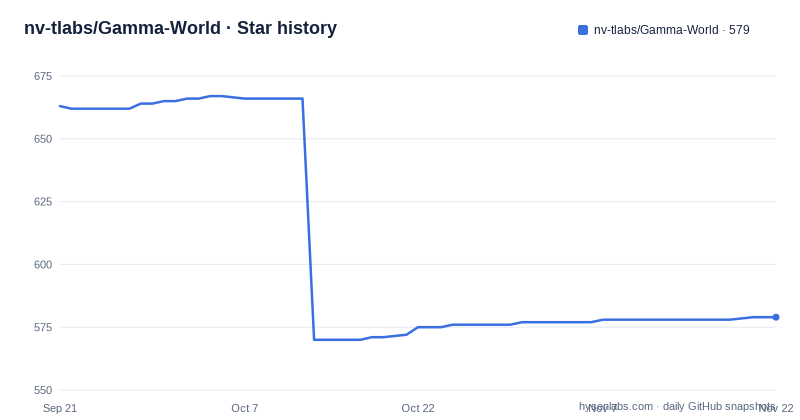
- nv-tlabs/Gamma-World579 ★ · -84
| Repository | 2026-09-21 | 2026-11-22 |
|---|---|---|
| nv-tlabs/Gamma-World | 663 | 579 |
-84 Stars in the last 62 days, measured from the daily GitHub snapshot. Compare with other projects
Editorial analysis
What Gamma-World is for, and who it is aimed at
Most interactive video world models generate the future from one control signal. Gamma-World starts from the opposite assumption: several players, robots or embodied agents act at the same time inside one shared space, and the model has to roll out a single coherent environment for all of them. The README describes the target as multiplayer virtual games and real-world multi-robot environments, which is a narrower audience than general video generation. The intended user is a research team that already has synchronized multi-view observations and per-agent action streams, and wants to train or fine-tune a model that keeps those agents independently controllable while the world stays consistent.
The pyproject classifiers say the same thing in metadata form: Development Status 4 - Beta, Intended Audience Science/Research, Environment GPU NVIDIA CUDA, Operating System POSIX Linux. There is no web service, no CLI shipped for end users, and no released checkpoint documented as a one-line download. This is a code release attached to a paper, and it should be evaluated as such.
Simplex Rotary Agent Encoding and Sparse Hub Attention
The two architectural ideas in the README address agent identity and cross-agent cost, and both are worth understanding before you read the code.
Simplex Rotary Agent Encoding is described as a parameter-free extension of 3D RoPE. Rather than giving each agent a scalar index or a learned identity vector, agents are placed at the vertices of a regular simplex in rotary angle space. Every pair of agents is then at equal pairwise distance, so the encoding is permutation-equivalent, while each agent still gets a distinct rotary phase. The practical consequence stated in the README is that agent identity scales without learned per-slot embeddings and without a fixed agent ordering. That is what the project credits for generalizing from two to four players without additional training.
Sparse Hub Attention attacks the cost of letting every agent attend to every other agent. Learnable hub tokens sit in the middle: agent tokens attend to their own stream and to the hubs, and the hubs aggregate across agents and broadcast back. The README states this reduces cross-agent attention from O(N squared) to O(N). It is a bottleneck by design, and the trade-off is explicit in the name. Whether the hub tokens preserve enough cross-agent detail for your scenario is an empirical question, and the README does not quantify it.
The generation stack is a causal multi-agent DiT that tokenizes each agent stream with shared visual and action encoders. For streaming, a full-context diffusion teacher is distilled into a causal student that produces temporal blocks sequentially with KV caching for past visual tokens and hub states. The README claims 24 FPS rollout for that student. There is no benchmark table in the README, so treat the number as the project's own figure rather than a measured result.
Installing Gamma-World with uv and the CUDA extras
The repository is built around uv, and the justfile wraps the common commands. The install recipe writes a CUDA name to .cuda-name and runs uv sync with the matching extra, so the first thing to decide is whether you are on cu128 or cu130.
The Dockerfile shows the intended base environment: an NVIDIA CUDA devel image on Ubuntu 24.04, with ffmpeg, git, git-lfs and uv pulled in. If you would rather not assemble that yourself, the docker/ directory and the Dockerfile are the reference.
The install path is a single recipe:
just install cu128Running it without an argument uses the default CUDA name, which the justfile sets to cu128 on x86 and cu130 on aarch64. The recipe echoes the name into .cuda-name and then calls uv sync --extra=<name>, so subsequent recipes can pick the same extra back up without you repeating it. The pyproject declares cosmos-oss==0.1.0 as the only runtime dependency, with cosmos-oss[cu128_torch27] and cosmos-oss[cu130_torch29] as the two optional extras, and a [tool.uv] conflicts block that prevents installing both at once.
Once the environment exists, the run recipe executes a command inside it:
just run pythonThat starts an interpreter in the synced environment, which is the cheapest check that the install resolved. There is also a test-install recipe that removes .cuda-name, runs uv sync -q and then attempts to run python without the extra, which the justfile comments say should produce a "CUDA extra not installed" message. Use it if you want to confirm the guard behaves as documented.
The README points to docs/setup.md for environment and dependencies, docs/inference.md for running the bidirectional, causal and causal-few-step models on your own init frames and actions, and docs/training.md for converting a released checkpoint to DCP and training the teacher, causal and DMD stages. Those three files are where the real instructions live; the top-level README is an index.
Where Gamma-World stops being the right tool
The most concrete limitation is the environment contract. The classifiers list Environment GPU NVIDIA CUDA and Operating System POSIX Linux, and the install path is built around a CUDA extra. There is no documented CPU path, no macOS or Windows path, and no mention of a reduced-precision fallback for machines without an NVIDIA GPU. If your evaluation hardware is a laptop or a CI runner without CUDA, this repository is not going to install cleanly.
The second limitation is the checkpoint workflow. The README says training requires converting a released checkpoint to DCP first. That is an extra step between you and a training run, and the README does not describe a reverse conversion or a way to go back to the original format. If you need to move weights between this codebase and another one, check docs/training.md before assuming the path is round-trip.
The third is the scale of the claims relative to the evidence in the README. The 24 FPS figure and the two-to-four player generalization are stated as project results, with the paper linked at arxiv.org/abs/2605.28816 and a PDF in assets/. The README gives no hardware specification next to the FPS number and no benchmark table. Reproducing either claim on your own hardware is a separate project from installing the code.
Finally, the four-agent generalization is described as zero-shot from the simplex encoding. That is a property of the encoding, not a guarantee about your agents. If your agents differ in observation modality, action space or embodiment, the permutation symmetry that helps here may not map onto your setup at all.
How this differs from single-agent world models and game engines
The nearest comparison is a single-agent interactive video world model, the class the README describes as generating future observations from a single control signal. The difference is structural rather than a matter of quality: a single-agent model has no agent axis to encode and no cross-agent attention to pay for, so it can use dense attention without the O(N squared) problem that Sparse Hub Attention exists to solve. If you only ever have one controllable entity, the hub bottleneck is cost you are paying for nothing, and a single-agent model will be simpler to train and to reason about.
A second comparison is a conventional game engine or physics simulator. Those give you exact, deterministic multi-agent state and no learned uncertainty. Gamma-World gives you generated frames, which means the shared world is a sample, not a ground truth, and consistency is something the model is trained to preserve rather than something the architecture guarantees. For a robotics team that needs a planner to trust the next state, that distinction matters: a generative world model is useful for imagination and data augmentation, not as a substitute for a simulator in a control loop.
The repository also depends on cosmos-oss, pinned at 0.1.0. That pin is a real constraint. Whatever that package provides for the environment and dependencies, Gamma-World is written against that exact version, so upgrading it is not a matter of bumping a number without checking the training and inference paths.
Licence, maintenance and the cost of keeping up
The licence is Apache-2.0, declared in pyproject.toml, in the LICENSE file at the repository root, and in the SPDX headers on the source files, which carry Copyright (c) 2025 NVIDIA CORPORATION & AFFILIATES. Apache-2.0 permits commercial use and modification and includes an explicit patent grant. It also requires that you keep the licence and notice files and state significant changes. There is a THIRD_PARTY_NOTICES.md at the top level, and because the runtime dependency is cosmos-oss, that file is the place to look for what else is bundled before you redistribute anything. This is a description of the licence text, not legal advice; your own counsel decides what your distribution needs.
The repository is not archived and the last push was on 2026-06-17. That is roughly three months before this writing, so the project is recent but there is no long history of releases to lean on. The releases list is empty, which means there is no versioned artifact to pin against. Your pin is the commit you clone plus cosmos-oss==0.1.0.
Upgrade cost is dominated by three things: the CUDA extra you chose, the cosmos-oss version, and the checkpoint format. The justfile stores the extra name in .cuda-name, so switching between cu128 and cu130 is a matter of re-running just install with the other argument and a fresh uv sync. The cosmos-oss pin and the DCP conversion step are the parts that will bite during an upgrade, because both sit between your code and the weights. The repository ships pre-commit and pyrefly recipes, so if you contribute back, just lint and just pyrefly are the local gates to run first.
Editorial conclusion
Adopt Gamma-World if you are a research or simulation team with NVIDIA GPUs, a Linux host and the patience to convert a released checkpoint to DCP before training. Do not adopt it if you need a packaged product, a stable API, or CPU-only inference, because the project classifies itself as Beta, targets POSIX Linux and NVIDIA CUDA, and its single runtime dependency is cosmos-oss==0.1.0. Before committing, verify that docs/setup.md matches your driver and CUDA combination, that the cu128 or cu130 extra resolves for your machine, and that the checkpoint conversion step in docs/training.md produces the DCP layout the training entry points expect.
Frequently asked questions
What is Gamma-World?
It is a generative multi-agent world model from NVIDIA that rolls out a single shared environment for multiple independently controllable agents. The repository contains the code and training pipeline for the method described in the linked paper.
How do I install Gamma-World?
The repository uses uv, and the justfile wraps the install. Running just install cu128 writes cu128 to .cuda-name and runs uv sync --extra=cu128; on aarch64 the default CUDA name is cu130. The README points to docs/setup.md for environment and dependencies.
Does Gamma-World support more than two players?
The README states that the permutation-symmetric simplex agent encoding lets the model generalize from two to four players without additional training. That generalization is presented as a property of the encoding rather than a guarantee for arbitrary agent configurations.
Can I train Gamma-World from a released checkpoint?
Yes, but the README says the checkpoint must first be converted to DCP. docs/training.md covers that conversion and the teacher, causal and DMD training stages.
What Python version and platform does Gamma-World require?
pyproject.toml sets requires-python to >=3.10 and the classifiers list POSIX Linux with an NVIDIA CUDA environment. There is no documented CPU or non-Linux install path.
Official sources
Add this badge to your README
If you maintain this project, the badge below links readers to this analysis and shows its maintenance status from the daily GitHub snapshot. Paste the markdown into your README; add ?metric=license or ?metric=stars to the image URL for a different field.

[](https://hysenlabs.com/projects/nv-tlabs-gamma-world)Star history chart for your README
[](https://hysenlabs.com/projects/nv-tlabs-gamma-world)Was this useful?