OpenGOAL's jak-project: a decompiler and compiler that rebuild Jak and Daxter for x86-64 PCs
Reviving the language that brought us the Jak & Daxter Series
At a glance
- What is it?
- open-goal/jak-project ports the original Jak and Daxter trilogy to PC by decompiling the game's GOAL code and recompiling it natively. It ships no game assets, so you need your own PS2 disc, and the GitHub repository is aimed at developers rather than players.
- Who is it for?
- Use this repository if you want to build, modify or contribute to the Jak 1, 2 and 3 port from source and you own a PAL, NTSC or NTSC-J PS2 copy. If you only want to play, start from the project website and its video guide instead of the GitHub repository.
- Can I use it commercially?
- Yes. ISC is a permissive licence: you can use, modify and sell software built on it, as long as you keep its copyright and licence notices.
- Is it still maintained?
- Yes. The repository last received commits 1 day ago.
- What is it written in?
- Mainly Common Lisp, according to GitHub's language statistics.
Answers come from the project's GitHub data, last synced on November 15, 2026, and from our analysis. They are not legal advice.
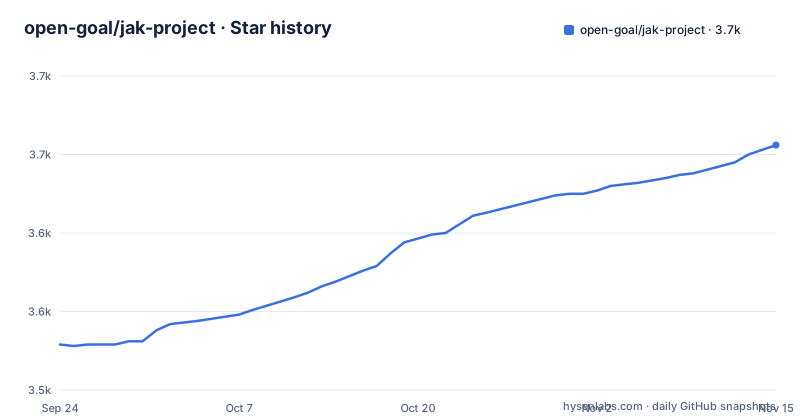
Star history
- open-goal/jak-project3,656 ★ · +127
| Repository | 2026-09-24 | 2026-11-15 |
|---|---|---|
| open-goal/jak-project | 3.5k | 3.7k |
127 Stars in the last 52 days, measured from the daily GitHub snapshot. Compare with other projects
Editorial analysis
The GitHub repository is for development, and the README says end users should look elsewhere
The first thing the README does is warn that the repositories on GitHub are for development of the project and tracking active issues. Most of the information there is about setting up the project for development and is not relevant to the end user. For installing and playing, it points to a video guide, a Discord server and the main website at opengoal.dev, where frequently asked questions are answered.
The consequence is that someone who clones the repository expecting a ready-made game launcher will find a C++ and Lisp source tree with a Taskfile.yml, CMake presets and top-level folders such as decompiler, goalc, goal_src, game and test. Reading the rest of the README as a player's install guide would send you down a build-from-source path that you did not need.
OpenGOAL contains no game assets, and only the PS2 releases will work
A warning in the README says not to use the decompilation project without your own legally purchased copy of the game. OpenGOAL does not include any assets from the original games, so you must provide your own legitimately obtained PS2 copy. It supports every retail PAL, NTSC and NTSC-J build, including Greatest Hits copies.
The limit is explicit: later releases on PS3, PS4 and PS5 are not supported. If your only copy of the trilogy is one of those re-releases, you cannot feed it to the extractor. You also need to get the disc contents out as an ISO and place them in the right folder yourself, which the build steps below describe.
Jak 1 is finished, Jak 2 is in beta, and Jak 3 has a good amount of work left
The status section is specific about each game. Jak 1 has been considered in a polished, complete state for years. Jak 2 is considered beta because of a few known issues that need fixing, though to the casual user the game is essentially complete. Jak 3 has a good amount of work left to do.
So the three games are not equal choices. If you want the smoothest run, Jak 1 is the one the maintainers consider done. If you play Jak 2, expect rough edges in places the maintainers already know about. Jak 3 is a game you would be trying out in unfinished form, and the README gives no schedule for finishing it.
The decompiler needs hand-written type casts before its output compiles
The decompiler processes GOAL code and unpacks game assets. The workflow is manual: contributors specify function types and the locations where they believe the original code had type casts, or where casts feel appropriate, and repeat until decompilation succeeds. Then they clean up the output by adding comments and adjusting formatting, and save it in goal_src/.
The decompiler is built specifically for the output of the original GOAL compiler. Because of that, given correct casts it often produces code that can be fed straight into a compiler and works, and that is continually tested as part of the unit tests. The catch is the word often. Some functions still need human work, which is why porting progress follows the status above game by game rather than arriving all at once.
The port targets x86-64 only, with macOS covered through Rosetta translation
The README states the current support: x86_64 on Windows, Linux and macOS, where macOS runs through Rosetta translation. It also says there are no plans to ever make a mobile release.
This closes off two groups of readers. Anyone hoping for an Android or iPhone build will not find one planned. And on Apple Silicon Macs the game depends on the translation layer rather than a native arm64 build. The stated goal is a native application on x86-64 with high performance: it should not be emulated, interpreted or transpiled.
Getting from ISO to a running game takes four steps driven by task commands
The README lists four main steps: build the C++ tools, extract assets from the game, build the game, and run it. Extraction starts by telling the tooling which game and version you use. For the black label version of Jak 1:
task set-game-jak1
task set-decomp-ntscv1 # or for example for PAL, `task set-decomp-pal`
The README adds that `task --list` shows the other options. Next you extract your ISO file contents into the matching iso_data folder, which for Jak 1 is iso_data/jak1. Then, from a terminal in the jak-project folder:
task extractBuilding the game uses the GOAL compiler in a REPL:
task replThe prompt greets you with the OpenGOAL banner and tells you to run (repl-help) for help and (lt) to connect to the local target.
Compiler goals include live code changes and speed near unoptimized C
The objectives list is concrete about what the custom compiler should do. Its performance should be around the same as unoptimized C. It should match the original game and its development where possible: since the original GOAL compiler supported live modification of code while the game is running, this one does as well, even though a pure port would not need it. And it should support modifications, so that editing the code does not break everything else.
The tradeoff is that the project carries a full compiler and a REPL that connects to the running game, not just a one-off conversion of the code, so the build is more involved than a plain port.
Releases reach v0.3.9, and the last push was 31 October 2026
The most recent releases are v0.3.9 on 15 October 2026, v0.3.8 on 20 September 2026 and v0.3.6 on 25 August 2026. The last push to the repository was on 31 October 2026, and it is not archived. The project is licensed under ISC.
Version numbers below 1.0 and a roughly monthly release rhythm fit the status section: this is a working port with parts still in progress. The repository also contains custom_assets, lsp and tools folders and an AI_POLICY.md file, which are worth reading if you plan to contribute.
Editorial conclusion
Use this repository if you want to build, modify or contribute to the Jak 1, 2 and 3 port from source and you own a PAL, NTSC or NTSC-J PS2 copy. If you only want to play, start from the project website and its video guide instead of the GitHub repository. Do not expect Jak 3 to be finished, and do not expect an Android, mobile or PS3/PS4/PS5 path.
Frequently asked questions
Is Jak 2 supported by the OpenGOAL jak-project?
Yes. The README considers Jak 2 to be in beta because of a few known issues, but says the game is essentially complete to the casual user. Jak 1 is complete and Jak 3 still has a good amount of work left.
Does the jak-project include the original Jak and Daxter game files?
No. OpenGOAL includes no assets from the original games, so you must provide your own legally obtained PS2 copy in a retail PAL, NTSC or NTSC-J build.
Which platforms does the jak-project run on?
It supports x86_64 on Windows, Linux and macOS, with macOS running via Rosetta translation. The README says there are no plans to ever make a mobile release.
Official sources
Add this badge to your README
If you maintain this project, the badge below links readers to this analysis and shows its maintenance status from the daily GitHub snapshot. Paste the markdown into your README; add ?metric=license or ?metric=stars to the image URL for a different field.

[](https://hysenlabs.com/projects/open-goal-jak-project)Star history chart for your README
[](https://hysenlabs.com/projects/open-goal-jak-project)Was this useful?