CPM-Live promised a downloadable model and never recorded finishing one
Live Training for Open-source Big Models
At a glance
- What is it?
- A project that trained a 10B model in public with live metrics and daily logs, then iterated through two bilingual models and a smaller one. The news feed stops in May 2023, the milestone table has no entry for the model the repository is named after, and no licence is recorded anywhere.
- Who is it for?
- Treat this as an archive of a specific and unusual experiment rather than as a source of weights. What it documents is valuable: a 10B model trained with public metrics, a daily log release commitment, and two intermediate bilingual models that were genuinely useful and did land in a mainstream transformers release.
- Can I use it commercially?
- Not without permission. GitHub finds no licence file in the repository, and without a licence all rights are reserved by default: you may read the code but not reuse it. Check the README, or ask the authors, before using it.
- Is it still maintained?
- Yes. The repository last received commits 131 days ago.
- What is it written in?
- Mainly Python, according to GitHub's language statistics.
Answers come from the project's GitHub data, last synced on November 15, 2026, and from our analysis. They are not legal advice.
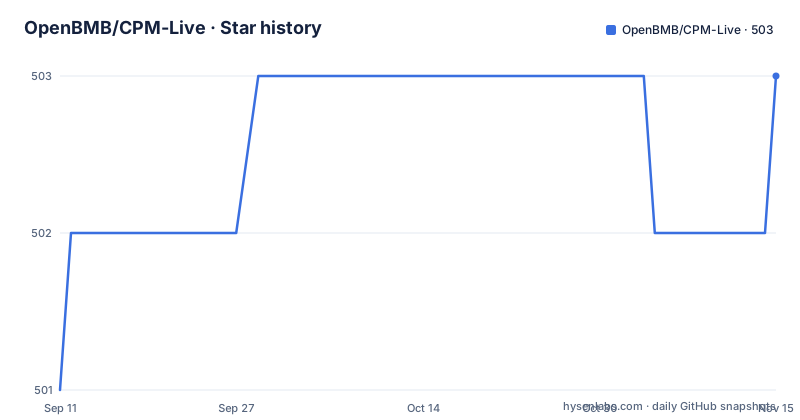
Star history
- OpenBMB/CPM-Live503 ★ · +2
| Repository | 2026-09-11 | 2026-11-15 |
|---|---|---|
| OpenBMB/CPM-Live | 501 | 503 |
2 Stars in the last 65 days, measured from the daily GitHub snapshot. Compare with other projects
Editorial analysis
The news feed stops in May 2023 while commits run to July 2026
The page is built around the idea of liveness: real-time training metrics, a training log released every day, community feedback handled weekly, checkpoints dropped at irregular intervals. The dated news list at the top, though, tells a different story. Its six entries run from May 2022 to a final line announcing the smaller model's release on 27 May 2023. The default branch's last push is dated 7 July 2026, so roughly three years of commits produced no new entry in a feed whose entire purpose is to announce them. That is not a maintenance judgement, because recent commits say nothing about whether the work matters. It does mean the front page is not a reliable index of what the repository currently contains, and that anything after May 2023 has to be discovered by reading the repository rather than the readme.
The model this repository is named after has no milestone entry
Three milestones are listed, and the names are CPM-Ant, CPM-Ant-plus, and CPM-Bee, each with a date range. CPM-Ant runs from late May to early August 2022, the plus variant from early August to mid-October, and the smaller model from mid-October through May 2023. Three models, sequential to the day, each following the last by a single day. None of them is the model the project set out to build. The training plan states plainly that the project would start with a 10B model, and the page is titled for that effort, but there is no milestone for it, no completion date, and no announcement anywhere in the news list. The three models that did get milestone entries are all smaller successors. A reader arriving for the 10B model finds a record of everything that happened after it.
The download promise is conditional on a completion nobody reported
The most concrete promise on the page is in the resources section, and it has the structure of an if-then that never resolves. The text says that once training is complete, the model parameters are free to download under an open licence, and that the licence includes permission for commercialisation. Then it adds that with compression and acceleration tools you can run large models on your own machine, without naming either. So the commercial permission everyone cites from this project is contingent on a completion that the milestone table omits and the news list never announces. The two models that did ship have their own checkpoint links, which are the concrete artefacts, and the smaller of them has since moved to its own repository. The flagship parameters are the part that is promised and unaccounted for.
No licence file, no recorded licence, and a promise about parameters
The repository records no licence, and there is no licence file in its root. That is worth separating carefully from what the readme claims, because the claim is narrower than a code licence and the absence is consistent with it. The readme promises an open licence for the model parameters that permits commercialisation; it never promises a licence for the training code, and the root has no licence file to match one. So the two facts do not contradict each other, and this is not a case where a repository forgot to add a file next to a licence badge. It is a case where the only licence statement in the project is written in the future tense about artefacts that were never published. Anyone planning commercial use has to satisfy that question outside this repository.
Each model lives on its own branch, and two release dates disagree
The code and model links for the two intermediate bilingual models do not point at the default branch. Each points into a directory on a branch named after the model, with checkpoints expected at a path inside it. The smaller model has moved to a separate repository of its own. That layout means the default branch holds none of the three shipped models, and anyone browsing the repository's main branch sees a code directory and a plans directory rather than a model. There is also a date conflict between the two lists on the page. The news list says the first bilingual model was released on 16 September 2022, but the milestone table gives its run as ending on 5 August 2022, which puts that announcement inside the next model's window instead.
Proposals could join the model mid-training, with no rule stated
The most interesting governance idea on the page is also the vaguest. Anyone can put forward a proposal about architecture, training method or data sources, and the text commits that if a proposal gathers enough support and is practically feasible, the team will add it to the model currently being trained, on the stated logic that the model can learn continuously with help from everyone. Three things are left undefined. What counts as enough support, who judges feasibility, and how a text proposal becomes part of a training run that has already started. If any of those were settled, the answer would say so, and the practical reading is that it remains a statement of intent about a training process rather than a mechanism you could rely on. The parallel offer about submitted applications is similarly unquantified, promising to show the most popular on the website with no stated measure of popularity.
Five entries at the root, one of which is a log directory
The whole repository is small enough to describe exactly. There is a Chinese readme beside the English one, a code directory whose name matches the subdirectory used on each model branch, a plans directory holding the training plan documents, and a logs directory. That last one is the interesting entry, because the daily-log commitment is what the liveness pitch rests on, and a committed logs directory is the physical evidence of it. There is no requirements file, no package manifest, no test directory and no build configuration, so the Python in this repository is research code you read rather than a project you install. The plans directory holds its documents under Chinese filenames, and the readme links to one of them by its Chinese name, so the navigation and the filesystem are consistent in language even where a reader following a link has to percent-encode it.
Editorial conclusion
Treat this as an archive of a specific and unusual experiment rather than as a source of weights. What it documents is valuable: a 10B model trained with public metrics, a daily log release commitment, and two intermediate bilingual models that were genuinely useful and did land in a mainstream transformers release. What it cannot give you is the flagship model, because the page never records that training finishing, and the download promise is written in the conditional. If you want the intermediate models, use the branch links, and note that they are the ones with recorded end dates. Read the licence question yourself before using anything here commercially, since the repository records none and the readme's promise is attached to parameters rather than to code.
Frequently asked questions
What is OpenBMB CPM-Live?
A project to train a large language model in public. It published a training plan, trained a 10B model with public metrics, daily logs and downloadable checkpoints, and then produced two intermediate bilingual models and a smaller one that now lives in its own repository.
Can I download the CPM-Live model weights?
The README promises the parameters are free to download under an open licence that permits commercialisation, but the promise is written as conditional on training being complete, and no completion is recorded. The repository root holds no licence file and no licence is recorded against it.
Which CPM-Live models were actually released?
Three, each with a recorded date range: a bilingual model from May to August 2022, a plus variant from August to October 2022, and a smaller model from October 2022 to May 2023. The first two live on branches of this repository and the third has its own repository.
How do I install or run the CPM-Live training code?
The README contains no installation or run instructions, and the repository has no requirements file, package manifest or test directory. The page links to a training plan document and to wiki pages on the community discussions instead.
Official sources
Add this badge to your README
If you maintain this project, the badge below links readers to this analysis and shows its maintenance status from the daily GitHub snapshot. Paste the markdown into your README; add ?metric=license or ?metric=stars to the image URL for a different field.

[](https://hysenlabs.com/projects/openbmb-cpm-live)Star history chart for your README
[](https://hysenlabs.com/projects/openbmb-cpm-live)Was this useful?