OpenMVG splits reconstruction into libraries, binaries and chained pipelines
open Multiple View Geometry library. Basis for 3D computer vision and Structure from Motion.
At a glance
- What is it?
- OpenMVG is a C++ framework for image-based 3D reconstruction that ends at a sparse structure-from-motion result and hands dense work to another project. This looks at how the three layers fit, what the container build actually does, and where the tags and the default branch disagree.
- Who is it for?
- OpenMVG is a good fit when you want readable C++ implementations of camera geometry and structure from motion, or when you need the sparse scene exported into another framework, and the layered design makes the second case easy. It is a poor fit if you need dense point clouds from this repository alone, or if your build system expects a tagged release, because v2.1 dates from 2023-12-28 while the default branch develop took a push on 2026-08-30.
- Can I use it commercially?
- Yes, with conditions. MPL-2.0 is a weak copyleft licence: you can use it inside commercial and closed-source software, but if you distribute changes to its own files, you must publish those changes under the same licence.
- Is it still maintained?
- Yes. The repository last received commits 7 days ago.
- What is it written in?
- Mainly C++, according to GitHub's language statistics.
Answers come from the project's GitHub data, last synced on November 14, 2026, and from our analysis. They are not legal advice.
Star history
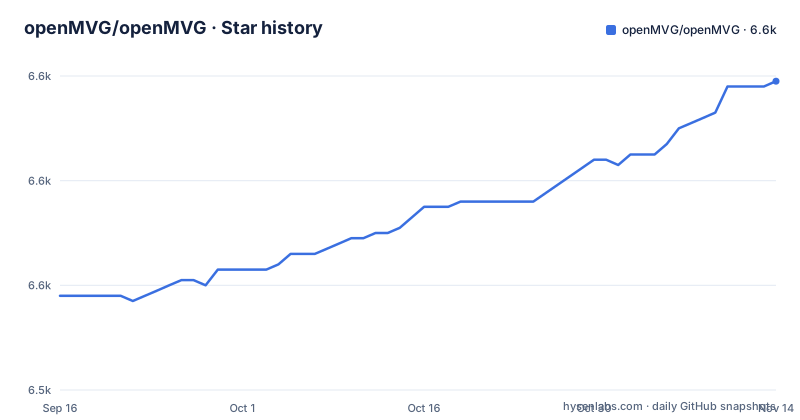
- openMVG/openMVG6,599 ★ · +41
| Repository | 2026-09-16 | 2026-11-14 |
|---|---|---|
| openMVG/openMVG | 6.6k | 6.6k |
41 Stars in the last 59 days, measured from the daily GitHub snapshot. Compare with other projects
Editorial analysis
Libraries, binaries and pipelines are three different things
OpenMVG is written in C++ and describes itself as an end-to-end 3D reconstruction framework from images, compounded of libraries, binaries and pipelines. The three carry different costs for whoever adopts it.
The libraries are the readable part: image manipulation, feature description and matching, feature tracking, camera models, multiple-view geometry, robust estimation and structure-from-motion algorithms. The binaries solve unit tasks a pipeline might require: scene initialization, feature detection and matching, and SfM reconstruction. The pipelines are not separate programs. They are the binaries chained together to compute image matching relations and then solve reconstruction, triangulation and localization.
The mission statement is narrow, extending awareness of 3D reconstruction from images through a C++ framework, and the credo underneath it is one line: keep it simple, keep it maintainable. The project states it runs on Android, iOS, Linux, macOS and Windows.
The container build is the only step-by-step install path in the tree
There is no command block in the README. The README links `BUILD.md` as its local/docker build tutorial, and the `Dockerfile` spells out a complete container build. It starts from `ubuntu:jammy`, with a comment noting Ubuntu 22.04 support until April 2027, then installs cmake, build-essential, graphviz, git, `coinor-libclp-dev`, `libceres-dev`, `liblemon-dev`, `libjpeg-dev`, `libpng-dev`, `libtiff-dev` and python3. It copies the source to `/opt/openMVG`, initialises submodules, and configures from `src/`:
RUN mkdir /opt/openMVG_Build; \
  cd /opt/openMVG_Build; \
  cmake -DCMAKE_BUILD_TYPE=RELEASE \
    -DCMAKE_INSTALL_PREFIX="/opt/openMVG_Build/install" \
    -DOpenMVG_BUILD_TESTS=ON \
    -DOpenMVG_BUILD_EXAMPLES=OFF \
    -DCOINUTILS_INCLUDE_DIR_HINTS=/usr/include \
    -DLEMON_INCLUDE_DIR_HINTS=/usr/include/lemon \
    -DCLP_INCLUDE_DIR_HINTS=/usr/include \
    -DOSI_INCLUDE_DIR_HINTS=/usr/include \
    ../openMVG/src; \
  make -j 4;
The last line runs the suite and installs, and the image had already put that install prefix on `PATH`:
RUN cd /opt/openMVG_Build && make test && make install;Submodules decide whether your tree configures at all
`.gitmodules` sits in the root, and the container build treats its contents as a required step rather than an optional convenience. Immediately after `ADD. /opt/openMVG` it runs:
RUN cd /opt/openMVG && git submodule update --init --recursiveA clone that skipped the recursive step hands CMake a source tree with unfilled submodule directories, and the failure appears at configure time rather than at the git step. The README does not name which submodules the build expects or what each one contains.
Two more files sit alongside `BUILD.md` for people arriving with their own build system. `CONTRIBUTING.md` is the contribution path, and the tutorial section links straight into `BUILD.md` for using OpenMVG as a third-party library dependency with CMake. The root also carries `pixi.toml` and `pixi.lock`, and neither file is mentioned in the README.
CMake is pointed at system CLP, LEMON and OSI copies
Four of the configure flags are include-directory hints, and they are the interesting part of the build: `-DCOINUTILS_INCLUDE_DIR_HINTS=/usr/include`, `-DLEMON_INCLUDE_DIR_HINTS=/usr/include/lemon`, `-DCLP_INCLUDE_DIR_HINTS=/usr/include` and `-DOSI_INCLUDE_DIR_HINTS=/usr/include`. Three of the four point at the same directory, so the image expects system packages for the Coin-OR and LEMON stack rather than vendored copies, and a self-hosted build has to reproduce that arrangement.
The remaining two flags decide what you get. `-DOpenMVG_BUILD_TESTS=ON` builds the test suite, which is why `make test` can run inside the image. `-DOpenMVG_BUILD_EXAMPLES=OFF` leaves the examples out, so the container is a runtime image for the installed binaries, not a place to browse sample code.
One detail is worth copying if you build by hand: the container caps parallelism at `make -j 4`. That is a container-friendly number, not a statement about your hardware.
The newest tag is from December 2023, and develop has moved since
Three releases are visible, and each is named after a fish: v1.6 Halibut on 2020-05-13, v2.0 Rainbow Trout on 2021-10-20 and v2.1 Sablefish on 2023-12-28. The repository is not archived, and the last push to the default branch `develop` landed on 2026-08-30. The gap is the fact that matters: work has continued on the branch for roughly two and a half years after the most recent tag, so a pin on v2.1 pins December 2023 code.
The README's own links show how easily that split gets missed. The licence and the docker build tutorial point at `blob/master`, while the tutorial for using OpenMVG as a library points at `blob/develop`. The default branch is `develop`, so part of the documentation describes a branch that is not where new work lands.
Nothing here says the project is stalled. It says the tags and the branch tell you different things, which is the part an integrator has to resolve.
Quality gates live in CI configs, not in the library
The repository carries its own review apparatus at the root: `.coveralls.yml` for coverage, a CodeQL workflow named `codeql.yml`, and `.lgtm.yml`. A continuous integration workflow named `compile_and_run_test.yml` covers Linux, macOS and Windows, matching the claim that the framework runs on those systems. The README's credibility argument ties to this: strict test-driven development and samples are named as the reason the library can be trusted inside larger systems.
Documentation splits in two. API reference lives outside the repository at `openmvg.readthedocs.org`, while the tutorials live in the project wiki, with pages for the OpenMVG data structure, using OpenMVG as a library, and running OpenMVG on your own image dataset. The `docs/` and `logo/` directories sit at the root next to them.
The licence is MPL-2.0. For a C++ library consumed as source or as a build dependency, that is a file-level copyleft, so check how you vendor it before shipping it inside a closed product.
OpenMVG stops at sparse points, and the dense half is a second project
The clearest limit is in the README's own description of the binaries. They can export the reconstructed scene to another multiple-view stereovision framework in order to compute dense point clouds or textured meshes. Dense reconstruction is therefore somebody else's job in this arrangement, and the root file list has no viewer application or depth-estimation tool to fill the gap.
OpenMVS is the framework that pairing usually means, and the difference is one of scope rather than quality: OpenMVG owns image matching, camera geometry and the sparse point cloud, and the partner project consumes that scene to produce depth and meshes.
If your goal is a textured mesh from images, budget for two build trees, two sets of dependencies and one conversion step. If your goal is to read, modify or reuse the geometry code itself, that split costs you nothing.
Editorial conclusion
OpenMVG is a good fit when you want readable C++ implementations of camera geometry and structure from motion, or when you need the sparse scene exported into another framework, and the layered design makes the second case easy. It is a poor fit if you need dense point clouds from this repository alone, or if your build system expects a tagged release, because v2.1 dates from 2023-12-28 while the default branch develop took a push on 2026-08-30. Before you pin anything, check that `git submodule update --init --recursive` runs on your clone, since the container build treats it as a required step.
Frequently asked questions
How do I use OpenMVG?
The README routes usage through the wiki and the build guide: a page on the OpenMVG data structure, a page on running OpenMVG on your own image dataset, and `BUILD.md` for using it as a third-party library dependency with CMake. Its binaries cover scene initialization, feature detection and matching, and structure-from-motion reconstruction.
OpenMVS vs OpenMVG: which one do I need?
OpenMVG's binaries end at the sparse structure-from-motion reconstruction and can export the scene to another multiple-view stereovision framework to compute dense point clouds or textured meshes. Dense reconstruction is not part of this repository, so a full photogrammetry run pairs OpenMVG with a second project.
How do I build OpenMVG?
The `Dockerfile` lists a complete container build: install cmake, build-essential, graphviz, git, coinor-libclp-dev, libceres-dev, liblemon-dev, libjpeg-dev, libpng-dev, libtiff-dev and python3 on ubuntu:jammy, copy the source to `/opt/openMVG`, run `git submodule update --init --recursive`, then configure with cmake and build with make. The README links `BUILD.md` as the local/docker build tutorial.
Which platforms does OpenMVG run on?
The README states Android, iOS, Linux, macOS and Windows, and the continuous integration workflow `compile_and_run_test.yml` covers Linux, macOS and Windows. The project is licensed MPL-2.0.
Official sources
Add this badge to your README
If you maintain this project, the badge below links readers to this analysis and shows its maintenance status from the daily GitHub snapshot. Paste the markdown into your README; add ?metric=license or ?metric=stars to the image URL for a different field.

[](https://hysenlabs.com/projects/openmvg-openmvg)Star history chart for your README
[](https://hysenlabs.com/projects/openmvg-openmvg)Was this useful?