AI Research Skills by Orchestra Research: 98 claimed, 90 in the table, one router underneath
Comprehensive open-source library of AI research and engineering skills for any AI model. Package the skills and your claude code/codex/gemini agent will be an AI research agent with full horsepower. Maintained by Orchestra Research.
At a glance
- What is it?
- The library ships 23 category folders of Markdown skills that a coding agent can load, installed into a shared home directory rather than your project. The interesting parts are the arithmetic in its own inventory, the one-skill orchestrator everything else hangs off, and what a single npm command puts on your disk.
- Who is it for?
- Use this library if you want your agent to carry domain notes on Megatron, vLLM, TRL, Axolotl and NeMo Curator without writing them yourself, and if you are willing to have those skills installed into a home directory shared by every project you open.
- Can I use it commercially?
- Yes. MIT is a permissive licence: you can use, modify and sell software built on it, as long as you keep its copyright and licence notices.
- Is it still maintained?
- Yes. The repository last received commits 34 days ago.
- What is it written in?
- Mainly TeX, according to GitHub's language statistics.
Answers come from the project's GitHub data, last synced on November 13, 2026, and from our analysis. They are not legal advice.
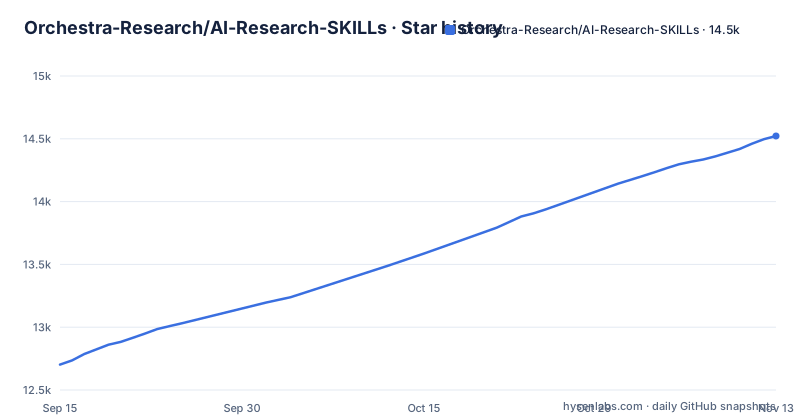
Star history
- Orchestra-Research/AI-Research-SKILLs14,522 ★ · +1,820
| Repository | 2026-09-15 | 2026-11-13 |
|---|---|---|
| Orchestra-Research/AI-Research-SKILLs | 12.7k | 14.5k |
1,820 Stars in the last 59 days, measured from the daily GitHub snapshot. Compare with other projects
Editorial analysis
The headline says 98 skills, the category counts add up to 90
The banner and the category table do not agree. The table title reads All 23 Categories (98 Skills), and the closing line of the install section repeats that this installs all 98 skills. Adding the Skills column across all 23 rows gives 90: Post-Training 8, Multimodal 7, Distributed 6, Optimization 6, Emerging Techniques 6, Model Architecture 5, RAG 5, and the rest between 1 and 4.
Eight skills are unaccounted for, and neither the banner nor the table says which eight. The practical effect lands on you at install time: the installer offers everything, a quickstart bundle, whole categories or individual skills, and you cannot tell from the table which individual names exist.
Skills land in ~/.orchestra/skills, not in the repository you are working on
The installer writes to your home directory and links from there.
npx @orchestra-research/ai-research-skillsIt auto-detects which coding agents you have installed, named as Claude Code, Hermes Agent, OpenCode, Qoder, Cursor and Gemini CLI, then installs the skills to ~/.orchestra/skills/ with symlinks pointing each agent at that directory. On Windows it falls back to copying instead of symlinking, so the two platforms update differently. The agent-driven route is a single instruction to your assistant:
Read https://www.orchestra-research.com/ai-research-skills/welcome.md and follow the instructions to install and use AI Research Skills.Because the location is your home directory and not your project, a skill you install is visible to every repository you open on that machine.
The root package.json is not the manifest of the package you install
Compare what you type with what the repository declares.
{
  "name": "ai-research-skills",
  "version": "1.0.1",
  "license": "ISC",
  "main": "index.js",
  "directories": { "doc": "docs" },
  "scripts": { "test": "echo \"Error: no test specified\" && exit 1" }
}
The install command is scoped, npx @orchestra-research/ai-research-skills, while the manifest at the root of this repository declares an unscoped name. It carries version 1.0.1 against tagged releases that reach v1.7.2, and it declares ISC while the repository itself is under MIT. The repository does contain packages/ and scripts/ directories that the manifest does not reference.
Do not read the root manifest as the identity of the installed package. Check the published package on npm for the version and license you actually get.
The only npm script is a test command that exits 1
There is no test suite to run. The single entry under scripts is a placeholder that echoes an error and fails the command, so anyone who reaches for npm test after cloning gets a non-zero exit rather than a signal. With nothing automated to check it, the quality claim in the README rests on where the documentation came from: official repositories, real GitHub issues and production workflows. That is a statement about sourcing, and it is not something a test would have caught either way.
What the release history does show is attention to the inventory itself. v1.7.1 on 2026-06-15 is titled Inventory Consistency, Drift Guard and Security Hardening, and v1.7.2 on 2026-06-16 adds Qoder Agent Support. The last push landed on 2026-10-11, and v1.4.0, which introduced autoresearch, dates from 2026-03-16.
One autoresearch skill routes to every other skill, and routing is the whole design
The category table gives Autoresearch a count of 1 and describes it as the central layer that manages the full lifecycle and routes to all other skills. Its architecture is two-loop, and the README states plainly that it orchestrates the entire research workflow, routing to domain skills as needed. The install step that pulls in the whole library also loads this orchestration layer.
That design makes your agent's behavior depend on a dispatch decision made before any domain knowledge is in context. If you only need one leaf skill, installing everything and relying on the router to find it is a different bet than installing a single category, and the installer supports both.
Two install mechanisms write into the same agents, and their overlap is undocumented
The npm path installs everything or a bundle, while the Claude Code marketplace installs category by category.
/plugin marketplace add orchestra-research/AI-research-SKILLs
/plugin install fine-tuning@ai-research-skills
/plugin install post-training@ai-research-skills
/plugin install inference-serving@ai-research-skills
/plugin install distributed-training@ai-research-skills
/plugin install optimization@ai-research-skills
These two paths are not interchangeable. The npm installer symlinks from ~/.orchestra/skills, while the marketplace installs categories through the Claude Code CLI, and the underlying names differ: the marketplace category inference-serving corresponds to the table category named Inference.
The README lists maintenance commands for the npm side.
npx @orchestra-research/ai-research-skills list
npx @orchestra-research/ai-research-skills update
The inventory is deep in training work and thin in data and monitoring
Category counts tell you what the library actually covers. Post-Training has 8 skills covering TRL, GRPO, OpenRLHF, SimPO, verl, slime, miles and torchforge. Multimodal has 7. Distributed has 6 across DeepSpeed, FSDP, Accelerate, Megatron-Core, Lightning and Ray Train, Optimization has 6 across Flash Attention, bitsandbytes, GPTQ, AWQ, HQQ and GGUF, and Emerging Techniques has 6. By contrast, Tokenization and Data Processing have 2 each, Observability has 2, and Autoresearch has 1.
If your bottleneck is curating data with NeMo Curator or Ray Data, or reading traces out of a training run, this library gives you two skills to start and no deeper bench. If your bottleneck is a distributed post-training run or a quantized inference stack, the coverage is the reason to look. The paper-writing side is two skills, one covering LaTeX templates with citation verification and one covering academic plotting.
Twenty-three numbered folders are the router's index, not a naming convention
The layout is a contract. Directories run from 0-autoresearch-skill/ through 22-agent-native-research-artifact/, with each number matching a row of the category table: 03-fine-tuning/, 06-post-training/, 08-distributed-training/, 12-inference-serving/, 15-rag/, 20-ml-paper-writing/, 21-research-ideation/. Autoresearch sits at 0 because it is the entry point rather than one peer among many.
Alongside the numbered folders sit CLAUDE.md, CONTRIBUTING.md, WELCOME.md, CITATION.cff and an anthropic_official_docs/ directory, plus demos/, dev_data/, docs/, packages/, scripts/, video-promo/ and .claude-plugin/. WELCOME.md is the document the agent-driven install points at, so it is part of the install path and not just onboarding reading.
Editorial conclusion
Use this library if you want your agent to carry domain notes on Megatron, vLLM, TRL, Axolotl and NeMo Curator without writing them yourself, and if you are willing to have those skills installed into a home directory shared by every project you open. Do not expect an audited package: the root manifest carries an ISC license, an unscoped name and version 1.0.1, against the repository's MIT license, the scoped install command and releases up to v1.7.2, and the test script exits 1. Before you install, run the list command to see what is already in ~/.orchestra/skills, and decide whether the single autoresearch router is enough to reach the category you actually need.
Frequently asked questions
What are the Claude Researcher skills?
This library targets Claude Code among others. The installer auto-detects Claude Code, Hermes Agent, OpenCode, Qoder, Cursor and Gemini CLI, and a separate path adds a Claude Code marketplace with `/plugin marketplace add orchestra-research/AI-research-SKILLs` followed by `/plugin install` for one category at a time.
What exactly is AI research?
The project defines its scope as agents conducting AI research from literature survey and idea generation through experiment execution to paper writing. It splits that into a research orchestration layer, covering autoresearch, ideation and paper writing, and the engineering skills for training, evaluation and deployment at each stage.
What is an example of an AI skill?
Skills are grouped by framework, so one example is the Fine-Tuning category with Axolotl, LLaMA-Factory, PEFT and Unsloth, or the Inference category with vLLM, TensorRT-LLM, llama.cpp and SGLang. Each skill carries guidance with real code examples, troubleshooting guides and production workflows.
What skills are needed for an AI researcher?
The library splits that question into 23 categories: Autoresearch, Ideation, ML Paper Writing, Model Architecture, Tokenization, Fine-Tuning, Mechanistic Interpretability, Data Processing, Post-Training, Safety, Distributed, Infrastructure, Optimization, Evaluation, Inference, MLOps, Agents, RAG, Prompt Engineering, Observability, Multimodal, Emerging Techniques and Agent-Native Research Artifact.
Official sources
Add this badge to your README
If you maintain this project, the badge below links readers to this analysis and shows its maintenance status from the daily GitHub snapshot. Paste the markdown into your README; add ?metric=license or ?metric=stars to the image URL for a different field.

[](https://hysenlabs.com/projects/orchestra-research-ai-research-skills)Star history chart for your README
[](https://hysenlabs.com/projects/orchestra-research-ai-research-skills)Was this useful?