analogi Glaza Boga: a Telegram bot catalogue graded by price and access
Аналоги бота Глаз Бога, а также боты похожие на ГБ и альтернативы Глаза Бога.
At a glance
- What is it?
- This repository is a directory, not a tool. It lists Telegram bots similar to Glaz Boga, tags each one for access type, VPN need, subscription, per-request cost or free tier, and then admits in the same breath that no free equivalent exists in practice.
- Who is it for?
- This catalogue suits someone deciding which Telegram lookup bot to pay for, because the pricing and access labels are attached per entry rather than buried, and because the legal caveat is written into the page instead of hidden. It does not suit anyone expecting a free replacement, since the page's own conclusion is that fully free analogs with comparable coverage do not exist.
- Can I use it commercially?
- Not without permission. GitHub finds no licence file in the repository, and without a licence all rights are reserved by default: you may read the code but not reuse it. Check the README, or ask the authors, before using it.
- Is it still maintained?
- Yes. The repository last received commits 5 days ago.
- What is it written in?
- GitHub does not report a main language for this repository.
Answers come from the project's GitHub data, last synced on October 21, 2026, and from our analysis. They are not legal advice.
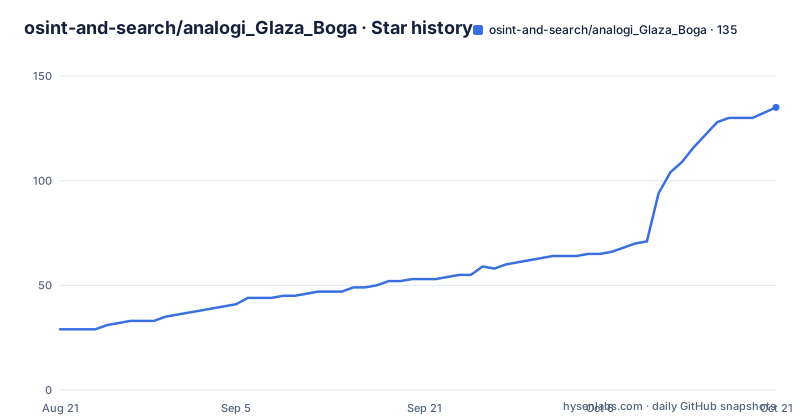
Star history
- osint-and-search/analogi_Glaza_Boga135 ★ · +106
| Repository | 2026-08-21 | 2026-10-21 |
|---|---|---|
| osint-and-search/analogi_Glaza_Boga | 29 | 135 |
106 Stars in the last 61 days, measured from the daily GitHub snapshot. Compare with other projects
Editorial analysis
A directory graded by price rather than by feature
The repository holds almost nothing: a README and two images, one of which has the catalogue's own name in the file name. There is no code, no licence is declared, GitHub detects no primary language, and there are no releases. The value is entirely in the page, which answers a question Telegram users keep asking: can the Glaz Boga bot be used for free, and if not, what is there instead. What makes the page usable is a legend of six marks applied to every link, and the marks are the real content. A link mark means the target opens a Telegram bot or app, a globe mark means it opens a website or browser page, a help mark means a VPN may be required, a recycle mark means there is a monthly subscription, a coin mark means payment per request, and a free mark means the bot is free or has free functions. Every entry is a t.me link carrying a start parameter, which is how the referrals are attributed.
The bot the list replaces is not working
Glaz Boga is described as a well known Telegram bot that became popular through its OSINT capabilities, meaning intelligence gathered from open sources. The README then puts the decisive fact in bold: it is not working at the moment. What it used to do is listed in four lines, and that list is the closest thing to a specification anywhere in the repository. It determined data from phone numbers, searched by email address, found profiles on social networks by nickname or name, and checked whether data had appeared in leaks. Two observations follow. The catalogue is a replacement list for a service that has stopped, not a review of working alternatives, and the four capabilities it names are the baseline every entry is implicitly measured against, even though the entries themselves are described in terms of price and data coverage rather than in a feature matrix.
Seven entries, each with its price marks
The main table has seven rows, and the marks are the argument. Sherlock carries the per-request coin mark together with the free mark, described as a powerful bot with a broad set of databases and detailed results, distinguished by accessible prices and output quality. Vektor carries the subscription mark and the free mark, a modern tool with convenient tariffs and the ability to try before paying. Enigma carries only the per-request mark and is described as having unique databases oriented at deep probing of rare sources. Himera carries the per-request mark and is framed as legal but expensive, for people who prefer to work within the law. Likho, the reputation bot, charges per request and analyses open messages to surface negative reviews and complaints about a user. Fanstat charges per request with free functions and covers Telegram monitoring: finding people, groups and channels, reading messages in chats, and surveillance. LeakOSINT is the only subscription entry with no free functions.
The catalogue argues against its own free tier
After the table there is a paragraph that is worth more than the list. Free versions of these services usually fall behind Glaz Boga in the volume and currency of data, results are often incomplete or contain outdated information, and fully free analogs with comparable functionality do not exist in practice. The advice that follows is equally direct: if you need regular access to current and accurate data, consider the paid options and subscriptions. Two marks on the entries therefore do not mean the bot is free, only that some function is. Sherlock and Vektor and Fanstat all carry a free mark alongside a paid one, and the distinction matters because a reader who reads the free mark as a price will choose the wrong row. A second table of three further tools keeps the same discipline, with Unamer marked per request, and SearchBot and the chat and channel search bot marked per request with free functions.
LeakOSINT asks for a foreign SIM card
One entry has an access requirement that has nothing to do with price. LeakOSINT is marked as a subscription and described as a specialised bot for searching foreign sources, with the note that it also works on post-Soviet sources. It may require a Telegram account registered on a foreign SIM card, which is a gate before any payment happens. That makes it the hardest entry in the table to try and the most likely to be abandoned at the first step. The other constraints are softer but equally explicit. Himera is positioned as legal but expensive, which reframes legality as a paid feature rather than a free one. Enigma is sold on rare sources rather than volume, and the reputation bot is sold on analysis of public messages. Three of the seven rows are therefore competing on coverage, one on compliance, and one on a registration requirement.
Most of the catalogue searches Telegram itself
The second table and one row of the first are not general OSINT tools at all, they search inside Telegram, which changes what they can find. Unamer is described as a Telegram search engine with its own database that sometimes turns up profiles other tools miss. SearchBot is a universal bot for discovering channels, chats and related information. The chat and channel search bot is presented as a powerful tool for finding Telegram communities across topics and directions. Fanstat goes furthest, combining people, group and channel search with reading messages in chats and surveillance, and Likho reads open messages to find negative reviews and complaints. Read together, these entries cover a person by nickname, a channel by topic, and a reputation by what the public has written, and the catalogue's list of reasons for using such services says as much: collecting data from many sources in one place, finding hidden connections and additional profiles, spotting scammers and fakes, checking reputation in minutes, and gathering evidence for investigators, journalists and security specialists.
Crypto top-up is solved with a wallet bot
There is a short section on payment mechanics, because the balance has to be filled somehow. For cases where you want to top up with cryptocurrency and do not know how, the page points to a Telegram wallet called Antarctic, and describes it as simple and convenient, with the ability to buy cryptocurrency for rubles. The emphasised note adds that through the same wallet you can pay for purchases by QR code in ordinary shops, which in practice means spending crypto as if it were rubles. The rest of the page is the legal framing, and it is unusually direct. The bots are described as used exclusively to demonstrate capabilities and for education. Data probing or identification of third parties is said to be permissible only for checking your own information or with the explicit consent of the information owner, and in most countries searching and distributing other people's personal data is prohibited under confidentiality and personal data law, with article 137 of the Russian Criminal Code and the Russian law on personal data given as examples. The authors accept no responsibility for unlawful use, all information is provided as is, and a link returns to the wider OSINT tools catalogue.
Editorial conclusion
This catalogue suits someone deciding which Telegram lookup bot to pay for, because the pricing and access labels are attached per entry rather than buried, and because the legal caveat is written into the page instead of hidden. It does not suit anyone expecting a free replacement, since the page's own conclusion is that fully free analogs with comparable coverage do not exist. Before using anything listed here, read the terms section: the catalogue states that data probing about third parties is only acceptable for your own data or with explicit consent, and names article 137 of the Russian Criminal Code and the Russian law on personal data as examples of what applies.
Frequently asked questions
Is the Glaz Boga bot still working?
The catalogue states plainly that it is not working at the moment. What it used to do was determine data from phone numbers, search by email address, find social network profiles by nickname or name, and check whether data had appeared in leaks.
Is there a free alternative to Glaz Boga?
Several listed bots carry a free mark, meaning free or partly free functions, but the catalogue's own conclusion is that fully free analogs with comparable functionality do not exist in practice, and that free versions fall behind in data volume and currency. For regular access to current data it recommends paid options and subscriptions.
What do the marks next to each bot in the catalogue mean?
Six marks are used: a link mark for a bot or app, a globe mark for a website, a help mark when a VPN may be required, a recycle mark for a monthly subscription, a coin mark for payment per request, and a free mark for free or partly free functions. Each entry carries the marks that apply to it.
Which listed bot needs a foreign SIM card?
LeakOSINT, the subscription entry for searching foreign sources, may require a Telegram account registered on a foreign SIM card. It is also the entry with no free functions, so both the access requirement and the payment are in front of the user.
What are the legal limits the catalogue puts on using these bots?
The page says the bots are for demonstrating capabilities and education, and that probing data or identifying third parties is only acceptable for checking your own information or with the owner's explicit consent. It cites article 137 of the Russian Criminal Code and the Russian law on personal data as examples, states that the authors are not responsible for unlawful use, and provides all information as is.
Official sources
Add this badge to your README
If you maintain this project, the badge below links readers to this analysis and shows its maintenance status from the daily GitHub snapshot. Paste the markdown into your README; add ?metric=license or ?metric=stars to the image URL for a different field.

[](https://hysenlabs.com/projects/osint-and-search-analogi-glaza-boga)Star history chart for your README
[](https://hysenlabs.com/projects/osint-and-search-analogi-glaza-boga)