ReZygisk: a C rewrite of Zygisk Next that you can actually read
Transparent implementation of Zygisk.
At a glance
- What is it?
- ReZygisk implements the Zygisk API for Magisk, KernelSU and APatch in pure C, forked from a Zygisk Next whose recent releases stopped being open source. What that means for auditing, hiding and day-to-day stability.
- Who is it for?
- ReZygisk earns its place for anyone who needs the Zygisk API on Magisk, KernelSU or APatch and wants the code in front of them, since v1.0.0 shipped on 2026-05-10 and commits landed as recently as 2026-09-21. Two things to settle first: the licence, because the README says AGPL 3.0 while the repository metadata reports GPL-3.0 and both cannot govern a single tree, and the base, because a fork of Zygisk Next inherits the ongoing question of what upstream detection does.
- Can I use it commercially?
- Yes, with conditions. GPL-3.0 is a copyleft licence: if you distribute software that includes it, you must release that software's source code under the same licence. Running it internally without distributing it does not trigger that obligation.
- Is it still maintained?
- Yes. The repository last received commits 11 days ago.
- What is it written in?
- Mainly C, according to GitHub's language statistics.
Answers come from the project's GitHub data, last synced on October 20, 2026, and from our analysis. They are not legal advice.
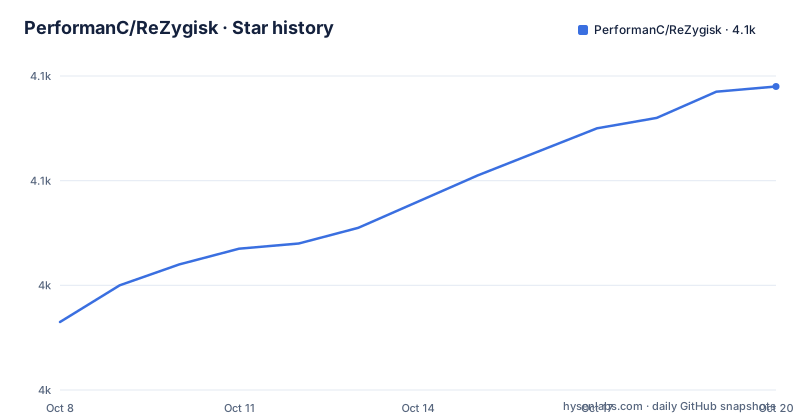
Star history
- PerformanC/ReZygisk4,078 ★ · +45
| Repository | 2026-10-08 | 2026-10-20 |
|---|---|---|
| PerformanC/ReZygisk | 4k | 4.1k |
45 Stars in the last 12 days, measured from the daily GitHub snapshot. Compare with other projects
Editorial analysis
Why the fork exists: closed-source releases upstream
ReZygisk is a fork of Zygisk Next, and the reason is stated plainly in the README: the latest Zygisk Next releases are not open source, with the code reserved entirely for its developers. The project argues that this blocks contributions and makes auditing impossible, and that audit matters more than usual here because a Zygisk module runs with root privileges and can reach the whole system.
The README is careful not to make this an accusation. It says the Zygisk Next developers are famous and trusted in the Android community and that PerformanC understands they have their reasons for keeping the code closed, then argues the opposite position anyway. That framing matters for how you read the project: the case for ReZygisk rests on inspectability, not on a claim that the original is malicious or vulnerable.
The topics on the repository line up with the scope: android, apatch, injection, kernelsu, magisk, root, zygisk and zygote. GPL-3.0 is what the repository metadata reports as the licence, while the README states the project is licensed under AGPL 3.0 and links the OSI text for it. Two different licences are recorded for one tree, and if licence compliance matters to you that conflict is worth resolving by reading the `LICENSE` and `NOTICE` files at the repository root directly. The `NOTICE` file, plus `TRANSLATOR.md` and a `READMEs/` directory holding seven translated READMEs, is also where attribution questions get answered.
Rewritten in C, with custom linkers for hiding
The technical claim is that the codebase was rewritten entirely in C, which the README says brings a cleaner codebase that is easier to follow, plus lighter and faster binaries. Compare that with the composition of the tree and it is credible: `loader/`, `zygiskd/`, `module/` and `webroot/` are four clear responsibilities, with `scripts/` holding the signing step and `common.mk` at the root shared by the sub-makes.
The more interesting engineering decision is the custom linkers. The README states they were introduced to future-proof ReZygisk against future detections, and that under normal circumstances it does not use the system linker at all, which it frames as defeating linker-based detection. This is the part of the project that competes with other root modules on the same device. `loader/` is the component that has to survive that competition, and the `.gitmodules` file suggests parts of it come from elsewhere.
Two C dependencies are declared: PLTI, described as a simple PLT hook for Android, and CSOLoader, described as a state-of-the-art Linux custom linker. The Android NDK is the only build tool listed. So this is a native build with a small, explicit dependency set rather than a Gradle project, and building it yourself is a reasonable first step if you intend to run it at all.
Picking a build: release for use, debug for issues
The installation section is unusually clear that the build you choose changes how the module behaves. The `release` build is the one to pick for most cases: it removes app-level logging and ships more optimized binaries. The `debug` build is the opposite, with heavy logging and no optimizations, and the README says to use it only for debugging and when gathering logs to open an issue. On branches, use `main` unless the developers say otherwise, or unless you specifically want upcoming features and understand the risk.
That framing makes the choice feel riskier than a typical build picker, and it is: the README says the selection determines how hidden and stable ReZygisk will be.
Flashing is the standard module flow. Download the zip, open the `Modules` section of your root manager, select the zip, then check the installation logs for errors before rebooting. One step is specific to Magisk users, who must disable the built-in Zygisk option in Magisk settings because it conflicts with ReZygisk.
Verifying the daemons actually started
After the reboot, the check happens in the module description in your root manager. It should indicate that the necessary daemons are running, and on a device supporting both architectures it lists the monitor and the 64-bit and 32-bit daemons with a checkmark each, followed by the words Standalone implementation of Zygisk.
This is the step people skip, and it is the one that catches the most common failure: two Zygisk implementations loaded at once, which is exactly what happens if Magisk's built-in Zygisk was left enabled. If the description does not list both architectures, one of the daemons did not start.
If you are building from source rather than flashing a release, the `Makefile` shows how far the automation goes. Debug and release targets both delegate to a build that produces a single zip, and install targets exist for KernelSU, Magisk and APatch, with matching reboot variants. Where ADB is available the Makefile pushes the artifact and reboots the device for you:
ADB_CMD := adb push $(ZIP_FILE) /data/local/tmp && adb shell
INSTALL_PATH := /data/local/tmp/$(ZIP_NAME)
REBOOT_CMD := adb reboot
Under Termux the same targets use `su -c reboot` instead of ADB. The zip name is built from the module name, version, version code, commit hash and build type, which is what makes it possible to tell from a filename which binary you are running.
Where the risk actually sits
This is a module that loads into the zygote and runs with root, and the README says so without hedging. The practical risks are the ordinary ones for that class of software. An unstable build can boot-loop a device, and the `debug` build is explicitly the unoptimized one, so shipping it to a daily driver is a bad trade. Detection is the second concern: the custom linker work exists to make the module harder to find, and the README acknowledges that by telling you the release build is more hidden.
A third factor is upstream drift. ReZygisk is a fork, and its value rests on tracking a Zygisk API and Android releases that Zygisk Next also has to track. The release history shows v1.0.0-rc.8 on 2026-04-26, v1.0.0-rc.9 on 2026-05-03 and v1.0.0 on 2026-05-10, so reaching a stable 1.0 took several release candidates within a few weeks, and the tree carries a `NOTICE` file that is the usual place for upstream attribution requirements to surface.
Community support runs through Discord and two Telegram channels plus a Signal group, all listed in the README. Contributions are not open invitation: the README says following PerformanC's contribution guidelines is mandatory, along with their security policy, code of conduct and syntax standard.
Editorial conclusion
ReZygisk earns its place for anyone who needs the Zygisk API on Magisk, KernelSU or APatch and wants the code in front of them, since v1.0.0 shipped on 2026-05-10 and commits landed as recently as 2026-09-21. Two things to settle first: the licence, because the README says AGPL 3.0 while the repository metadata reports GPL-3.0 and both cannot govern a single tree, and the base, because a fork of Zygisk Next inherits the ongoing question of what upstream detection does. Install the `release` build, leave Magisk's built-in Zygisk off as the README insists, and verify the module description before assuming the daemons are up.
Frequently asked questions
What is ReZygisk for?
ReZygisk is a standalone implementation of the Zygisk API that gives modules built against that API a runtime under Magisk, KernelSU and APatch. It is a fork of Zygisk Next, rewritten in C, and exists so that the Zygisk layer can be inspected and modified rather than shipped closed.
What are the key differences between ReZygisk and Zygisk Next?
ReZygisk is a fork of Zygisk Next whose codebase was rewritten entirely in C, which the project says makes the code easier to follow and the binaries lighter and faster. It also introduces custom linkers so it does not use the system linker in normal circumstances, which it presents as defeating linker-based detection. The fork exists because the latest Zygisk Next releases are not open source.
How do I install ReZygisk?
Download the release build unless you are collecting logs for an issue, then flash the zip from the Modules section of Magisk, KernelSU or APatch, check the installation logs and reboot. Magisk users must disable the built-in Zygisk option in settings first, because it conflicts. After the reboot the module description should show the daemons running for each supported architecture.
Official sources
Add this badge to your README
If you maintain this project, the badge below links readers to this analysis and shows its maintenance status from the daily GitHub snapshot. Paste the markdown into your README; add ?metric=license or ?metric=stars to the image URL for a different field.

[](https://hysenlabs.com/projects/performanc-rezygisk)Star history chart for your README
[](https://hysenlabs.com/projects/performanc-rezygisk)Was this useful?