gamevault-app is the client half of a source-available platform
Frontend for the self-hosted gaming platform for drm-free games
At a glance
- What is it?
- The C# repository behind GameVault, a self-hosted library for DRM-free games. There is no build command, no framework statement and no platform list in the README, the license is CC BY-NC-SA 4.0 with the metadata recording nothing at all, and the newest release predates the last push by eight months.
- Who is it for?
- Treat gamevault-app as the client tier of a platform rather than as a project you can run from the repository. Three checks first.
- Can I use it commercially?
- Check first. The repository uses a licence we do not classify automatically, so read its LICENSE file before any commercial use.
- Is it still maintained?
- Yes. The repository last received commits 17 days ago.
- What is it written in?
- Mainly C#, according to GitHub's language statistics.
Answers come from the project's GitHub data, last synced on November 15, 2026, and from our analysis. They are not legal advice.
Star history
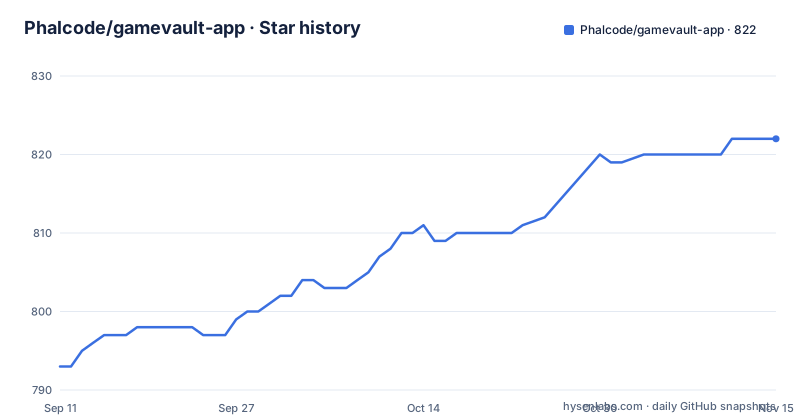
- Phalcode/gamevault-app822 ★ · +29
| Repository | 2026-09-11 | 2026-11-15 |
|---|---|---|
| Phalcode/gamevault-app | 793 | 822 |
29 Stars in the last 65 days, measured from the daily GitHub snapshot. Compare with other projects
Editorial analysis
This repository is the client, not the platform
The README is explicit about what you are looking at: the platform is GameVault, a self-hosted, source-available alternative to popular gaming platforms for DRM-free games stored on a file server, and the repository in front of you is the client application.
That split matters more than it sounds. The platform's own description, its guides and its downloads live at gamevau.lt, and the README's only instruction is to go there. There is no server code in the tree, so a self-hosted installation needs two pieces, and only one of them is here.
The positioning line is also worth quoting rather than paraphrasing: think of it as a self-hosted Steam. That is the mental model the project hands you, with DRM-free titles on your own storage instead of a storefront, and the README's framing is the entire product description, at about 320 words.
The domain itself is worth noting once: the homepage is spelled gamevau.lt, with no second l.
CC BY-NC-SA 4.0 on a C# application, and an empty license field
The license section names Creative Commons Attribution-NonCommercial-ShareAlike 4.0 International, linking the deed and stating the terms. A `LICENSE` file exists at the top level.
The license recorded in the repository metadata is different in kind: it is NOASSERTION, which is the marker GitHub uses when it cannot classify what it finds. So the two disagree about whether there is a license to read at all, and there is no third source in the repository to settle it. Read `LICENSE` before assuming anything, and do not rely on the metadata field.
The choice itself is unusual for a desktop or client application. CC BY-NC-SA 4.0 is a content license built for sharing creative works with attribution, non-commercial use and share-alike, not one of the OSI-approved software licenses. Read together with the README's next line, which says the project is not and never was open source and links a blog post explaining why, the intent is coherent: the code is readable and redistributable under conditions, and commercial use is not granted. What that means for your own distribution is a question for a lawyer, not for this page.
A contributing guide in a repository that is not open source
The top level contains `CONTRIBUTING.md`, `SECURITY.md`, `CHANGELOG.md`, `LICENSE`, a `.github/` directory, `.gitattributes` and `.gitignore`. That is the standard public-project skeleton, sitting next to a README that says the project is not and never was open source.
The tension is worth resolving rather than repeating, because it changes who is allowed to do what. A contributing guide invites patches, while a non-commercial share-alike license restricts how the result can be used, and the two are not obviously compatible for outside contributors. The README does not say whether pull requests are accepted, who reviews them, or whether a contribution is licensed differently from the rest of the code.
So the repository tells you the code exists and how it is licensed, and leaves open the question of whether the community is meant to extend it.
The newest release is from December 2025, the last push from August 2026
The release list has three entries, all in the same year and all four-part numbers: 1.17.3.0 on 2025-11-08, 1.17.4.0 on 2025-11-13 and 1.17.5.0 on 2025-12-13. Then the branch moved: the last push recorded is 2026-08-25.
That is roughly eight months of commits after the newest tag, and there is no 1.18 entry to describe them. So `master` is ahead of every published release, and anyone building from source is building something the release list cannot speak for. The fourth version component is also unusual, suggesting a component of the build that increments independently, though nothing in the README explains the scheme.
The default branch is master rather than main. There are no instructions for building it here, and no statement of which platform each build targets.
One solution file, one project directory, no stated framework
The C# tree is small: `gamevault.sln` at the top and a single `gamevault/` directory beside it. There is no `apps/`, no tests project and no separate backend project in the top-level entries.
What that leaves unanswered is the whole build question. The README never states the UI framework, the target operating systems or the minimum runtime, and there is no dotnet command anywhere in it. Whether this is a mobile client, a desktop shell or something else is not answerable from the repository text; the project's own site is the only pointer for that.
For a client application that is an unusual amount of silence. Without knowing the framework or the platforms, you cannot judge whether it builds on your machine, and you cannot tell whether the client expects a particular server version, since the configuration surface is not described either.
GameVault+ is the paid tier, with four donation routes beside it
The support section is the longest part of the README. It asks for GameVault+, a paid tier, and then lists four donation platforms: Ko-Fi, Liberapay, GitHub Sponsors and PayPal. The project says it works on this in its free time.
There is a supporter mechanism worth noting because it is unusual: connecting a Discord account to Ko-Fi grants a Supporters role automatically, while donating through another platform means sending the maintainers a message with the receipt as proof.
That is the business model in full. The code is non-commercial and share-alike, the hosted features are behind a paid tier, and the direct funding route is donations. For an adopter it means the client you read in this repository is the piece the project keeps in step with a server it also sells access to.
DRM-free is defined narrowly, and the disclaimer leans on your jurisdiction
The legal section is three short paragraphs and does real work. GameVault manages DRM-free games and is described as solely a tool to address that need, with the project not responsible for the content or files users store or share.
The second paragraph narrows the term: when it says DRM-free, it only means games obtained legally. The README acknowledges the platform could theoretically be used with illegally obtained games, states that piracy is neither endorsed nor supported, and closes with an appeal to copyright law in the user's own jurisdiction.
That is a self-hosted system with no content gate of its own. The stated boundary is legal rather than technical, which is a distinction worth keeping clear: nothing in the client inspects what a server is being asked to index, so the restriction lives entirely in how you use it.
Editorial conclusion
Treat gamevault-app as the client tier of a platform rather than as a project you can run from the repository. Three checks first. What you actually get: one solution and one project directory, with the server, the setup guides and the release downloads living on the project's own site, so a clone is not a working install. What you may do with it: the README states the project is not and never was open source, describes it as source-available, and applies Creative Commons Attribution-NonCommercial-ShareAlike 4.0 to it, which is a content license rather than an OSI one and forbids commercial use, while the license field in the repository metadata is empty. And what version you would be reading: the newest tagged release is 1.17.5.0 from 2025-12-13, while the branch itself was pushed on 2026-08-25, so the code on master is well past anything the release list describes. The last push was 2026-08-25.
Frequently asked questions
Is GameVault open source?
The README says the project is not and never was open source, describes it as self-hosted and source-available, and links a blog post explaining the reasoning. The license applied is Creative Commons Attribution-NonCommercial-ShareAlike 4.0.
What does the gamevault-app repository actually contain?
The client application only. The README states that the project you are looking at is the client, and directs readers to the project's own site for the platform itself, the guides and the downloads.
What license does gamevault-app use?
The README states Creative Commons Attribution-NonCommercial-ShareAlike 4.0 and a LICENSE file exists at the top level, while the license recorded in the repository metadata is NOASSERTION. The file is the only source that settles it.
Is GameVault meant for illegally obtained games?
No. The legal disclaimer says DRM-free means games obtained legally, that piracy is neither endorsed nor supported, and that users must comply with copyright law in their own jurisdiction. The client does not inspect what a server indexes.
How do I build or run gamevault-app?
The README contains no build or run command. It carries a Visual Studio solution at the top level and one `gamevault/` project directory, and sends you to the project's website for setup guides.
Official sources
Add this badge to your README
If you maintain this project, the badge below links readers to this analysis and shows its maintenance status from the daily GitHub snapshot. Paste the markdown into your README; add ?metric=license or ?metric=stars to the image URL for a different field.

[](https://hysenlabs.com/projects/phalcode-gamevault-app)Star history chart for your README
[](https://hysenlabs.com/projects/phalcode-gamevault-app)Was this useful?