pondorasti/emojis: Slack Emoji Generator Setup
Turn your ideas into emojis in seconds. Generate your favorite Slack emojis with just one click.
At a glance
- What is it?
- pondorasti/emojis is a TypeScript web application for generating Slack-style emoji images through Replicate. Its hosted design depends on several external services, which makes infrastructure setup and ongoing configuration the main adoption concerns.
- Who is it for?
- Adopt pondorasti/emojis if you need a Vercel-oriented Slack emoji application and can support its Replicate, PlanetScale, Vercel Blob, Vercel KV, and Prisma components. Do not choose it for a self-contained local generator.
- Can I use it commercially?
- Yes, with strict conditions. AGPL-3.0 is a network copyleft licence: if people use a modified version over a network, for example as a hosted service, you must offer them its source code under the same licence.
- Is it still maintained?
- Yes. The repository last received commits 7 days ago.
- What is it written in?
- Mainly TypeScript, according to GitHub's language statistics.
Answers come from the project's GitHub data, last synced on November 6, 2026, and from our analysis. They are not legal advice.
Star history
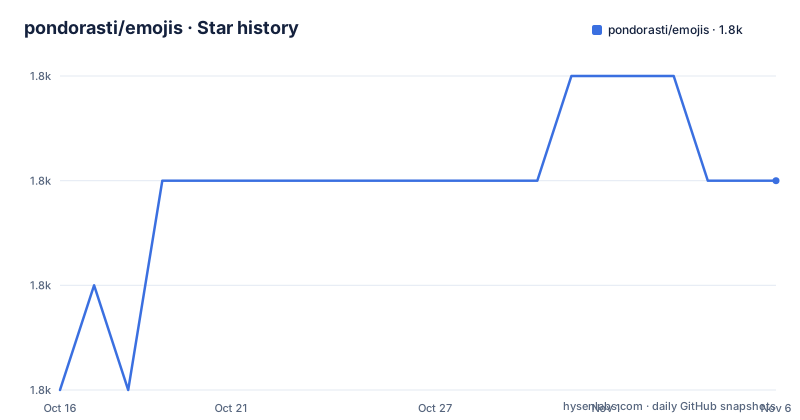
- pondorasti/emojis1,767 ★ · +2
| Repository | 2026-10-16 | 2026-11-06 |
|---|---|---|
| pondorasti/emojis | 1.8k | 1.8k |
2 Stars in the last 21 days, measured from the daily GitHub snapshot. Compare with other projects
Editorial analysis
pondorasti/emojis serves Slack emoji generation
pondorasti/emojis solves a narrow product problem: turning a written idea into an image intended for Slack. Its README describes the application as a way to "Generate your favorite Slack emojis with just one click." The target users are therefore people who maintain Slack communities or teams and need custom emoji images without designing every asset manually. It can also serve developers seeking a reference application for combining AI image generation with a Next.js interface.
The repository is an application, not a documented command-line utility or reusable image library. Its `package.json` marks the package as private and defines scripts for development, production builds, linting, and Prisma operations. The top-level repository contains `src/`, `prisma/`, `public/`, and deployment configuration. No public library API, CLI command, or documented batch-processing workflow appears in the README.
That scope matters for adoption. A team seeking one output may prefer a direct Replicate model. A team seeking a hosted application may find the application structure useful. The README does not document supported Slack image dimensions, file formats, generation quotas, prompt limits, history retention, or download behavior, so those details require checking the running service before choosing it for an organizational deployment.
pondorasti/emojis uses a multi-service Next.js architecture
The application is built with Next.js 13.5.2, React 18.2.0, and TypeScript 5.2.2. The README identifies the App Router and Server Actions, while the dependency on `server-only` suggests that selected operations are deliberately excluded from browser-side code. This arrangement is consistent with a server-mediated generation workflow in which provider credentials and storage operations remain outside the client.
Replicate is the documented AI provider. The README credits `fofr/sdxl-emoji`, described as an SDXL-based emoji model fine-tuned from Apple's emoji style. It also credits `fofr/prompt-classifier`, described as a toxicity classifier based on Llama 13B, and `rembg`, credited with removing image backgrounds. These credits indicate intended model responsibilities, but they do not specify the request order, model parameters, output sizing, retries, or failure messages.
Vercel Blob supplies the object-storage layer, while Vercel KV is described as a Redis database. PlanetScale supplies MySQL, accessed through Prisma. The dependencies also include `@upstash/ratelimit`, which indicates request-limiting support exists somewhere in the codebase, although the README does not document the limits. The resulting architecture distributes generation, storage, caching, persistence, and hosting across several providers. That is convenient for a Vercel deployment but makes the system harder to operate independently.
Deploying pondorasti/emojis needs its documented service configuration
The README does not provide a local installation tutorial. Instead, it directs users to deploy the template to Vercel and says that Replicate, PlanetScale, Vercel Blob, and Vercel KV must be configured. The repository's `.env.example` gives the concrete environment variable names. These variables are configuration requirements rather than usable credentials, so each value must come from its corresponding provider.
REPLICATE_API_TOKEN=
WEBHOOK_SECRET=
NGROK_URL=
BLOB_READ_WRITE_TOKEN=
KV_URL=
KV_REST_API_URL=
KV_REST_API_TOKEN=
KV_REST_API_READ_ONLY_TOKEN=
DATABASE_URL=
`REPLICATE_API_TOKEN` is needed for the AI provider. `WEBHOOK_SECRET` is intended to protect webhook processing, and the example links to a secret generator. `NGROK_URL` is labeled for forwarding requests during local development, but the README does not say which route must be public or how to test webhook delivery locally. The `KV_*` variables configure Vercel KV, and `DATABASE_URL` supplies Prisma with its MySQL connection.
The documented first deployment is therefore to create the four external services, populate the environment variables, use the README's Vercel deployment button, and open the deployed application. A successful deployment should expose an emoji-generation interface like the screenshot in the README. The documentation does not provide a health-check endpoint, a test prompt, or an exact success message for the first generated image.
pondorasti/emojis package scripts expose a Bun development workflow
The repository lists Bun as its package manager and includes `bun.lockb`, but the README does not give a complete command sequence for installing dependencies or starting local development. The `package.json` scripts still reveal the intended workflow. The development server runs through `next dev`, production builds use `next build`, and the production server starts through `next start`.
Prisma has its own lifecycle and database scripts. The `postinstall` hook runs `prisma generate --no-engine`, preparing the generated client while leaving database engine selection outside that install command. `prisma:studio` starts Prisma Studio for inspecting database records, while `prisma:push` applies the schema using `prisma db push`. The `prisma/` directory and `DATABASE_URL` show that persistence is an intentional part of the application rather than an optional local convenience.
The dependency versions deserve attention before an upgrade. Next.js, React, TypeScript, Tailwind CSS, and several Vercel packages have explicit versions. `@prisma/client` and `prisma` are both declared as `latest`, while the lockfile records the resolved dependency state. Because the repository has no GitHub releases, operators do not receive a documented tagged upgrade plan from the available release history. Reviewing `bun.lockb`, regenerating the Prisma client, and checking database schema changes are separate operational tasks.
pondorasti/emojis has clear operational failure boundaries
The first failure mode is missing service configuration. Without `REPLICATE_API_TOKEN`, the documented image-generation provider cannot be reached. Without `BLOB_READ_WRITE_TOKEN`, the application cannot use Vercel Blob. Missing `KV_*` settings can break the Redis-backed layer, while an invalid `DATABASE_URL` prevents Prisma from connecting to the configured MySQL database. The README does not provide troubleshooting procedures or provider-specific error handling, so a failed deployment may require inspection of Vercel logs and external dashboards.
The project is also a poor fit for a strict local or isolated environment. Its documented architecture depends on Replicate and hosted Vercel services. Even if the application code can run outside Vercel, the README does not document replacements for those services, and `NGROK_URL` suggests that webhook testing introduces another external dependency.
Content controls are another limitation. The credited `prompt-classifier` indicates that toxicity detection is planned or implemented, but the README does not state whether classifier output blocks generation, what categories are rejected, or how false positives are handled. The repository also does not specify how prompts, generated images, or account data are retained. The linked Terms & Conditions and Privacy Policy are the appropriate project sources for those service-specific terms, while the README itself does not establish commercial-use rights for generated output.
Direct Replicate models are a smaller alternative to pondorasti/emojis
A direct Replicate workflow is the clearest alternative when the only goal is image generation. The credited `fofr/sdxl-emoji` model can be considered independently of the pondorasti/emojis application interface. That approach removes the need to deploy the Next.js application, configure Prisma against PlanetScale, connect Vercel Blob, or establish the Vercel KV layer.
pondorasti/emojis adds a product-oriented application layer around generation. Its documented structure includes a web interface, Server Actions, storage, relational persistence, and deployment configuration. Those pieces may be useful for a Slack-focused service, but they also create more failure boundaries and more provider accounts. A direct model workflow may be preferable for an individual image request or an experiment. The full application is more relevant when the web experience and application architecture are part of the goal.
The README does not provide a direct Replicate API example, so no client command should be inferred. Before choosing between the two approaches, compare model access, image output requirements, moderation behavior, storage needs, and data retention. For pondorasti/emojis specifically, verify whether the running application preserves a generation history and whether that history is necessary for the intended Slack use case.
pondorasti/emojis maintenance depends on hosted integrations
The repository is not archived, and its last push was on 2026-09-11. That date confirms recent code activity, but it does not establish a stable release process. No GitHub releases are available, so there is no documented versioned upgrade path or compatibility statement. Maintenance requires tracking changes in the `main` branch and reviewing changes to external provider interfaces.
The application also has several dependencies that can change behavior without a repository commit. Replicate model availability, Vercel Blob permissions, Vercel KV configuration, PlanetScale connectivity, and Prisma schema compatibility all affect operation. The `latest` declarations for `@prisma/client` and `prisma` add another reason to inspect dependency resolution before upgrading. A successful `next build` would check the application build, but it would not prove that every remote service is reachable.
The repository identifies `AGPL-3.0` as its license and links to separate Terms & Conditions and Privacy Policy pages on `emojis.sh`. This is not legal advice. Operators should review those documents and the license for their deployment model, especially if they modify the application, provide it over a network, or use generated images commercially. Before upgrading, first verify that the Vercel deployment still matches the configured Blob, KV, PlanetScale, Prisma, and Replicate integrations.
Editorial conclusion
Adopt pondorasti/emojis if you need a Vercel-oriented Slack emoji application and can support its Replicate, PlanetScale, Vercel Blob, Vercel KV, and Prisma components. Do not choose it for a self-contained local generator. Before deployment, verify model access, database setup, asset storage, webhook handling, and the rights associated with generated images.
Frequently asked questions
Can I run pondorasti/emojis locally?
The README does not provide a complete local installation or startup tutorial. It identifies Bun as the package manager and includes `NGROK_URL` for local request forwarding, but it does not explain the full local setup.
Which external services does pondorasti/emojis require?
The README identifies Replicate, PlanetScale, Vercel Blob, and Vercel KV as required services. Prisma connects the application to the MySQL database.
What license applies to pondorasti/emojis?
The repository identifies `AGPL-3.0` as its license. It also links to separate Terms & Conditions and Privacy Policy pages on `emojis.sh`.
Official sources
Add this badge to your README
If you maintain this project, the badge below links readers to this analysis and shows its maintenance status from the daily GitHub snapshot. Paste the markdown into your README; add ?metric=license or ?metric=stars to the image URL for a different field.

[](https://hysenlabs.com/projects/pondorasti-emojis)Star history chart for your README
[](https://hysenlabs.com/projects/pondorasti-emojis)Was this useful?