vibe-check-mcp is in maintenance mode and its version numbers do not line up
Vibe Check is a tool that provides mentor-like feedback to AI Agents, preventing tunnel-vision, over-engineering and reasoning lock-in for complex and long-horizon agent workflows. KISS your over-eager AI Agents goodbye! Effective for: Coding, Ambiguous Tasks, High-Risk tasks
At a glance
- What is it?
- PV-Bhat/vibe-check-mcp-server is a Model Context Protocol server that pauses an agent and asks a second language model for feedback before it continues, backed by a paper on Chain-Pattern Interrupts. The README declares the project finished with feature work, package.json and the README both claim version 2.9.0 while the newest visible release is v2.7.6, and the intervention logic itself lives in a different repository.
- Who is it for?
- vibe-check-mcp is worth evaluating if you run long agent workflows where the agent quietly escalates scope, since the intervention is a genuine second opinion from a separate model call rather than a heuristic, and the transport hardening in v2.9 is a real change from the earlier wildcard configuration.
- Can I use it commercially?
- Yes. MIT is a permissive licence: you can use, modify and sell software built on it, as long as you keep its copyright and licence notices.
- Is it still maintained?
- Yes. The repository last received commits 14 days ago.
- What is it written in?
- Mainly TypeScript, according to GitHub's language statistics.
Answers come from the project's GitHub data, last synced on November 15, 2026, and from our analysis. They are not legal advice.
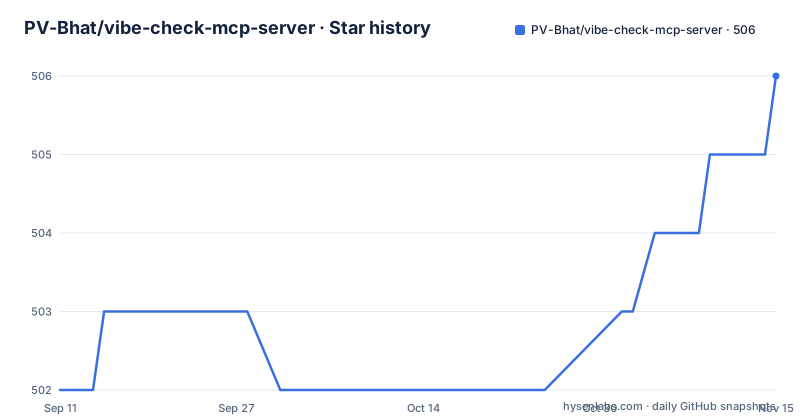
Star history
- PV-Bhat/vibe-check-mcp-server506 ★ · +4
| Repository | 2026-09-11 | 2026-11-15 |
|---|---|---|
| PV-Bhat/vibe-check-mcp-server | 502 | 506 |
4 Stars in the last 65 days, measured from the daily GitHub snapshot. Compare with other projects
Editorial analysis
Maintenance mode is declared, and the visible release list stops two minor versions back
The first thing in the README is a notice, and it is unambiguous.
The project is stated to be in maintenance mode. Active feature development has ended, only maintenance patches for security and bug fixes are published, and v2.9.0 is named as the latest maintenance release. The server is described as remaining fully functional, and community forks and contributions are welcomed under the MIT licence.
The repository itself is not archived and its last push was on 2026-09-29, so the code is still moving. What has stopped is features.
Here is the part that needs reconciling. The package manifest declares version 2.9.0, and the maintenance notice names v2.9.0 as the latest release. The release list attached to the repository shows three tags: v2.7.6 from 2025-11-06, v2.7.4 from 2025-10-28, and v2.7.1 from 2025-10-16. There is no 2.8 and no 2.9 in that list.
So the version the package publishes itself as has no matching entry in the visible release history, and the newest tag you can see is nearly a year older than the version string in the manifest. Anyone pinning by release tag and anyone installing from the registry are getting different things, and the repository does not explain the gap.
The badge line makes a second unrefreshed claim in the same document. It announces the server as featured on a most-popular-this-week listing, and the Recognition section dates that to the week of 13 Oct 2025. A dated award presented in the present tense is the kind of thing to discount.
v2.9 locked down HTTP, and the Dockerfile is the case the docs warn about
The example environment file is where this project's most careful work is.
There are three transport settings, and all three only apply when you start the server with the HTTP flag rather than over stdio.
The CORS setting lists the origins allowed to call the MCP endpoint from a browser, and unset means loopback origins only. The comment underneath is the important part: you can pass a comma-separated list, or an asterisk to restore what it calls the pre-2.9 wildcard. So the previous release accepted any origin, and 2.9 stopped doing that, with a documented way back.
The second setting is the host headers the server will accept, described as DNS-rebinding protection. Unset means localhost, the IPv4 loopback, and the IPv6 loopback. The comment says to set it, or to pass an asterisk, when serving on a non-loopback hostname, and gives Docker as the example.
The third is a cap on the JSON request body size, defaulting to 100kb.
Read together, the defaults are a server that will not talk to anything it does not recognise, and the escape hatch is documented rather than hidden. That is well-judged for something an agent spawns on a developer machine.
The catch is that the Dockerfile in the same repository sets none of the three. The README's HTTP example starts the server on a specific port.
npx -y @pv-bhat/vibe-check-mcp start --http --port 2091A health endpoint is given for confirming the service is live, and JSON-RPC requests go to a path under the same host and port. The container image exposes 3000 instead, and the container is exactly the non-loopback case the allowed-hosts comment names. Deploying the image as written means choosing your own host list first.
The intervention logic lives in a separate CPI repository
The mechanism this project is named for is not in this repository.
The overview splits the design in two. Vibe Check is described as a metacognitive signal layer that surfaces traits, uncertainty, and risk scores. Chain-Pattern Interrupts, abbreviated CPI, consumes those triggers and enforces an intervention policy before the agent is allowed to resume.
Both halves have documentation here. The integration guide is at `docs/integrations/cpi.md` inside the repository, and a component map sits at `docs/architecture.md`. But the CPI implementation is linked out to a separate project on the same owner's account, and that is where the intervention policy lives.
So the package you install is the signal layer plus the wiring. The thing that actually decides when to interrupt an agent, and what to say when it does, is a dependency on someone else's repository that is not versioned together with this one. There is no shared release train between them in anything the README shows.
The paper behind it is named in the header links: Do AI Agents Need Mentors, Evaluating Chain-Pattern Interrupt for Oversight and Reliability, hosted on ResearchGate. The project states results from a study in which agents calling Vibe Check improved success by 27% and harmful actions fell by 41%, and the feature table credits CPI with phase-aware prompts that challenge assumptions.
The framing in the README is worth quoting because it is unusually modest about what the tool is. A rubber-duck debugger for language models, a quick sanity check before your agent goes down the wrong path.
Every check is a second model call, and OpenRouter has no default
The cost model of this tool is one sentence in the README, and it is easy to skim past.
Vibe Check invokes a second language model to give meta-cognitive feedback to your main agent. So the oversight layer is not a heuristic and not a rule engine; it is another inference, on every check, from whichever provider you configured.
Four providers are listed in the feature table: Gemini 3.6, Claude 5, GPT-5.6, and OpenRouter. The environment file names the four configuration keys, and the default provider is Gemini.
The model selection rules are where it gets precise. Leaving the default model unset uses the provider's own default, and three of those are named in the comment: a Gemini flash model, a GPT model on a Terra tier, and a Claude Sonnet model on version 5. If you do set it, it must name a model belonging to the selected provider, and it is ignored when a call overrides the provider.
The exception is stated without softening: OpenRouter has no default, so you must pass a fully-qualified slug. Miss that and the call has nothing to fall back to.
There is also a behaviour flag, `USE_LEARNING_HISTORY`, which defaults to false and corresponds to the optional vibe_learn feature in the table, the one that logs mistakes and fixes for future reflection. The other table entries are history continuity, which summarises prior advice when a session identifier is supplied, and the CPI interrupts themselves.
Four providers, three integration styles, and no Anthropic SDK
The dependency list is short enough to read as an architecture summary.
There are two vendor SDKs: one for Google and one for OpenAI. There is no Anthropic SDK. There is also axios, an HTTP client.
So of the four advertised providers, two are reached through an official client library and two are reached over raw HTTP. The Anthropic path is the interesting one, because the example environment file carries a base URL, a version string fixed at 2023-06-01, and a commented authentication token described as for Anthropic-compatible proxies and gateways. Those three together are the parameters of the raw messages endpoint, which is what you hand-roll when you are not using their client.
The rest of the runtime dependencies explain the rest of the tool. An Express server and a CORS middleware are the HTTP transport. A command-line parser gives you the start, install, and doctor subcommands. A dotenv loader reads the environment file. A diff library sits behind the history and learning features. A version-comparison library is there for model handling. And a process-spawning library is present for shelling out.
Node 20 or newer is the stated engine floor, which matches the quickstart requirement of Node 20 or later.
Two metadata fields are worth noting because they matter for discovery rather than function. The package carries an MCP name identifying it to registries, and the repository root holds four separate registry manifests, one for a general MCP registry, one named for a server listing, one for Smithery, and one version file.
Two test systems and six scripts at the repository root
There are two testing arrangements in this repository and only one of them is wired into the manifest.
The wired one is a normal setup. Tests run through Vitest, with a config file at the root and a test directory alongside the source. There is a pretest hook that builds the project first, so a test run always exercises freshly compiled output rather than a stale `build` directory. Coverage is a separate script backed by the V8 coverage provider, and there is also a standalone security-check script that runs a Node file from the scripts directory.
The unwired one is at the top level. Six scripts sit in the repository root: three near-identical test files that differ by provider, one plain test file, a test client in JavaScript, and the same test client in TypeScript. Alongside them are two JSON files named as if they were fixtures, one called `test` and one called `request`.
So a reader looking for how to exercise this server finds a Vitest suite, a set of ad-hoc scripts at the root, and two loose JSON files, with nothing in the README explaining which is current.
The rest of the tree is documentation and distribution. There are directories for docs, examples, scripts, tests, and source, a single example file for CPI integration, an attachments directory with a capitalised name that is the only such entry in an otherwise lowercase tree, and the usual governance files including a code of conduct, a contributing guide, a security policy, and a citation file. The citation file is consistent with a project that points at a published paper as its evidence.
The published package is a build directory and nothing else
The package manifest ships compiled output and stops there.
The files array contains exactly one entry, the build directory. The main entry point is the compiled index file inside it, and the command-line binary points at a second compiled file, also inside it. So the tarball a client installs contains JavaScript and no source, no docs, no examples, and no tests.
The build is a TypeScript compile followed by a small inline Node script that marks the two entry files executable, chmodding them to 0755 if they exist. That chmod step is why the check for existence is there: a fresh checkout where one of the two was not produced does not fail the build.
Three lifecycle hooks invoke that build. The prepare hook runs it, which means installing the repository from a clone compiles it. The prepublish-only hook runs it again before publishing. And the Dockerfile reflects that arrangement precisely: it runs npm install with scripts ignored, then runs the build as an explicit separate step. The ignore flag is there so the prepare hook does not fire during the dependency install, where the compiler is not yet guaranteed to be present.
One more field is unusual for a package that is run with npx. A package manager is pinned to a specific npm version in the manifest. The README's quickstart uses npx, the Dockerfile uses a floating LTS Node image, and the manifest pins npm. Three toolchain opinions in one repository, and only one of them is enforced.
Editorial conclusion
vibe-check-mcp is worth evaluating if you run long agent workflows where the agent quietly escalates scope, since the intervention is a genuine second opinion from a separate model call rather than a heuristic, and the transport hardening in v2.9 is a real change from the earlier wildcard configuration. It is not worth taking a fresh dependency on if you need upstream development, because the project declares feature work finished and publishes only security and bug fixes, and the mechanism you are buying lives in a separate CPI repository. Three things to check. The versions do not line up: package.json and the README both say 2.9.0 while the newest release in the visible list is v2.7.6 from 2025-11-06, so ask which build you would actually be pinning. Every check costs a second model call, and the OpenRouter path has no default model, so a bad default fails rather than falling back. And if you serve over HTTP, set the allowed hosts variable yourself, because unset means loopback only and the bundled Dockerfile does not set it.
Frequently asked questions
Is vibe-check-mcp-server still being developed?
The README states the project is in maintenance mode, that active feature development has ended, and that only maintenance patches for security and bug fixes are published, with v2.9.0 named as the latest maintenance release. The repository is not archived and its last push was on 2026-09-29.
How do I run vibe-check-mcp without installing it locally?
With npx. Run npx -y @pv-bhat/vibe-check-mcp start --stdio to let an MCP-aware client spawn it, or npx -y @pv-bhat/vibe-check-mcp start --http --port 2091 and then check curl http://127.0.0.1:2091/healthz, sending JSON-RPC to http://127.0.0.1:2091/mcp. Node 20 or newer is required.
Which LLM providers does vibe-check support?
Gemini 3.6, Claude 5, GPT-5.6, and OpenRouter, selected with a provider setting that accepts gemini, openai, openrouter, or anthropic. OpenRouter has no default model, so a fully-qualified slug has to be passed for it.
Where is the CPI implementation kept?
The integration guide is in this repository at docs/integrations/cpi.md, but the Chain-Pattern Interrupt implementation itself is in a separate repository on the same account. The package installed from npm is the signal layer and the wiring; the intervention policy lives elsewhere.
What happens to CORS and host checking on the vibe-check HTTP transport?
With the allowed origins variable unset, only loopback origins may call the endpoint, and passing an asterisk restores the wildcard that earlier versions accepted. With the allowed hosts variable unset, only localhost and the IPv4 and IPv6 loopback host headers are accepted, as DNS-rebinding protection, and the example environment file tells you to set it when serving on a non-loopback hostname such as in Docker. Request bodies are capped at 100kb by default.
Official sources
Add this badge to your README
If you maintain this project, the badge below links readers to this analysis and shows its maintenance status from the daily GitHub snapshot. Paste the markdown into your README; add ?metric=license or ?metric=stars to the image URL for a different field.

[](https://hysenlabs.com/projects/pv-bhat-vibe-check-mcp-server)Star history chart for your README
[](https://hysenlabs.com/projects/pv-bhat-vibe-check-mcp-server)Was this useful?