python/typing: Python Static Typing Reference
Python static typing home. Hosts the documentation and a user help forum.
At a glance
- What is it?
- python/typing is the GitHub home for Python static typing documentation, the type system specification, user support, and checker conformance tests. It is a reference and coordination project, not a runtime type checker.
- Who is it for?
- Adopt python/typing as the documentation, specification, and conformance reference for Python static typing work, especially if you maintain a checker or need authoritative help resources. Do not treat it as an installable checker, a current typing_extensions source, or runtime enforcement.
- Can I use it commercially?
- Check first. The repository uses a licence we do not classify automatically, so read its LICENSE file before any commercial use.
- Is it still maintained?
- Yes. The repository last received commits 2 days ago.
- What is it written in?
- Mainly Python, according to GitHub's language statistics.
Answers come from the project's GitHub data, last synced on November 7, 2026, and from our analysis. They are not legal advice.
Star history
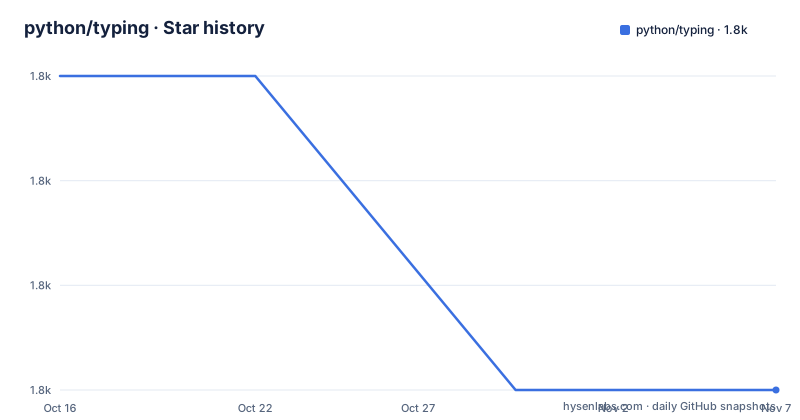
- python/typing1,783 ★ · -3
| Repository | 2026-10-16 | 2026-11-07 |
|---|---|---|
| python/typing | 1.8k | 1.8k |
-3 Stars in the last 22 days, measured from the daily GitHub snapshot. Compare with other projects
Editorial analysis
What python/typing Owns in Python's Type System
python/typing solves a coordination problem rather than a code-execution problem. Python supports static typing through annotations and a documented type system, but the language's rules evolve. This repository maintains the documentation published at typing.python.org, including the specification, and gives users and checker authors places to ask questions or discuss improvements. The README assigns user help to GitHub Discussions and proposals about the type system to Python's Discourse, with implementation tracking in GitHub issues.
That division matters for developers choosing where to report a problem. A question about using annotations can be directed to the support forum. A proposal that would change typing semantics belongs on Python's Discourse before its status is tracked as an issue. The repository therefore acts as the documentation and coordination hub for Python's static typing system. It is aimed at application developers, library authors, typing specialists, and maintainers of static type checkers. It is not positioned as a checker that users install to analyse their own projects.
Documentation, Specification, Forum, and Conformance Tests
The repository has four concrete areas. The docs directory contains the documentation maintained for typing.python.org. The specification is part of that documentation and has its own update procedure, so a proposal affecting type-system rules can be reviewed through a documented process. GitHub Discussions provides a persistent forum for questions from people using Python typing.
The conformance directory contains tests intended for Python static type checkers. The README links both the conformance test documentation and the latest published results. Based on the repository layout, these tests are a shared compatibility reference rather than an implementation of checking. A checker project can compare its accepted or rejected cases against conformance results, but this repository does not present itself as the software that performs those checks on a user's code.
The historical contents should not be confused with current ownership. The README says typing_extensions moved to its own repository. It also says the old backport of the typing module was removed after all Python versions that lacked typing in the standard library reached end of life. An archived release supporting Python 2.7 and 3.4 remains available on PyPI, but it is historical rather than the repository's current package.
Reading the Specification and Its Change Path
The type system specification is the main technical artifact for developers who need to understand how Python typing is defined. The README specifically points readers to the update procedure in the specification metadata. That separation is useful: the normative rules and the process for changing them are published together, but the repository does not ask users to infer an undocumented workflow from ordinary issue activity.
A practical first use is to open the specification, identify the section that defines the typing feature or syntax in question, and check whether the question is already answered there. If the wording is unclear or appears to conflict with an expected behavior, the README directs user support to GitHub Discussions. A proposal that would change the type system belongs on Python's Discourse, where it can be discussed before tracking or documentation work proceeds.
For checker maintainers, the conformance README and published results provide a separate inspection path. Start from a relevant conformance result, then compare it with the specification text. This avoids treating an implementation's current result as proof of what the specification requires. The repository does not document a rollback procedure, GitHub release process, or command for selecting a checker-specific test target in its README. Those details should not be assumed.
Setting Up a Documentation Build Without Claiming an Install
The README does not give an installation or first-run command, so this project should not be presented as a package with a documented CLI installer. It says the documentation lives in the docs directory and points readers to typing.python.org. The repository metadata adds useful build context: pyproject.toml declares a documentation dependency group containing sphinx==9.1.0 and python-docs-theme, while also listing flake8, flake8-bugbear, and flake8-pyi under the test dependency group.
The first real use for most readers needs no checkout at all:
Open the published documentation:
https://typing.python.org/Navigate from there to the specification. If the published text does not settle a typing question, open the repository's GitHub Discussions and ask there. For a proposed semantic change, use the Python Discourse category identified in the README rather than treating an ordinary help request as a specification change.
Repository contributors can also inspect the documented specification update procedure. Based on the repository configuration, Python 3.12 or later is required for building the documentation and related project tasks. However, no exact dependency-installation command, Sphinx build command, documentation preview URL pattern, or contribution command is documented in the README.
Maintenance, Compatibility, and Licensing Boundaries
The repository is not archived. Its last push was on 2026-10-14, which supports the limited statement that recent repository activity exists. This alone does not establish a release cadence or guarantee that every issue will be handled promptly. GitHub releases are listed as unavailable, so the repository should not be described as producing versioned GitHub releases.
The repository metadata requires Python 3.12 or later for building documentation and other project tasks. That is a documentation and development constraint, not a claim that Python 3.12 is required to consume annotations in application code. The old typing backport for Python 2.7 and 3.4 is separately identified as historical. Contributors should also distinguish this repository from typing_extensions, which now has its own repository.
The LICENSE file uses a custom licence that GitHub cannot classify as Other. Its terms are not reproduced in the README, so it is not possible to state permitted uses, redistribution conditions, or compatibility obligations precisely. Review the LICENSE file before copying repository content or treating documentation text as reusable under assumptions about another licence. This is a licence boundary, not a legal conclusion.
Where python/typing Is the Wrong Tool
The main mismatch is expecting a type checker from this repository. Its stated contents are documentation, a discussion forum, and conformance tests. If a developer needs a tool that reads a Python project and reports annotation errors, this project is not the documented source for that executable. The README also does not claim runtime type validation, enforcement of annotations, or automatic conversion of untyped code.
It is also the wrong place to look for current typing_extensions development. That package moved to its own repository, and the historical backport package should not be confused with current support for newer typing features. Similarly, this repository does not document packaging a standalone library for application use. Its pyproject.toml identifies project metadata for the repository's own documentation and test tooling, including a dummy version, rather than presenting a runtime typing library.
A second limitation is visible in the support model. User help, type-system discussion, and issue tracking are separated across GitHub Discussions, Python's Discourse, and GitHub issues. That structure keeps audiences distinct, but it requires contributors to choose the correct venue. The README does not claim that a question in Discussions becomes a specification decision, nor does it promise that every proposed semantic change will be accepted.
Editorial conclusion
Adopt python/typing as the documentation, specification, and conformance reference for Python static typing work, especially if you maintain a checker or need authoritative help resources. Do not treat it as an installable checker, a current typing_extensions source, or runtime enforcement. Before contributing, inspect the specification update procedure and confirm the Python version and checker behavior addressed by the proposed change.
Frequently asked questions
Is python/typing a type checker that I can install?
No. The repository documents Python's static typing system and hosts conformance tests for static type checkers, but the README does not present the repository as an installable checker.
Where should I ask a Python typing support question?
The README directs typing-related user help to the GitHub Discussions forum at github.com/python/typing/discussions.
Where is typing_extensions maintained now?
The README says typing_extensions now lives in the separate typing_extensions repository. The historical package in python/typing should not be treated as its current development location.
Official sources
Add this badge to your README
If you maintain this project, the badge below links readers to this analysis and shows its maintenance status from the daily GitHub snapshot. Paste the markdown into your README; add ?metric=license or ?metric=stars to the image URL for a different field.

[](https://hysenlabs.com/projects/python-typing)Star history chart for your README
[](https://hysenlabs.com/projects/python-typing)Was this useful?