FBGEMM for low-precision inference and recommendation workloads
FB (Facebook) + GEMM (General Matrix-Matrix Multiplication) - https://code.fb.com/ml-applications/fbgemm/
At a glance
- What is it?
- FBGEMM is a C++ library for low-precision matrix multiplication and convolution, with related PyTorch GPU packages for recommendation and generative AI workloads. It is best suited to teams optimizing inference kernels rather than developers seeking a general-purpose matrix library with simple installation instructions.
- Who is it for?
- Adopt FBGEMM when server-side inference needs low-precision matrix operations, quantized accuracy controls, or PyTorch operator implementations, especially for recommendation systems. Do not treat it as a general linear algebra package or begin integration until you have checked the package-specific documentation, current hardware support matrix, accuracy behavior for your tensors, and the licensing terms in the repository's LICENSE file.
- Can I use it commercially?
- Check first. The repository uses a licence we do not classify automatically, so read its LICENSE file before any commercial use.
- Is it still maintained?
- Yes. The repository last received commits 1 day ago.
- What is it written in?
- Mainly C++, according to GitHub's language statistics.
Answers come from the project's GitHub data, last synced on November 6, 2026, and from our analysis. They are not legal advice.
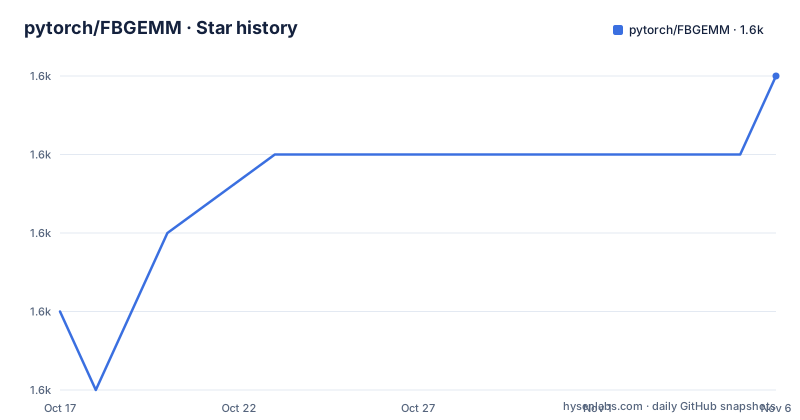
Star history
- pytorch/FBGEMM1,598 ★ · +3
| Repository | 2026-10-17 | 2026-11-06 |
|---|---|---|
| pytorch/FBGEMM | 1.6k | 1.6k |
3 Stars in the last 20 days, measured from the daily GitHub snapshot. Compare with other projects
Editorial analysis
FBGEMM's inference-specific matrix and convolution scope
FBGEMM, short for Facebook GEneral Matrix Multiplication, addresses a specific server-side inference problem: performing matrix multiplication and convolution with low-precision arithmetic at useful throughput. The repository describes it as a C++ library rather than a general application framework. That distinction matters because its design is tied to the memory and numerical constraints of inference workloads.
The documented focus is small-batch matrix multiplication. This is a narrower target than the full range of workloads covered by conventional GEMM libraries. The README specifically highlights efficient low-precision general matrix multiplication for small batch sizes, along with convolution support. Teams working on recommendation systems, where model calls may have modest batch dimensions and large embedding-related tensor operations, are more likely to encounter the intended use case than teams seeking a general replacement for every dense linear algebra operation.
FBGEMM also addresses accuracy loss, an unavoidable concern when inference uses reduced numeric precision. The README names row-wise quantization and outlier-aware quantization as techniques that minimize accuracy loss. This is the central engineering compromise in the project. Reducing memory traffic can make inference cheaper, but the implementation must preserve enough numerical information for the model's output to remain acceptable.
The project is not limited to one package. The repository publishes three related packages with separate documentation and features: FBGEMM, FBGEMM_GPU, and FBGEMM_GPU GenAI. Choosing the repository alone does not determine which component should be integrated.
FBGEMM_GPU's PyTorch and recommendation-system layer
FBGEMM_GPU is the GPU-oriented package in the repository. According to the README, it consists of PyTorch GPU operator libraries built on FBGEMM and targets both training and inference, with particular emphasis on recommendation systems. This package is the relevant entry point for teams that want GPU operators integrated with PyTorch rather than directly linking the C++ library.
Its architecture is layered. FBGEMM supplies the low-level numerical and kernel foundation, while FBGEMM_GPU exposes collections of PyTorch GPU operators for use by models and frameworks. The README links to a separate document under `fbgemm_gpu/README.md`, which is the correct place to inspect the supported operator set, build requirements, and package-specific details. The top-level README does not claim that every PyTorch operation is replaced by FBGEMM_GPU.
Recommendation systems are explicitly named as a focus. That makes the package more relevant to teams dealing with embedding tables, sparse recommendation data, or GPU inference paths than to projects whose only need is an isolated convolution kernel. However, the repository excerpt does not document a complete list of supported hardware, model types, or deployment frameworks. Those details cannot be inferred from the project name or from the existence of GPU operators.
FBGEMM_GPU also differs from the CPU-oriented FBGEMM package in its stated use. FBGEMM is described as a backend for PyTorch quantized operators on x86 machines, while FBGEMM_GPU is presented as a collection of GPU operator libraries. An evaluation should therefore identify the execution device and package before comparing integration options.
FBGEMM_GPU GenAI's separate quantization and collective scope
FBGEMM_GPU GenAI is not merely another label for the same GPU package. The README identifies it as a collection of PyTorch GPU operator libraries designed for generative AI applications. It specifically gives FP8 row-wise quantization and collective communications as examples of its focus.
This separation has practical consequences. FP8 row-wise quantization addresses reduced-precision model operations, while collective communications are relevant when multiple accelerator processes need to coordinate. Those examples point toward a narrower generative AI systems workload than general recommendation inference. They also show why a team should not select a package solely because it contains the FBGEMM name.
The project documentation points readers to `fbgemm_gpu/experimental/gen_ai/README.md` for this package. The README does not provide the operator-level API, supported collective backends, GPU requirements, or compatibility information. It would therefore be unsafe to assume that the experimental package has the same stability, build process, or deployment support as the main FBGEMM_GPU package. The word experimental appears in the documentation path, but the README does not define its support policy.
For an engineer, the package choice can be summarized by workload and integration target. Use FBGEMM when the requirement is low-precision server-side matrix multiplication or convolution. Examine FBGEMM_GPU when the requirement is PyTorch GPU operators, especially in recommendation systems. Examine FBGEMM_GPU GenAI when the requirement includes generative AI operators such as row-wise FP8 quantization or collective communication.
Quantization, fusion, and bandwidth-oriented design
The documented design addresses two related inference constraints: arithmetic cost and memory movement. FBGEMM uses fusion opportunities to reduce the cost of lower-precision matrix multiplication when operations are bandwidth-bound. In this context, fusion means combining operations so that intermediate data does not need to be repeatedly written and read in the same way as separate implementations.
The README does not enumerate every fused operator or describe the internal scheduling rules. It does establish that fusion is part of the library's approach, rather than presenting the project as a collection of isolated mathematical routines. This is important when interpreting its purpose. FBGEMM is designed around the way data moves through inference operations, not only around completing a matrix multiplication.
Quantization is equally central. Row-wise quantization applies quantization information at a granularity associated with rows, while outlier-aware quantization is named as another accuracy-loss-minimizing technique. The README does not specify accepted numerical formats, calibration procedures, or error bounds. It also does not claim that these techniques preserve accuracy for every model. Numerical validation remains an application-specific requirement.
The project is consequently a fit for organizations that can compare implementations under their own model shapes and batch sizes. A kernel optimized for small batches may not be the right choice for a workload dominated by very large batches, and low precision may be unacceptable for sensitive numerical paths. The repository excerpt supports those as design considerations, but it does not provide a workload-selection table.
Building FBGEMM and performing a first package-specific check
The README does not include a complete installation command, Python package name, version pin, or first-run example for the three FBGEMM packages. It directs readers to the full documentation at `https://pytorch.org/FBGEMM` for building, installation, development, the current support matrix, and API documentation. It also points package-specific readers to `fbgemm_gpu/README.md` and `fbgemm_gpu/experimental/gen_ai/README.md`.
Because no installation steps are documented in the top-level README, there is no justified command to reproduce here. Copying a package install command from a different FBGEMM package would risk selecting the wrong artifact or build target. A first real use should begin with the package-specific documentation, then verify that the selected package supports the intended CPU or GPU environment.
For the CPU-oriented FBGEMM package, the first useful check is the quantized-operator path described in the README. It identifies PyTorch quantized operators on x86 machines as a backend use case. For FBGEMM_GPU, the first check is the separate GPU README and its operator documentation. For FBGEMM_GPU GenAI, the first check is the experimental package README. These are different integration surfaces and should not be treated as interchangeable.
The repository's top-level build files include `CMakeLists.txt`, `BUILD.bazel`, `MODULE.bazel`, and `WORKSPACE.bazel`. Those files indicate that the source tree has multiple build-system entry points, but the README does not explain which one to select for a particular package. The documentation link is therefore necessary before attempting a build.
FBGEMM limitations, hardware fit, and maintenance boundaries
FBGEMM has several boundaries that matter during adoption. First, the main package is focused on server-side inference, while FBGEMM_GPU also covers training and inference. A team needing a general-purpose training or scientific linear algebra library should not assume that the repository's positioning covers its use case.
Second, the README does not document hardware compatibility, supported operating systems beyond the x86 CPU reference, build flags, package versions, or API guarantees. It links to a support matrix, which signals that such information exists elsewhere, but the matrix itself is not present here. Hardware selection should therefore be treated as unresolved until the linked documentation and the target deployment environment agree.
Third, quantization can change numerical results. The README presents row-wise quantization and outlier-aware quantization as techniques for minimizing accuracy loss, not as proof that loss is eliminated. Models with unusual distributions, sensitive layers, or strict output requirements need their own validation. The README does not describe fallback behavior or a general accuracy report.
The repository is not archived, and its last push was on 2026-10-15. That fact establishes recent repository activity, but it does not by itself guarantee compatibility with a particular PyTorch version, CUDA release, GPU, or CPU. The listed releases also show separate FBGEMM_GPU releases, including v1.8.0 on 2026-07-22, v1.7.0 on 2026-05-18, and v1.6.0 on 2026-03-30. Release names do not replace checking the package-specific compatibility documentation.
FBGEMM's relationship to PyTorch and other matrix backends
The clearest documented relationship is with PyTorch. The README says FBGEMM is used as a backend for PyTorch quantized operators on x86 machines and links directly to PyTorch's quantized CPU operator source. FBGEMM_GPU adds PyTorch GPU operator libraries for training and inference. This is an integration path, not merely a claim that FBGEMM exposes an unrelated C++ API.
Compared with using only PyTorch's default operator implementations, the proposed benefit is access to specialized low-precision kernels and quantization-oriented techniques. The README does not provide performance measurements, so it does not establish that FBGEMM will be faster for every tensor shape, model, or device.
Compared with a general-purpose GEMM library, FBGEMM has a more explicit inference and low-precision emphasis. A general-purpose library may be a better fit when broad shape coverage, arbitrary precision, or a conventional linear algebra API is the priority. FBGEMM is the more specific choice when the workload matches its small-batch, bandwidth-oriented inference design. The documented community Huawei Ascend NPU port also illustrates that hardware coverage can be expanded separately, but it is a community-maintained implementation and should not be treated as part of the upstream package support matrix.
Editorial conclusion
Adopt FBGEMM when server-side inference needs low-precision matrix operations, quantized accuracy controls, or PyTorch operator implementations, especially for recommendation systems. Do not treat it as a general linear algebra package or begin integration until you have checked the package-specific documentation, current hardware support matrix, accuracy behavior for your tensors, and the licensing terms in the repository's LICENSE file. For an initial engineering decision, the boundary is clear: FBGEMM addresses performance-sensitive inference kernels, while it does not provide a documented all-purpose workload selection interface.
Frequently asked questions
What is FBGEMM used for?
FBGEMM is a low-precision matrix multiplication and convolution library intended primarily for server-side inference. The repository also publishes GPU operator packages for PyTorch training, inference, recommendation systems, and generative AI applications.
How do I install FBGEMM?
The README does not provide a complete installation command. It directs users to `https://pytorch.org/FBGEMM` for build and installation documentation, with additional package-specific documentation for FBGEMM_GPU and FBGEMM_GPU GenAI.
Which FBGEMM package should I choose?
Choose FBGEMM for low-precision CPU-oriented server inference, FBGEMM_GPU for PyTorch GPU operators with a recommendation-system emphasis, and FBGEMM_GPU GenAI for generative AI operators such as FP8 row-wise quantization and collective communications.
Official sources
Add this badge to your README
If you maintain this project, the badge below links readers to this analysis and shows its maintenance status from the daily GitHub snapshot. Paste the markdown into your README; add ?metric=license or ?metric=stars to the image URL for a different field.

[](https://hysenlabs.com/projects/pytorch-fbgemm)Star history chart for your README
[](https://hysenlabs.com/projects/pytorch-fbgemm)Was this useful?