Thinking Claude was a prompt library, and it retired itself
Let your Claude able to think
At a glance
- What is it?
- Thinking Claude was a browser extension plus a set of versioned prompt files that told Claude to think before answering, and the file now opens by saying the repository is retired because Claude became a reasoning model with thinking of its own. The author also states it was never aimed at benchmarks, since the capability is set by the base model.
- Who is it for?
- Thinking Claude is worth reading now as a document rather than adopting: the instruction sets are dated prompt engineering from late 2024, the extension is a renderer for output the model produced anyway, and the author has retired both. Nothing here belongs in a product.
- Can I use it commercially?
- Yes. MIT is a permissive licence: you can use, modify and sell software built on it, as long as you keep its copyright and licence notices.
- Is it still maintained?
- Activity is slowing. The repository last received commits 7 months ago.
- What is it written in?
- Mainly TypeScript, according to GitHub's language statistics.
Answers come from the project's GitHub data, last synced on November 14, 2026, and from our analysis. They are not legal advice.
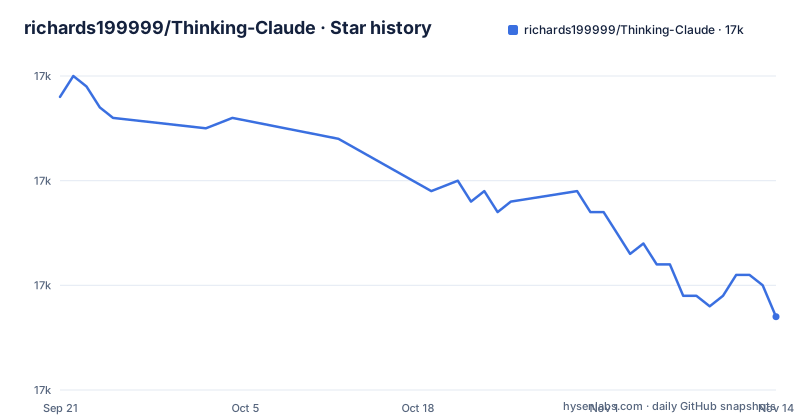
Star history
- richards199999/Thinking-Claude17,007 ★ · -21
| Repository | 2026-09-21 | 2026-11-14 |
|---|---|---|
| richards199999/Thinking-Claude | 17k | 17k |
-21 Stars in the last 54 days, measured from the daily GitHub snapshot. Compare with other projects
Editorial analysis
The first thing in the file is a note saying the project is retired
The repository opens with a caution block and it is unambiguous. It says this repository has been retired, that Claude is already a reasoning model with strong built-in thinking capabilities, and that this makes the project unnecessary. It thanks the people who contributed. Nothing else in the file contradicts that, and the version history agrees: the last three tags are extension releases from December 2024 and January 2025, and the last push recorded for the repository is 2026-04-07. That makes the retirement reason the most useful thing in the project, because it is a specific and falsifiable claim about a capability moving from a prompt into a model, stated by the person who spent the most effort trying to fake it.
The product was a versioned prompt library with a renderer attached
Strip away the extension and this is a directory of prompt files. The structure listing shows model_instructions/ holding a changelog and six dated documents whose names encode three things: a version prefix, an optional tier of lite or extensive, and a date. They run from a 3.5 set in mid-November 2024 through 4, 4-lite, 5-lite, 5.1 and finally 5.1-extensive in the first week of December. The project describes the first component as a set of instructions that guides the model to think deeply and systematically before responding. So the whole idea is a library of system-prompt-shaped text, versioned against model generations, and the six files are the entire active life of the work.
The author rules out the benchmark reading before you can assume it
There is a note early in the file that pre-empts the question every prompt project gets asked, and it deserves to be read rather than skimmed. It says this is not aimed at benchmarks or huge leaps in maths or anything of that kind, because those outcomes are pre-determined by the base model, which it names as a 3.5 Sonnet. The stated goal is to explore how far the model's deep mindset could be pushed, and the observation offered is that in daily use the model's internal monologue is interesting to read. That is an honest framing for a prompt experiment, and it has a practical consequence: there is no number here to compare, and a reader should not go looking for one. The project is a demonstration that a prompt can make a model articulate its reasoning, and the file says that is all it is.
The extension reformats output the model was going to produce anyway
The extension's feature list is short and it never claims to change what the model says. It makes the thinking process easy to read, folds and unfolds sections, copies any part with one click, works automatically with new messages, and calls itself a clean modern design. In other words it is a renderer. It takes the text the model emitted, finds structure in it, and presents that structure as collapsible sections so a long reasoning trace is navigable. That is a real interface problem and a reasonable thing to solve, and it is also exactly why the project became unnecessary: once the model has a thinking feature of its own, there is a native way to read the same content, and a script that reformats someone else's page into sections is no longer the shortest path to it.
The install path runs through a six-click route in someone else's settings screen
The getting-started section is the most fragile part of the design and it is worth quoting in full. You open the model's web app, click the style selector at the bottom of the input box, then create and edit styles, then create a custom style, then choose to describe the style manually, then start from scratch, then switch on the use custom instructions advanced option, and only then paste the contents of the file you want from the instructions directory. That is a chain of seven decisions inside a user interface this project does not control, each of them a place where a label change or a removed setting breaks the path. The file hedges the browser store route as possibly outdated and recommends the manual route instead, which tells you the author had the same concern. A prompt library with a stable file format would not have needed that.
Two generations of one browser extension, and a second browser unfinished
The extensions directory holds three things: a current Chrome version described as having a modern architecture and features, a legacy Chrome version explicitly marked deprecated, and a Firefox version marked as in development. So at its peak the project carried two generations of one extension for one browser and an unfinished second browser, and the installation section had to offer two routes for the same artefact, one of which it did not trust. That is the maintenance cost of this shape of project, and it is worth naming precisely: the instructions are stable text that never needs fixing, and the extension is a scraper of a live third-party interface that needs fixing constantly. The effort in this repository went where the churn was, not where the idea was.
The root manifest installs a git hook and nothing else
The package file at the root is a private package with one script, which prepares the git hooks, and one development dependency, the hook library itself. There is no build script, no test script and no release automation at the root, which means the extension was built with tooling inside its own directory and released as a zip of a built folder that you then load unpacked, exactly as the manual instructions describe. The version history matches that arrangement: two extension releases on the same day in January 2025, a few hours apart. It is a small project with a small toolchain, and the absence of a root build is not an oversight so much as the honest shape of something that is mostly text with a browser extension attached.
Editorial conclusion
Thinking Claude is worth reading now as a document rather than adopting: the instruction sets are dated prompt engineering from late 2024, the extension is a renderer for output the model produced anyway, and the author has retired both. Nothing here belongs in a product. If you are curious how this kind of prompt scaffolding was put together, the model_instructions directory is the artefact worth reading, and the extension's structure is a fair example of an extension that reformats a third-party page. If you want the capability itself, it is a model feature now, which is exactly the retirement note's point: a prompt that teaches a model to think stops being useful the moment the model thinks, and the author says so plainly rather than keeping the project alive on a promise of updates.
Frequently asked questions
what is thinking claude
It was a project with two parts: a thinking protocol, described as a set of instructions guiding Claude to think deeply and systematically before responding, and a browser extension that made that thinking easier to read. It also carried versioned instruction files for several model generations, from a 3.5 set through to an extensive 5.1 set. The repository is now retired.
What does thinking do on Claude?
In this project it meant pasting a custom instruction set into the model's own advanced custom instructions field, so the model was told to reason step by step before answering instead of answering directly. The extension then reformatted the resulting trace into collapsible sections, one-click copy and automatic handling of new messages.
How to show thinking in Claude?
The extension's stated feature is making the thinking process easy to read, by folding and unfolding the different parts and letting you copy any part with one click, working automatically as new messages arrive. It works against the model's web interface, and the project notes it is now retired.
is adaptive thinking claude good
The project does not make a capability claim, and it says so in advance: it is not aimed at benchmarks or large gains in areas like mathematics, because those are set by the base model rather than by a prompt. The stated goal was to explore how far the model's reasoning could be pushed, and the author notes the reasoning is worth reading in daily use.
Official sources
Add this badge to your README
If you maintain this project, the badge below links readers to this analysis and shows its maintenance status from the daily GitHub snapshot. Paste the markdown into your README; add ?metric=license or ?metric=stars to the image URL for a different field.

[](https://hysenlabs.com/projects/richards199999-thinking-claude)Star history chart for your README
[](https://hysenlabs.com/projects/richards199999-thinking-claude)Was this useful?