Zero-WAM: a robot policy that reads human video prompts, and what its RoboTwin numbers cover
In‑Context World‑Action Modeling from Human Videos for Open‑Ended Task Generalization
At a glance
- What is it?
- Zero-WAM is the research code behind a causal video-action policy that takes either language or a human demonstration video as its task instruction. This look covers the generated training pairs, the seven-task simulation result, and the heavy environment you need to reproduce it.
- Who is it for?
- Zero-WAM is a research release for robotics groups that already run CUDA, PyTorch 2.9.0 and RoboTwin 2.0 and want to study human-video prompting. It is not a drop-in robot controller, its headline numbers come from seven simulated tasks, and its version is 0.0.0 with no releases, so budget time for environment work first.
- Can I use it commercially?
- Yes. Apache-2.0 is a permissive licence: you can use, modify and sell software built on it, as long as you keep its copyright and licence notices.
- Is it still maintained?
- Yes. The repository last received commits 72 days ago.
- What is it written in?
- Mainly Python, according to GitHub's language statistics.
Answers come from the project's GitHub data, last synced on November 26, 2026, and from our analysis. They are not legal advice.
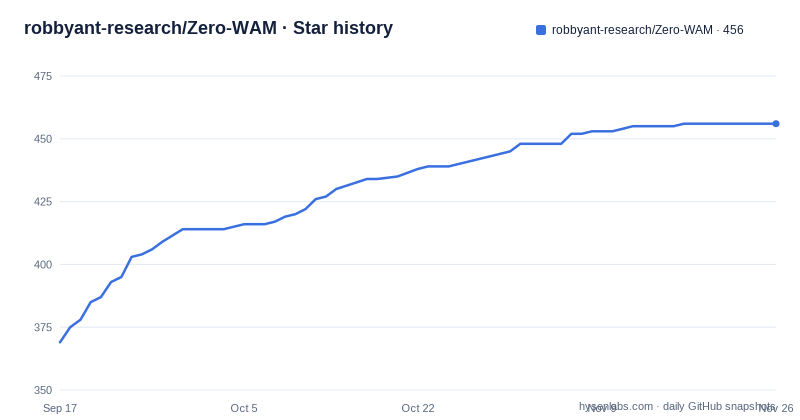
Star history
- robbyant-research/Zero-WAM456 ★ · +87
| Repository | 2026-09-17 | 2026-11-26 |
|---|---|---|
| robbyant-research/Zero-WAM | 369 | 456 |
87 Stars in the last 70 days, measured from the daily GitHub snapshot. Compare with other projects
Editorial analysis
One causal policy takes a language instruction or a human video as the task
Zero-WAM targets zero-shot cross-task robotic manipulation: the policy must execute tasks that were never practiced during training, using only context available at deployment time. The way it does that is in-context learning. A human demonstration video acts as a visual task specification, and a causal video-action policy predicts future robot observations and executable actions from either a language instruction or a human video prompt.
The reader-facing consequence is the input contract. You do not describe a new task with a reward function or a fine-tuning run. You supply a prompt, which is a sentence or a video of a person doing the thing. The flip side is that the quality of that prompt now decides the result, and the repository gives no number for how much a poor or mismatched human video costs. The authors list the work as coming from Robbyant, HKUST (GZ), and HKUST.
Human videos in the training pairs are generated from robot trajectories, not filmed
The training pairs come from a pipeline called HumanGen. It starts from task-sampled robot trajectories that retain executable actions. A VLM parses task semantics and object-state changes, an image editor converts the first robot frame into a human observation, and a video generation model synthesizes the corresponding human manipulation video. Each generated video is filtered for semantic preservation and physical plausibility, then paired back with the original robot trajectory as an in-context learning sample.
The totals are 74.2K human-robot ICL pairs over 8.6K tasks, drawn from external, in-house, simulation, and real-world sources. The practical point is that the human side of each pair is synthetic. The policy is trained to follow generated human motion, so the filtering step is the only safeguard against pairs where the human video and the robot action disagree. The robot-domain corpus, Task-diverse VA, re-samples five public robotic video-action datasets at the task level and yields more than 6K manipulation tasks and about 400K robot trajectories per training epoch.
The in-context future chunk prediction objective exists to stop the model ignoring the video
A known risk with prompt-conditioned policies is shortcut learning: the model can learn to act from the robot's own observations and treat the prompt as noise. Zero-WAM proposes an in-context future chunk prediction objective to reduce that shortcut and strengthen the use of human video prompts.
The repository packages the model code under wan_va, and the package data entry ships assets/*.pt and assets/norm_stats/*.json files with it. The name of the baseline in the results table, WAN-Action, sits next to that directory name. Training dependencies are an optional group in pyproject.toml: lerobot==0.3.3, scipy, and wandb. If you only plan to run evaluation or inference you can leave that group out, but anyone who wants to retrain must add it and should expect the pinned lerobot version to constrain the rest of the environment.
Seven unseen RoboTwin 2.0 tasks average 46.95%, and one of them stays near 9%
The README reports 46.95% average zero-shot success across seven unseen RoboTwin 2.0 tasks, ahead of LingBot-VA by 29.50 percentage points. The WAN-Action baseline averages 10.98 and LingBot-VA averages 17.45.
Per task, Zero-WAM scores 84.87 on placing an empty cup, 69.14 on moving a stapler to a pad, 59.00 on opening a microwave, 47.00 on stamping a seal, 35.00 on placing bread in a basket, 24.67 on placing an object on a scale, and 9.00 on stacking blocks three. Both baselines score 0.00 on that last task.
The limits are plain. These are seven simulated tasks, and the average hides a spread from about 9% to about 85%. A task like stack blocks three is still mostly failing. The README also states zero-shot generalization in real-world unseen task configurations, but the portion I can see gives no real-world numbers, so do not read the 46.95% as a hardware result.
The environment pins torch 2.9.0, CUDA 12.6 and a second install of RoboTwin 2.0
The environment section asks for Python 3.10 with a CUDA-enabled PyTorch environment, then one command.
python -m pip install -r requirements.txt --no-build-isolationrequirements.txt pins torch==2.9.0, torchvision==0.24.0, torchaudio==2.9.0, diffusers==0.36.0, transformers==4.55.2, numpy==1.26.4, and lerobot==0.3.3, and it includes flash_attn. The pyproject.toml requires Python at least 3.10 and below 4.0, and caps numpy below 2. INSTALL.md gives the exact tested environment as Python 3.10, PyTorch 2.9.0, CUDA 12.6, plus the tested RoboTwin revision and two unseen-task success-condition updates.
RoboTwin evaluation additionally needs a working RoboTwin 2.0 installation from its own guide. That means two environments to get right, and if your RoboTwin checkout differs from the tested revision or lacks the two success-condition updates, your numbers will not be comparable with the table above. Without an NVIDIA GPU stack there is no supported path.
Only two HumanGen subsets are released, so the full 74.2K pairs are not downloadable here
The repository releases Simulation ICL (RoboTwin) and Pre-training ICL (External). The simulation subset holds about 2,500 human-robot ICL pairs across 50 RoboTwin 2.0 tasks, with 43 tasks used for training and seven unseen tasks for evaluation. It includes robot videos, robot actions, human-video latents, robot-video latents, and a pairing manifest. The pre-training subset is built from five robotic video-action datasets. The in-house and real-world portions of the 74.2K pairs are not among the two releases named.
The download is a Hugging Face CLI call.
hf download Robbyant-Research/HumanGen \
  --repo-type dataset \
  --local-dir "${PROJECT_ROOT}/data/HumanGen" \
  --include "icl_configs/*" \
  --include "robotwin_data/**" \
  --include "human_latents/robotwin/**"
The command needs `python -m pip install "huggingface_hub[cli]"` first and PROJECT_ROOT exported as the repository path. The result is a layout of robotwin_data per task, human_latents/robotwin run folders of .pth files, and icl_configs/ICL_config_robotwin.json. Reproducing training on the full corpus is therefore not possible from what is released.
Version 0.0.0, no GitHub releases, and checkpoints that live on Hugging Face
pyproject.toml sets the package version to 0.0.0 and names the authors only as Zero-WAM Authors. The repository has no GitHub releases, so there is no tag to pin; use a commit hash. The last push was 2026-09-15, and the repository is not archived. The license is Apache-2.0, with the text in LICENSE.txt.
Model weights are linked from Hugging Face under robbyant-research: zero-wam-pretrain and zero-wam-posttrain-robotwin, along with the HumanGen dataset. The Makefile has one target, format, which runs isort and black. The repository also holds example/demo and example/robotwin folders, an evaluation directory, a script directory and a tests directory. A paper is linked on arXiv and a project page at robbyant-research.github.io/Zero-WAM. Because the code ships as a research artifact, expect to read it rather than call a stable API.
Editorial conclusion
Zero-WAM is a research release for robotics groups that already run CUDA, PyTorch 2.9.0 and RoboTwin 2.0 and want to study human-video prompting. It is not a drop-in robot controller, its headline numbers come from seven simulated tasks, and its version is 0.0.0 with no releases, so budget time for environment work first.
Frequently asked questions
What is Zero-WAM from robbyant-research?
Zero-WAM is research code for in-context world-action modeling from human videos. A causal video-action policy predicts future robot observations and actions from a language instruction or a human video prompt.
What do I need to run Zero-WAM?
Python 3.10 with a CUDA-enabled PyTorch environment, with the tested setup being PyTorch 2.9.0 and CUDA 12.6. RoboTwin evaluation also needs a separate RoboTwin 2.0 installation.
How well does Zero-WAM do on unseen tasks?
It reports 46.95% average zero-shot success on seven unseen RoboTwin 2.0 tasks, compared with 17.45 for LingBot-VA and 10.98 for WAN-Action.
Official sources
Add this badge to your README
If you maintain this project, the badge below links readers to this analysis and shows its maintenance status from the daily GitHub snapshot. Paste the markdown into your README; add ?metric=license or ?metric=stars to the image URL for a different field.

[](https://hysenlabs.com/projects/robbyant-research-zero-wam)Star history chart for your README
[](https://hysenlabs.com/projects/robbyant-research-zero-wam)Was this useful?