RPGJS v5: one TypeScript codebase for browser RPGs and MMORPGs
Framework to create an RPG or MMORPG (with the same code) in the browser with Typescript
At a glance
- What is it?
- RPGJS v5 provides game and multiplayer foundations for browser-based 2D RPG projects, including maps, events, combat, inventory, interfaces, and synchronization. Its main trade-off is adopting a framework-specific architecture whose root package remains marked as beta.
- Who is it for?
- RPGJS fits teams that want to build a TypeScript 2D RPG with multiplayer support already represented in the runtime. It is a weaker fit for projects that require a stable root release, a different rendering model, or infrastructure outside the documented packages.
- Can I use it commercially?
- Yes. MIT is a permissive licence: you can use, modify and sell software built on it, as long as you keep its copyright and licence notices.
- Is it still maintained?
- Yes. The repository last received commits 4 days ago.
- What is it written in?
- Mainly TypeScript, according to GitHub's language statistics.
Answers come from the project's GitHub data, last synced on November 6, 2026, and from our analysis. They are not legal advice.
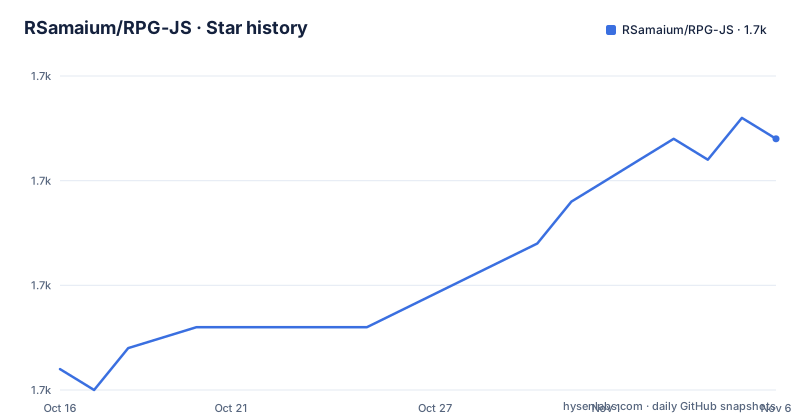
Star history
- RSamaium/RPG-JS1,682 ★ · +11
| Repository | 2026-10-16 | 2026-11-06 |
|---|---|---|
| RSamaium/RPG-JS | 1.7k | 1.7k |
11 Stars in the last 21 days, measured from the daily GitHub snapshot. Compare with other projects
Editorial analysis
The browser RPG problem RPGJS addresses
RPGJS targets developers who need more than a rendering library for a 2D role-playing game. The framework supplies structures for maps, events, dialogs, inventory, skills, combat, saves, graphical interfaces, and multiplayer synchronization, allowing the developer to concentrate on game rules and content. Its intended audience ranges from developers building a conventional single-player browser RPG to teams that expect to deploy the same gameplay code with multiplayer enabled.
The central design decision is that gameplay is written against a server-owned model. A standalone project can place the server in the browser, but multiplayer mode keeps the server authoritative. Each map then becomes a synchronized room. This matters because movement, interaction, inventory changes, and combat state can cross a network boundary in an MMORPG. RPGJS moves those concerns into the runtime rather than leaving a game project to assemble synchronization from scratch.
The choice is not that every project needs an MMORPG from its first release. It is that multiplayer does not require replacing the gameplay layer with a separate implementation. The README describes switching between standalone and MMORPG operation as a runtime configuration choice. That makes the framework relevant to teams whose product roadmap may expand, although the repository does not state that network deployment, persistence, moderation, or operational work becomes free after the switch.
RPGJS event definitions and server-owned gameplay
Game content is expressed as TypeScript event definitions rather than configured entirely through visual data. An event has identity, initialization behavior, and asynchronous action handlers that receive an `RpgPlayer`. The handler can ask the player to choose an option, inspect player state, modify gold, grant an item, and display another message. This model puts rules close to code, which suits programmers who want type checking, composability, and direct control over asynchronous interactions.
The documented merchant pattern is representative. Its `onAction` method calls `player.showChoices`, checks the selected `value`, verifies that the player has enough gold, subtracts the cost, adds the item, and shows a closing message. Because the action receives the player and event context, custom game rules can follow the same path instead of being scattered across interface handlers.
Combat can be attached to an event through battle AI. The README gives `new BattleAi(this, { enemyType: EnemyType.Aggressive })` for an enemy that fights back, while its broader feature list includes action combat, projectiles, states, classes, skills, and items. Maps can come from RPGJS Studio or Tiled, with events, world maps, shared scenarios, per-player scenarios, weather, lighting, and day and night cycles available through the documented world layer.
That flexibility also creates a dependency on framework conventions. The project does not behave like a blank canvas wrapper. Events, players, providers, and server context are part of its programming model, so application code will not transfer to an unrelated engine without rewriting.
Standalone and MMORPG modes in RPGJS v5
A standalone RPG uses `provideRpg(startServer)`, which places the RPG server in the browser. The starter output identifies this arrangement with `Server: runs in the browser (standalone)`. It preserves the same server-oriented gameplay model without requiring an external multiplayer service at that stage.
The MMORPG arrangement replaces that provider with `provideMmorpg({})` and is started with `RPG_TYPE=mmorpg npm run dev`. According to the README, the server remains authoritative, every map acts as a synchronized room, and the client predicts movement. Prediction is followed by reconciliation against server state, which allows local movement to feel immediate without granting the client final authority.
This is a more specific multiplayer model than merely broadcasting player coordinates. Inventory, choices, combat, maps, and other server-owned interactions can participate in synchronization, although the README does not document their packet formats or reconciliation thresholds. It also does not promise that all browser gameplay is latency-free. Server validation, bandwidth, persistence, reconnect behavior, and the cost of hosting a Node or Cloudflare Workers service remain deployment concerns.
The custom architecture alternative is to build a conventional client renderer and a separate authoritative networking service from the start, with each feature team defining serialization, state ownership, prediction, and persistence. That approach offers tighter control over protocols, but it directly incurs the integration work that RPGJS packages. RPGJS is the better fit when adopting its event model and runtime is preferable to owning that networking stack.
Starting RPGJS v5 from the documented starter
The README provides a short route from an empty directory to a playable starter. The starter is retrieved from the RPGJS organization with the `v5` branch, dependencies are installed, and the development server is started:
npx degit rpgjs/starter#v5 my-rpg-game
cd my-rpg-game
npm install
npm run dev
The documented output reports a Vite server at `http://localhost:5173/`, RPGJS v5.0.0, and a game entry at `./src/standalone.ts`. Opening that address should show the starter hero walking around a map. This is a real first use because it exercises the standalone provider and the browser-hosted server rather than merely installing a package.
Developers can switch the generated project to multiplayer by changing its provider and startup environment. The README documents this exact command:
RPG_TYPE=mmorpg npm run devThe corresponding TypeScript configuration replaces `provideRpg(startServer)` with `provideMmorpg({})` inside the `startGame` call. After editing the starter, restarting the development command should exercise the MMORPG provider. The README does not provide a separate authentication setup command for this path, so account and deployment configuration must be handled through the linked MMORPG documentation rather than assumed.
For editor or coding-assistant integration, RPGJS also documents an optional authoring command:
npx skills add https://github.com/RSamaium/RPG-JS#v5That command teaches a coding assistant about RPGJS v5. It is not required to run the game.
RPGJS interface, map, testing, and deployment boundaries
The browser interface layer includes a title screen, dialogs, menus, shops, HUD elements, character selection, themes, mobile controls, and gamepad support. Vue overlays are included, and `@rpgjs/ui-css` has a published 5.1.0 release dated 2026-10-13. Maps can be painted in RPGJS Studio or produced through Tiled support, which gives teams a choice of authoring environments rather than requiring a single map editor.
The repository layout confirms that RPGJS is a monorepo containing multiple packages and samples, including `samples/cloudflare-mmorpg/` and `samples/sample-dev/`. Root scripts include `test` for Vitest and `test:types` for TypeScript type tests. Documentation generation is separated into client API, map API, and player API commands, suggesting that public API boundaries receive dedicated checking through `api:boundary`.
Deployment is documented for Node and Cloudflare Workers. The project states that it does not lock users to one database or host. That portability is useful for an MMORPG prototype, but it does not mean the repository supplies production operations. The README does not document database schemas, migration procedures, account security defaults, observability, rate limiting, anti-cheat policy, backup policy, or rollback. Those areas must be verified before treating the starter as a production service.
RPGJS is therefore a development framework, not a complete hosting control plane. Its included accounts and chat features describe application capabilities, while operational requirements for a public game remain unspecified in the README.
RPGJS release status, upgrades, and MIT implications
The repository is not archived, and its last push was on 2026-10-14. Those are maintenance signals, not a guarantee of API stability. The most important release detail is the root `package.json`, which identifies `rpgjs` as version `5.0.0-beta.7`. Recent published v5 packages include `@rpgjs/[email protected]`, `@rpgjs/[email protected]`, and `@rpgjs/[email protected]`, all dated 2026-10-13. This means the repository root and individual package release lines should not be treated as one identical version.
Upgrading a v5 project may involve coordinating framework packages, the Vite integration, UI packages, and the starter layout. The repository includes `.changeset/`, package versioning scripts, a lockfile, and a public API boundary check, but the README does not provide a complete upgrade policy or compatibility matrix. The existence of `compatibilityV4Plugin()` from `@rpgjs/vite` offers a documented compatibility path for a v4 project layout on the v5 runtime. It does not mean that behavior and APIs are universally identical.
The repository uses the MIT License. That permits use, modification, distribution, and private development under the license's conditions, including preservation of its copyright and permission notice. This is a practical summary of the stated license, not legal advice. Teams should still inspect the full `LICENSE` file when distributing copies or bundling the framework.
Editorial conclusion
RPGJS fits teams that want to build a TypeScript 2D RPG with multiplayer support already represented in the runtime. It is a weaker fit for projects that require a stable root release, a different rendering model, or infrastructure outside the documented packages. Before adoption, verify the package version intended for production, the deployment target, and whether the server-authoritative design matches the game's interaction requirements. The concrete adoption boundary is RPGJS v5: the repository root remains at 5.0.0-beta.7 despite current v5 package releases.
Frequently asked questions
How do I install and start RPGJS v5?
The README uses `npx degit rpgjs/starter#v5`, followed by `npm install` and `npm run dev`. The documented local URL is `http://localhost:5173/`.
Can the same RPGJS project run as a single-player game and an MMORPG?
Yes. The documented configuration switches from `provideRpg(startServer)` to `provideMmorpg({})`. The project also documents `RPG_TYPE=mmorpg npm run dev` for MMORPG mode.
Is the RPGJS root package a stable v5 release?
The repository root `package.json` lists `rpgjs` as `5.0.0-beta.7`, although individual v5 packages have later releases. Verify the exact package versions intended for production before adopting the root package.
Which map and interface tools does RPGJS support?
The README documents maps made with RPGJS Studio or Tiled. It also lists dialogs, menus, shops, HUD elements, themes, character selection, mobile controls, gamepad support, and Vue overlays.
How are multiplayer movement and map state handled?
According to the README, multiplayer uses an authoritative server, synchronized map rooms, client movement prediction, and reconciliation. The README does not explain the underlying synchronization protocol.
Can an RPGJS v4 project run on v5?
The README states that `compatibilityV4Plugin()` from `@rpgjs/vite` can run a v4 project layout on the v5 runtime. It points to a migration guide but does not claim that every API behaves unchanged.
Official sources
Add this badge to your README
If you maintain this project, the badge below links readers to this analysis and shows its maintenance status from the daily GitHub snapshot. Paste the markdown into your README; add ?metric=license or ?metric=stars to the image URL for a different field.

[](https://hysenlabs.com/projects/rsamaium-rpg-js)Star history chart for your README
[](https://hysenlabs.com/projects/rsamaium-rpg-js)Was this useful?