Graph Fraud Detection Papers is one markdown file, and its chatbot is linked under two accounts
A curated list of Graph/Transformer-based fraud, anomaly, and outlier detection papers & resources
At a glance
- What is it?
- Graph Fraud Detection Papers is a reading list, not software: the repository tree contains a single README, the filterable dashboard and the retrieval chatbot it advertises both live elsewhere, and the default branch is still master. Inside the list itself the metadata columns are inconsistent in ways that affect whether an entry is usable.
- Who is it for?
- Graph Fraud Detection Papers is worth bookmarking as an index if you work on fraud or anomaly detection with graph or language models, and it is worth treating as a starting point rather than a bibliography, because the list is unversioned, unlicensed and self-correcting. Before you rely on it, check three things.
- Can I use it commercially?
- Not without permission. GitHub finds no licence file in the repository, and without a licence all rights are reserved by default: you may read the code but not reuse it. Check the README, or ask the authors, before using it.
- Is it still maintained?
- Yes. The repository last received commits 63 days ago.
- What is it written in?
- GitHub does not report a main language for this repository.
Answers come from the project's GitHub data, last synced on November 15, 2026, and from our analysis. They are not legal advice.
Star history
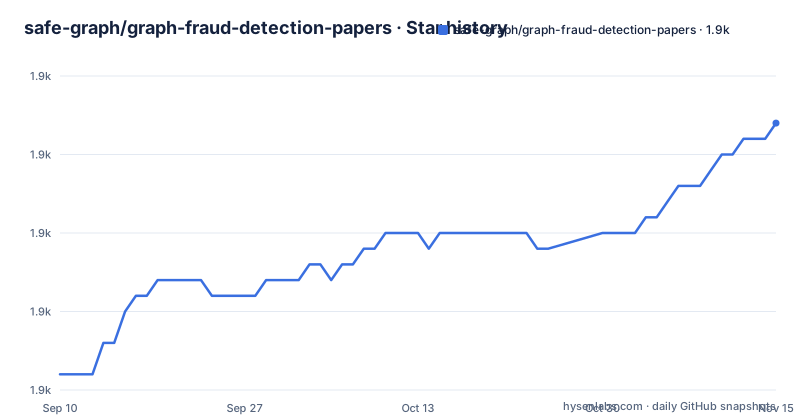
- safe-graph/graph-fraud-detection-papers1,907 ★ · +16
| Repository | 2026-09-10 | 2026-11-15 |
|---|---|---|
| safe-graph/graph-fraud-detection-papers | 1.9k | 1.9k |
16 Stars in the last 66 days, measured from the daily GitHub snapshot. Compare with other projects
Editorial analysis
The repository tree contains exactly one file, and the default branch is master
Everything this project is lives in a single markdown document at the root. There is no source directory, no data file, no site configuration, no script and no test. The listing of top level entries returns one name.
That has consequences for how the list is maintained and how it is consumed. A link to a paper is the only artefact, so there is nothing to clone-and-run, nothing to build a pipeline against, and nothing to pin. The default branch is also still named master, which is worth knowing before anyone writes automation against it.
The two things the page advertises as companions are both elsewhere. The interactive dashboard for viewing, filtering and searching the papers is hosted as a separate site on the project's own pages domain, and the branch name carries no guarantee that the two stay in step. The dashboard is described as covering the papers listed in the repository, which is a claim about synchronisation that nothing in the repository enforces.
The list's own scope is stated in one line at the top: graph and transformer based papers and resources for fraud, anomaly and outlier detection. The table of contents then splits the deep learning material by publication year, from 2026 back through a bucket for everything before 2020, with a separate section for non deep learning graph papers since 2014, and four more sections for tools, datasets, surveys and other resources.
The retrieval chatbot is linked under two different accounts
The page describes a local retrieval augmented chatbot built to support deep research over the papers, and says it covers 250 publicly accessible papers. It then sends the reader to that project's own README for deployment instructions.
Two different paths appear for it. In the link block at the top of the document, the chatbot is addressed under the same organisation as the list itself. In the prose that describes it, the address is under a personal account with a different name. Same project description, two homes.
That matters for anyone trying to deploy it. A reader who follows the link block gets a repository path owned by the list's organisation; a reader who follows the sentence gets a path owned by someone else. If those two are the same repository under two names, one of them is a redirect. If they are not, the list is describing one tool and linking another, and nothing on the page says which.
The phrase describing ownership is also worth reading closely. The document says the team developed the chatbot, then points at a repository under a different account and delegates the setup instructions to that repository's own documentation. A 250 paper corpus is also a fixed snapshot: it cannot include anything added to the list afterwards, and no date is attached to it.
The code column holds three different things, and two of them are not code
The LLM and transformer section is a five column table: year, title, venue, paper and code. The code column is where the table loses its meaning.
Three states appear in it. Some rows carry a repository address, which is usable. One row carries a link to an anonymous review service rather than to any code at all. And many rows carry the plain word for a link with no address behind it, which renders as text and resolves to nothing.
That last state is the majority. Reading down the visible rows, the entries with a real repository include a blockchain fraud detector, a prompting framework, a fake news propagation method, a sequential user behaviour model, an audit log analysis project, a text attributed graph anomaly project, and a code link that points into a subdirectory of a much larger identity project. Everything else in the column is the bare word.
So a reader filtering for reproducible work has no way to tell from the column alone which rows have code, and has to count the address cells by eye. The dashboard the page points at is described as searchable, so the distinction may be drawn there instead, but the repository itself does not make it.
One paper appears twice in the same table with two different links
Within the visible rows of the LLM table, a dual granularity prompting framework for fraud detection with graph enhanced language models appears twice.
The two rows agree on the title and on the venue, both naming an AAAI 2026 publication. They disagree on everything else. The first carries the conference proceedings address on the AAAI site and a code address pointing at a computing lab's repository. The second carries a preprint address on arXiv and no code link at all.
Both are plausible ways to reach the same paper, a proceedings version and a preprint version. The problem is that nothing marks them as the same work, so a reader scanning the list counts it twice, and a reader building a count of recent work in this area overstates it by one. The venue column makes it worse rather than better, because both rows claim a conference while one of the two links is to a preprint server, which is exactly the distinction the venue column is supposed to carry.
A list of this kind is normally maintained by appending, and a duplicate that survives publication is a sign that no second pass reconciles entries against each other.
The venue column mixes accepted papers with a preprint placeholder
The venue field is doing two jobs at once, and it does not mark which is which.
Some rows name a real publication venue and year: a data mining conference, an artificial intelligence conference, a computational linguistics conference, a computer vision conference, a security conference, a machine learning conference and one of its workshops, an industry track of a language conference, and two journals. Those entries are the strongest signal in the table, because a named venue means a review process happened.
Other rows carry the preprint server name and the year instead, which is the same information as saying the work is on arXiv. The column does not say that the two kinds are different, so a row naming a conference and a row naming a preprint server look equally settled.
One row makes the point sharply. A fraud detection paper with language model enhanced graph neural networks, listed as a 2025 data mining conference paper, links its PDF from a personal domain rather than from the publisher's own library. That may be the authors' copy, and authors are entitled to post them, but a reader following the link cannot tell whether the version matches the proceedings version, and a reader scanning for paywalled full text will find a free copy with no indication of which version it is.
It presents as an awesome list while the tree holds no licence, conduct or contributing file
The header block links to the awesome list directory, to the stargazers page and to a pull request template service. Those three badges are the convention for a community reading list, and they set an expectation: a list that anyone can contribute to under a stated licence.
The repository does not meet that expectation. The top level holds one file. There is no licence file, and the repository's own licence field is empty. There is no code of conduct, no contributing guide and no support file. There are also no releases, which for a document is a defensible choice, but combined with a branch still named master it means there is no version a reader can pin to.
The licence gap is the one that matters in practice. A reading list is copied into other people's notes, slides and internal wikis constantly, and the list itself does not state a licence for that. Its contents are links to other people's papers, which carry their own terms, but the curation itself is unlicensed.
The pull request badge points at a template service rather than at a document in the repository, so a new contributor is sent somewhere else to learn the format.
The declared scope is three problems, and the visible rows cover four
The description promises fraud, anomaly and outlier detection. The visible rows of the LLM table include work on early fake news detection through agent driven virtual propagation, work on reconstructing attack stories from audit logs using subgraph anomaly detection, work on detecting generated spam reviews by combining language embeddings with graph networks, and work on fraud detection in double entry bookkeeping.
None of those are fraud detection in the transaction sense, and one of them, the audit log work, is a security operations task that happens to use anomaly detection as a method. They are all reasonable entries for someone interested in anomaly detection, and all of them are reachable from a reader who arrived looking for transaction fraud.
The same broadening shows in the model choices. The table includes a foundation model named after a payments company, a detector that spans heterogeneous blockchains, and an interpretable credit card fraud detector built with reinforcement learning. Naming commercial systems in a neutral reading list is normal, but it does mean a reader has to judge each entry's relationship to any company they work for.
For the deep learning graph material the year buckets run from the current year back to 2020, with one bucket for earlier work, and non deep learning graph work since 2014 gets its own section. That structure implies an editorial line about what counts as deep learning, and the list does not state where it draws it.
Editorial conclusion
Graph Fraud Detection Papers is worth bookmarking as an index if you work on fraud or anomaly detection with graph or language models, and it is worth treating as a starting point rather than a bibliography, because the list is unversioned, unlicensed and self-correcting. Before you rely on it, check three things. Confirm the paper link actually resolves, since the same title appears twice with different links and one conference entry points at a personal domain rather than a publisher. Check whether the code column holds a repository or just the word for one, because most rows hold only the word. And confirm the venue, because a preprint placeholder and an accepted conference paper sit in the same column with the same weight.
Frequently asked questions
What is the Graph Fraud Detection Papers repository?
It is a curated reading list of graph and transformer based papers and resources for fraud, anomaly and outlier detection. The repository tree contains a single README file, so there is no code, no data and no releases to work with.
Does Graph Fraud Detection Papers include code for the papers it lists?
Sometimes. The code column mixes real repository addresses with links to an anonymous review service and with a bare word that carries no address. Most visible rows hold only that bare word, so a reader filtering for reproducible work has to count the address cells rather than filter the column.
Where is the dashboard for Graph Fraud Detection Papers?
On a separate site hosted under the project's own pages domain, described as an interactive dashboard for viewing, filtering and searching the papers in the repository. It is not part of the repository, which holds only a README, and the default branch is still named master.
What is the RAG chatbot mentioned by Graph Fraud Detection Papers?
A local retrieval augmented chatbot built to support deep research, described as covering 250 publicly accessible papers, with deployment instructions deferred to its own documentation. The page links it under the list's organisation in the header and under a different account in the prose.
Is there a duplicate entry in the Graph Fraud Detection Papers list?
Yes. A dual granularity prompting framework for fraud detection with graph enhanced language models appears twice in the visible LLM table. Both rows name the same 2026 conference venue, one links the proceedings address and a code repository and the other links a preprint address with no code.
What licence is Graph Fraud Detection Papers under?
None is stated. The repository tree holds a single README with no licence file, and the repository's own licence field is empty. There is also no code of conduct, no contributing guide and no tagged release to pin to.
Official sources
Add this badge to your README
If you maintain this project, the badge below links readers to this analysis and shows its maintenance status from the daily GitHub snapshot. Paste the markdown into your README; add ?metric=license or ?metric=stars to the image URL for a different field.

[](https://hysenlabs.com/projects/safe-graph-graph-fraud-detection-papers)Star history chart for your README
[](https://hysenlabs.com/projects/safe-graph-graph-fraud-detection-papers)Was this useful?