Freelancing in Finland, a guide written by someone who already made the jump
The ultimate resource for transitioning to freelancing for software developers 👩💻🇫🇮
At a glance
- What is it?
- The freelancing-in-finland repository is a long, maintained guide for software developers in Finland who want to switch to freelance work through their own limited liability company, organised as preparation, foundation and operation. Its value is not the facts about Finnish tax law, it is the ordering of the steps and the 200 hours of research behind them.
- Who is it for?
- Freelancing in Finland suits a software developer who already lives in Finland, has been there more than three months, and is deciding whether to register a limited company for freelance work, because the guide answers the questions the official material answers only obliquely.
- Can I use it commercially?
- Yes. MIT is a permissive licence: you can use, modify and sell software built on it, as long as you keep its copyright and licence notices.
- Is it still maintained?
- Yes. The repository last received commits 82 days ago.
- What is it written in?
- GitHub does not report a main language for this repository.
Answers come from the project's GitHub data, last synced on November 6, 2026, and from our analysis. They are not legal advice.
Star history
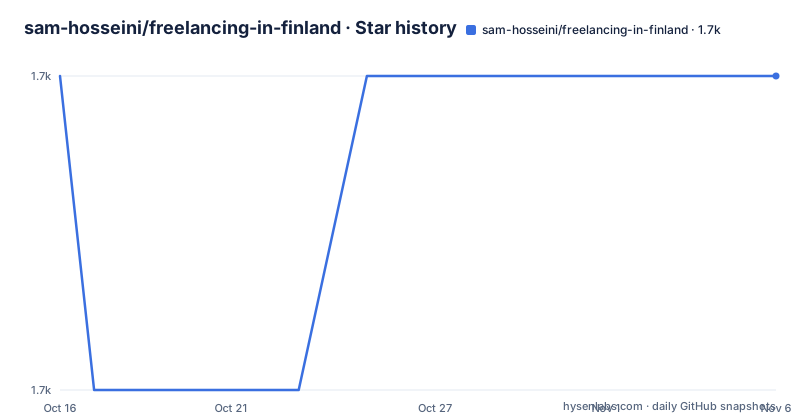
- sam-hosseini/freelancing-in-finland1,668 ★ · +0
| Repository | 2026-10-16 | 2026-11-06 |
|---|---|---|
| sam-hosseini/freelancing-in-finland | 1.7k | 1.7k |
0 Stars in the last 21 days, measured from the daily GitHub snapshot. Compare with other projects
Editorial analysis
The problem is filtering the official guides, not missing information
The introduction states the value proposition more precisely than a tagline would. In Finland, there are many extensive guides by authorities which have precise information about everything you need to know. The problem is that the target audience of those guides is the general population, and out of every 100 pages maybe 10 pages are relevant to your situation.
The cost of that filtering is quantified. The guide claims you would lose an estimated 200 hours figuring out how to do everything on your own, and says the author knows this because that is how much time he had to spend himself.
The three questions the author actually had are the ones that show the gap. How to get freelance projects without any network of your own. What you need to do before you establish your company to be eligible for government grants. And when you set up your company, what are your recurring obligations.
None of those is a question a government guide answers directly, and each one is the kind of question where reading ten pages of general material leaves you still not knowing what to do on Monday. That is the gap the guide fills, and it is a gap of selection and ordering rather than of missing information.
The target audience is stated as a four point list, and it is worth checking against your own situation before you read further. You are the audience if you are already living in Finland for more than three months, already working as a software developer, want to work as an independent freelance software developer, and want to establish a limited liability company to offer your freelance services through it.
The licence is MIT, which the README notes means use it at your own risk, and it carries the author's own disclaimer that he is not a lawyer and that no statement in the guide should be thought of as legal advice. That is a sensible framing for a document of this kind, and it should be read as a research project rather than as authority.
The last push was on 2026-08-17, the default branch is main, and the repository has no GitHub releases.
Three phases, and the order is the argument
The table of contents is organised into three phases, and the naming makes the sequencing explicit. Preparation is what to do before you establish your company. Foundation is what to do after you establish your company. Operation is what to do to run your company.
The preparation list is short and it is the part most people get wrong. Know how to handle your upcoming new immigration status. Network with freelance brokers and organizations. Wait until you find a project you like. Apply for startup grant. Quit your job. Establish your company.
The order matters more than the items. Finding a project before registering means you register a company you already know you can bill. The startup grant is listed before the company is established, which is a direct answer to the author's own question about what you need to do before you establish your company to be eligible for government grants. And quitting the job comes before establishing the company, so the transition from employee to freelancer is the last step rather than the first.
The foundation list is where the recurring machinery appears, and it is the list that answers the third of the author's questions. Apply for general housing allowance. Open a business bank account. Find an accountant. Buy social security insurance YEL. Understand your new personal taxation situation. Consider buying corporate liability insurance. Consider joining a union. Consider joining an unemployment fund. Consider arranging statutory preventive occupational healthcare, SPOH. Consider buying health insurance. Consider buying voluntary pension insurance. Consider selling your personal work-related tools to your company.
The last item is a small one that tells you the guide was written by someone who has done this. A self-employed developer with a laptop, a desk and a monitor has assets that arguably belong to the business, and moving them across has a tax consequence. It is exactly the kind of detail that official guides omit and that a person who has already made the mistake mentions.
The operation list is the shortest and the most concrete. Offer yourself benefits that you like. Offer yourself daily allowance when you travel for business. Send your invoices carefully. Take out money from your company in the most tax optimal way. Ensure that your obligations are fulfilled continuously. And a references section.
The consultation section, and why the sponsorship matters
There is a section for people who have questions specific to their case, and the author offers personal consultation. The background he gives is a useful indicator of how the material was produced.
He started working as a software developer in 2015 and established his company in 2019. He published the guide in 2020 and has kept it up to date ever since. And since 2019 he has spent over 1000 hours researching everything, with a link to a single commit that accounts for 40 hours of that.
The commit link is the interesting detail. It is a public record of a large amount of work on the document, which means a reader can see how the research was done and how long each pass took, rather than taking the claim on trust.
The consultation is offered for two situations. For someone who has not started and is deciding whether to make the jump, he can describe what it is like and what to expect. For someone who has just established the company and does not have the time or energy to read the whole guide, he can give specific help quickly.
The sponsorship disclosure is the part a reader should notice. eAccounting Finland Oy is the exclusive sponsor of the guide, and the author's justification is that he has been using their accounting services for his own company for five or more years, so he is recommending what he uses himself with proper skin in the game. His stated reasons are that he is extremely sensitive to fulfilling his company's obligations and they have not missed a deadline in five years, that every question got a reply by email within one to two days, and that their tax planning advice has saved his company money.
That is a genuine endorsement from a user rather than a paid testimonial, but it is still an advertisement for a paid service. A reader who is choosing an accountant should notice that the guide names exactly one, and that naming it is what keeps the guide funded.
How the document is built, and the ebook export
The repository is small in code terms and large in text terms. The top level holds the README.md, an ebook/ directory, images/, an opencode.json, a package.json with two dependencies, a package-lock.json, a LICENSE.md, a .all-contributorsrc and an .opencode/ directory.
The package.json is worth reading because it shows how the document is maintained, and it is a tiny toolchain. The two dependencies are all-contributors-cli at 6.26.1 and markdown-toc at 1.2.0, and there are four scripts. The table-of-contents script runs markdown-toc against README.md with the bullets flag and an ignore flag, and the contributors-list script runs all-contributors generate. The build script runs those two in order.
So the table of contents at the top of the README is generated rather than hand-maintained, and the contributor list is generated too. For a document that has been edited repeatedly since 2020, that matters, because a hand-maintained table of contents drifts the first time a section is renamed.
The two export scripts are the interesting part. The export:epub script concatenates ebook/meta_data.md and README.md into a file named Freelancing in Finland with the current date. The export:pdf script does the same thing with ebook/cover_image.md in place of meta_data.md. Neither is a real EPUB or PDF export, they are markdown concatenations with different front matter, named after the formats the author wants to distribute, and the actual conversion is left to another tool.
That is an honest trade for a personal guide. The content lives in one markdown file, the front matter is separated so it can be swapped, and the export is a concatenation. It is not reproducible publishing, but it is maintainable.
The .opencode/ directory and the opencode.json at the root suggest the document is also worked on with an AI coding assistant in the loop, which is a reasonable thing to have for a text project and one more piece of evidence about how the writing is done.
Editorial conclusion
Freelancing in Finland suits a software developer who already lives in Finland, has been there more than three months, and is deciding whether to register a limited company for freelance work, because the guide answers the questions the official material answers only obliquely. It is the wrong choice for someone outside Finland, since every step is specific to Finnish immigration, YEL insurance and taxation, and it is the wrong choice if you want a legal opinion, because the author states plainly that he is not a lawyer and that no statement should be treated as legal advice. Before relying on it, check the dates in the guide against current Finnish rules, and treat the sponsorship of the accounting firm as what it is, an advertisement for a paid service the author uses himself.
Frequently asked questions
Who is the freelancing-in-finland guide for?
The README states four conditions. You must already be living in Finland for more than three months, already be working as a software developer, want to work as an independent freelance software developer, and want to establish a limited liability company to offer your services through. It is not a guide for developers outside Finland.
What does the guide cover, in order?
It is organised in three phases. Preparation covers handling your upcoming immigration status, networking with freelance brokers and organizations, finding a project, applying for a startup grant, quitting your job and establishing the company. Foundation covers housing allowance, a business bank account, an accountant, YEL social security insurance, personal taxation, liability insurance, a union, an unemployment fund, SPOH healthcare, health and pension insurance, and selling personal tools to the company. Operation covers benefits, daily allowance, invoicing, taking money out tax optimally, and fulfilling obligations continuously.
Is the guide legally authoritative?
No, and the README says so directly. The guide is under the MIT licence, which the author notes means use it at your own risk, and he states that he is not a lawyer and that no statement in the guide should be thought of as legal advice.
How current and well-researched is the guide?
The author started as a software developer in 2015, established his company in 2019, published the guide in 2020 and has kept it up to date since, spending over 1000 hours researching the material, with a linked commit that accounts for 40 hours of that work in a single commit.
Who sponsors the guide?
eAccounting Finland Oy is the exclusive sponsor. The author says he has used their accounting services for his own company for five or more years and recommends them on that basis, and asks that readers who decide to use them because of the introduction say so, to increase the chance of the sponsorship continuing.
Official sources
Add this badge to your README
If you maintain this project, the badge below links readers to this analysis and shows its maintenance status from the daily GitHub snapshot. Paste the markdown into your README; add ?metric=license or ?metric=stars to the image URL for a different field.

[](https://hysenlabs.com/projects/sam-hosseini-freelancing-in-finland)Star history chart for your README
[](https://hysenlabs.com/projects/sam-hosseini-freelancing-in-finland)Was this useful?