Simpl is a page per browser feature, checked by linters and nothing else
Simplest possible examples of HTML, CSS and Javascript:
At a glance
- What is it?
- Simpl is the repository behind simpl.info, a set of smallest possible HTML, CSS and JavaScript examples served straight from the gh-pages branch. There is no library to install and no test suite: what runs is a Grunt task that lints JavaScript and CSS, which tells you exactly how much the examples are verified.
- Who is it for?
- Simpl is a reference to read, not a package to install: there is no module to add to a build and no release to pin. Use it when you want one minimal page per browser feature and you are willing to open each example in the browser you actually target.
- Can I use it commercially?
- Yes. Apache-2.0 is a permissive licence: you can use, modify and sell software built on it, as long as you keep its copyright and licence notices.
- Is it still maintained?
- Yes. The repository last received commits 16 days ago.
- What is it written in?
- Mainly HTML, according to GitHub's language statistics.
Answers come from the project's GitHub data, last synced on November 15, 2026, and from our analysis. They are not legal advice.
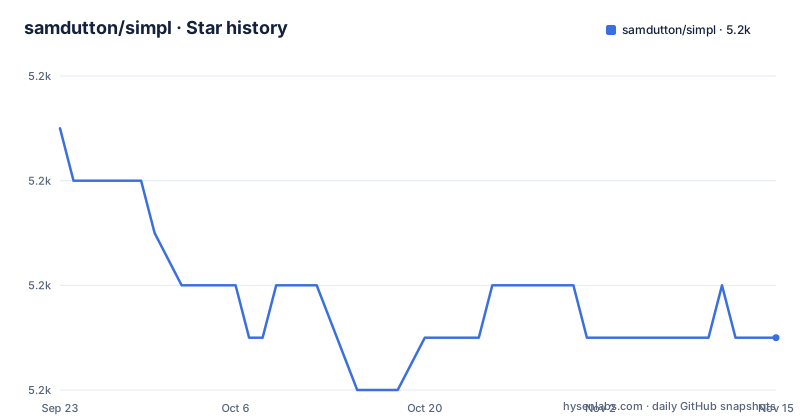
Star history
- samdutton/simpl5,181 ★ · -4
| Repository | 2026-09-23 | 2026-11-15 |
|---|---|---|
| samdutton/simpl | 5.2k | 5.2k |
-4 Stars in the last 53 days, measured from the daily GitHub snapshot. Compare with other projects
Editorial analysis
One directory per browser feature, published from the default branch
simpl.info is a website of simplest possible code examples, and this repository is that website rather than a library that other projects import. The default branch is `gh-pages`, so the branch you clone is the one the pages are served from, and a `CNAME` file at the root carries the custom domain. There is no framework and no bundler in the manifest, and no compiled output that a consumer is meant to load.
The taxonomy is the directory names. Each one is a subject: `ajax/`, `appcache/`, `av1/`, `battery/`, `canplaytype/`, `canvas/`, `cors/`, `datalist/`, `details/`, `devicemotion/`, `deviceorientation/`, `es6-modules/`, `eventsource/`, `fetch/`, `filesystem/`, `flexboxexpand/`, `flexvideo/`, `fullscreen/`, `geolocation/`, `getusermedia/`, alongside CSS subjects such as `cssfilters/`, `cssmenu/`, `cssregions/`, `csstextindent/` and `csstransition/`.
The practical consequence is simple: you read a page, you take the idea, and you copy the code. There is nothing here to add to a `package.json` and nothing whose version you have to track.
grunt --verbose is the whole test command, and every dependency says latest
The manifest declares one script, and the dependencies exist to run it:
  "scripts": {
    "test": "grunt --verbose"
  },
  "dependencies": {
    "eslint": "latest",
    "grunt": "latest",
    "grunt-cli": "latest",
    "grunt-eslint": "latest",
    "grunt-stylelint": "latest",
    "minimatch": "latest",
    "stylelint": "latest",
    "stylelint-config-standard": "latest"
  }
Two things follow from those eight lines. First, the `test` script does not test anything: it hands Grunt the build file and prints what Grunt does. Second, every dependency is the string `latest`, so nothing is pinned. Two people cloning the site on different days resolve different versions of eslint and stylelint, and a lint failure after an unrelated upgrade is a real possibility rather than a hypothetical one.
The `main` field points at `Gruntfile.js`, the repository's own build script, which is the clearest signal in the manifest that this package is not meant to be imported by anything.
LICENSE is Apache-2.0 while package.json says BSD-3-Clause
The README's License section gives the Apache License 2.0 notice, headed by `Copyright 2017 Google, Inc.`, and it ends with the line "Please note: this is not a Google product." The repository is reported as Apache-2.0.
The manifest disagrees. Its `license` field reads `"license": "BSD-3-Clause"`. Nothing else in the repository explains the discrepancy, and neither license text is included for BSD-3-Clause the way the Apache text is.
That matters only if you intend to reuse a page, and at that moment it matters completely. Automated license scanners read the manifest field and will report BSD-3-Clause; a human reading the README sees Apache terms with a 2017 copyright holder. Check which file your own process trusts before the copy, not after.
The repository URL in package.json points at samdutton/webrtc.git
Three fields in the manifest describe three different things. `homepage` and `bugs.url` both point at samdutton/simpl, which is correct. `repository.url` points somewhere else entirely:
  "repository": {
    "type": "git",
    "url": "https://github.com/samdutton/webrtc.git"
  },
The keywords tell the same story from the other side: `webrtc`, `demos`, `samples`, `javascript`, none of which describes a site of HTML and CSS examples. The `name` field, `simpl.info`, does describe the site.
The consequence is provenance. Any tool that resolves a package back to its source, or asks where bugs go, will land on a WebRTC repository instead of this one, and a code search for `simpl.info` as a dependency leads to the wrong history. Author the metadata by hand here rather than trusting what the manifest says.
Eslint and Stylelint carry the whole validation story
The repository's quality tooling is visible in its dotfiles: `.eslintrc`, `.eslintignore`, `.stylelintrc`, `.lighthouseci/`, `.travis.yml`, plus the `Gruntfile.js` that the `main` field points at. The dependency list matches that shape exactly, being eslint, grunt, grunt-cli, grunt-eslint, grunt-stylelint, minimatch, stylelint and stylelint-config-standard, and nothing else.
Style beyond the linters is handled by documents rather than tooling: `CONTRIBUTING.md` for contributions, and a Developer's Guide hosted as a document covering code style, structure and validation. The `.lighthouseci/` directory points at performance auditing, which is the one place the site is measured by something other than a linter.
What none of this does is execute a page. A demo that throws on load, draws the wrong thing, or has stopped working with a browser update passes `grunt --verbose`, because that task reads files and checks syntax. Every behavioural claim on the site rests on a human having opened the page.
No releases, a 2017 copyright line, and a branch that is also the live site
There are no releases in this repository, so there is no version to install and nothing to pin in a lockfile. The root holds an `AUTHORS` file and the copyright line in the README says 2017, while the last push was on 2026-10-30. The gap between those two dates is the honest summary of the project: pages that were written years ago and a repository that still takes corrections.
Because the default branch is `gh-pages`, the code and the published site are the same branch. A commit to a page under `canvas/` is a change to the live site, not a private edit, and a revert is a change to the live site too. `404.html` and `favicon.ico` sit at the root for the same reason: they are site assets that have to be on that branch.
There is also a bare `foo` entry at the root with no extension and no trailing slash, next to the directories and those two files. A repository of minimal examples collecting one stray artifact of that kind is a fair signal of how contributions land.
Editorial conclusion
Simpl is a reference to read, not a package to install: there is no module to add to a build and no release to pin. Use it when you want one minimal page per browser feature and you are willing to open each example in the browser you actually target. Skip it as a source of patterns for production code, because the only automated check is linting, and a page can pass it while behaving wrongly. Before copying a page, read `LICENSE` yourself, because it does not agree with the license string in `package.json`.
Frequently asked questions
What is Simpl and what is simpl.info?
Simpl is a website of simplest possible code examples for HTML, CSS and JavaScript, published at simpl.info. The repository is that site, served from its default gh-pages branch, with one directory per browser feature or CSS subject.
Can I install Simpl as a dependency or pin a version of it?
No. The repository has no releases, and package.json names Gruntfile.js as its main entry point with a single test script that runs grunt verbose. There is nothing to install, so treat the repository as pages to read.
Which license applies to the Simpl examples?
The README's License section gives the Apache License 2.0 notice with a 2017 copyright line from Google, Inc., and the repository is reported as Apache-2.0, while package.json declares BSD-3-Clause. The two disagree, so read the LICENSE file yourself before reusing a page.
Official sources
Add this badge to your README
If you maintain this project, the badge below links readers to this analysis and shows its maintenance status from the daily GitHub snapshot. Paste the markdown into your README; add ?metric=license or ?metric=stars to the image URL for a different field.

[](https://hysenlabs.com/projects/samdutton-simpl)Star history chart for your README
[](https://hysenlabs.com/projects/samdutton-simpl)Was this useful?