The install warning is the first thing on the page, and the only release is from 2024
🔥🔥🔥 An open source alternative to Mint, YNAB, and more. Stay on budget and build wealth without sacrificing your privacy.
At a glance
- What is it?
- financial-freedom is a self-hosted budget application built as a Laravel and Vue modular monolith behind Traefik. Its authors have put it on hold for funding reasons, say in the README not to install it until that message is removed, and have published exactly one release, an alpha from January 2024.
- Who is it for?
- financial-freedom is worth reading as a codebase and worth forking if you want a self-hosted budget tracker, but it is not something to deploy on its current terms. The authors say so themselves: the project is mid-refactor, installing it gives a blank screen, and there is no release newer than the January 2024 alpha.
- Can I use it commercially?
- Yes, with conditions. GPL-3.0 is a copyleft licence: if you distribute software that includes it, you must release that software's source code under the same licence. Running it internally without distributing it does not trigger that obligation.
- Is it still maintained?
- No. The owners have archived the repository on GitHub, so it is read-only and no longer receives changes.
- What is it written in?
- Mainly Vue, according to GitHub's language statistics.
Answers come from the project's GitHub data, last synced on November 22, 2026, and from our analysis. They are not legal advice.
Star history
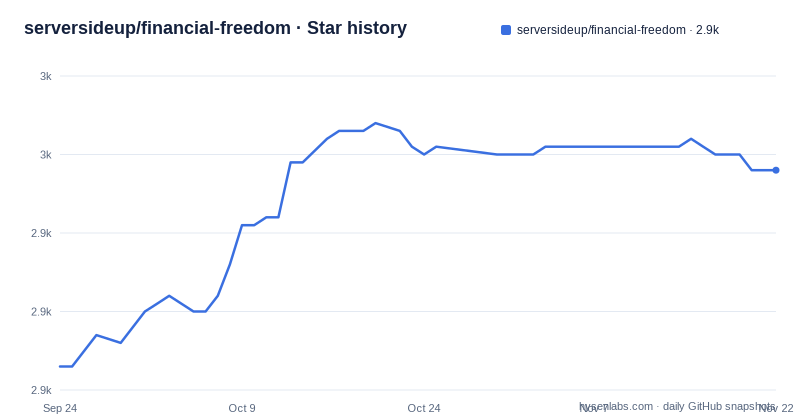
- serversideup/financial-freedom2,948 ★ · +25
| Repository | 2026-09-24 | 2026-11-22 |
|---|---|---|
| serversideup/financial-freedom | 2.9k | 2.9k |
25 Stars in the last 59 days, measured from the daily GitHub snapshot. Compare with other projects
Editorial analysis
A caution notice tells you not to install it
The first substantive thing on the page is a callout that says not to attempt to install the project until the message is removed. The reason given is that it is in the middle of a major refactor and that you will just see a blank screen, with a parenthetical explaining that the release process was being worked on before the project was put on hold. The same notice says you can review or fork the code if you want to see where the work stopped.
The release history backs that up. There is exactly one GitHub release, v0.2.0-alpha1, published 2024-01-10, so there has been no tagged build in more than two years. The recorded last push was on 2026-09-28. The repository is now archived and read-only; the release history and README warning should be read in that context.
The hold is a funding decision argued with a competitor's price
The reason for the pause is written out at length. To make the project succeed the team says it needs working capital to dedicate proper time to development, and it states plainly that it is not seeking venture capital or investors. As a two-person bootstrapped team it is funding the work by building professional products and SaaS services instead.
The argument for that choice uses a competitor's pricing. The text says competitors like Monarch Money charge eight dollars a month while likely profiting through other means, naming stock investments and selling metadata, and that venture-funded companies can keep prices artificially low to squeeze out competition while making money elsewhere. The conclusion drawn is that this is exactly why the project needs to exist, and also that it makes sustainable bootstrapping difficult. It closes with three commitments: this began as a side project that grew faster than expected, it will be self-funded, and it will not take VC money or sell user data.
Registration ships disabled and sessions live in cookies
The example environment file is where the operational settings are, and three of them matter before anyone else can log in. FINANCIAL_FREEDOM_ALLOW_REGISTRATION is false, so a fresh install has no way for a new user to sign up until an operator changes it. SESSION_DRIVER is cookie, so session state is held client side, and SESSION_LIFETIME is 120. The queue connection is synchronous, the cache driver is the file system and the broadcast driver is the log, which is a coherent set of choices for a single-host installation and a deliberately unambitious one.
The application key is the sharpest edge. The example ships APP_KEY as a base64 value reading 1234567890abcdefghijklmnopqrstuvwxyz, with a comment reminding you to run the artisan key generation command. Copying the example file without replacing it leaves an application whose encryption key is published on the front page, which matters more in an application that will hold bank-linked transactions than in most projects.
The root compose file is a stub and four other stacks sit beside it
docker-compose.yml at the repository root is eight lines long and contains two services: Traefik on version 3.0, and a php service that declares a dependency on it. That is the whole default stack. The real configurations are the four files named alongside it, docker-compose.dev.yml, docker-compose.prod.yml, docker-compose.ci.yml and docker-compose.gitpod.yml, plus a Gitpod configuration with its own Dockerfile and a directory called .infrastructure.
Storage follows the same pattern of one real choice and one stub. The database is SQLite, and the example environment file points it at a file under .infrastructure/volume_data/database.sqlite, inside the container's web root rather than on a named volume. Mail goes to a host called mailpit on port 1025, which is a local mail catcher for development. Four environment files are tracked in the repository, the example, a release one and a testing one, so the production and test configuration are both visible in the tree.
A Laravel modular monolith with Inertia and Vue on the front
The repository is a Laravel application with a Vue front end rather than a Vue project. At the root sit artisan, composer.json, composer.lock, phpunit.xml, and the standard Laravel directories bootstrap/, app/, config/, database/, routes/, storage/, public/ and resources/. The modular structure shows up as a Modules/ directory, a modules_statuses.json file, and a vite-module-loader.js that sits next to vite.config.js, which is the pattern a modular Laravel application uses to build each module separately.
The JavaScript side is small and marked private. package.json declares type module, and its only two scripts are dev, which runs Vite with a host flag, and build. There is no test script and no lint script on that side, while the PHP side carries phpunit.xml. The toolchain is Inertia for Vue, Vue 3, Tailwind 3, PostCSS and Vite 5, with a basic SSL plugin so development serves over HTTPS. The lock file is yarn.lock, so the JavaScript dependencies are installed with Yarn while the PHP ones go through Composer.
The client dependencies describe the feature set better than the documentation
The README's feature section is an empty shell, so the dependency list is the better description of what the application does. chart.js with vue-chartjs is a charting layer, papaparse is CSV parsing for import and export, and moment is the date library. Then there are two that describe account handling specifically: zxcvbn, a password strength estimator, and momentum-modal, a modal component. Paired with the headless UI and hero icon packages and the VueUse helpers, that is a budgeting front end with charts, a data import path and a signup flow.
That last combination is worth noticing against the configuration. A password strength meter and a signup modal are shipped in the front end while registration is disabled in the environment file, so the account surface exists in code and is switched off in configuration. Nothing in the documentation lists the features individually; the features block is a table of image cells inside a details element, and the images are the only content it had.
The README has machine-managed regions and a paid business attached
Two regions of the README are wrapped in HTML comment markers, one around the sponsors section and one around the about section, which is how a site generates and rewrites that content. The sponsor list is tiered: a platinum sponsor, a silver sponsor, and two infrastructure sponsors, named as a hosting company, an infrastructure vendor, and a Docker Hub account belonging to the same organisation. The text above it says all of the software is free and open to the world and that none of it arrives without the financial backing of those sponsors.
The same two people named in the about section also run a paid consultancy, advertised further down as two senior Laravel specialists delivering code with predictable monthly pricing and thirty or more years of combined experience. That is the revenue the hold notice names: paid client work funding the free project. Nothing hidden there, but it does mean the project that cannot pay for itself is being carried by commercial work from the same two authors.
Security reports go to a Notion page while SECURITY.md sits in the tree
The contributing section routes everything except code through a different destination. Bugs go to a GitHub issue template, feature requests to a numbered discussion, documentation changes to a readme inside the docs directory, and questions to GitHub Discussions or Discord. Code of conduct is a file in the .github directory and the contribution guidelines are hosted on the project website rather than in the repository.
Critical security issues are the odd one out. The README sends them to a responsible disclosure policy hosted on Notion, while a SECURITY.md file is present at the repository root and is not linked from that instruction. Two things follow. The first is that a security policy split across a repository file and a wiki page is harder to audit than one document, and the second is that a project with no release since 2024 is still asking people to report vulnerabilities in a codebase its authors have labelled unreviewable.
Editorial conclusion
financial-freedom is worth reading as a codebase and worth forking if you want a self-hosted budget tracker, but it is not something to deploy on its current terms. The authors say so themselves: the project is mid-refactor, installing it gives a blank screen, and there is no release newer than the January 2024 alpha. If you fork it anyway, three things need attention before real data goes in. Generate a real application key, because the example environment file ships a placeholder string. Decide about registration, which ships disabled. And look at the session driver, which is configured to keep sessions in cookies on an application intended to hold financial records. The stated reason for the pause is funding, not demand, and it is not a technical one.
Frequently asked questions
Is serversideup/financial-freedom ready to install?
Not by its own account. A caution notice at the top of the README says not to attempt to install it until that message is removed, because it is in the middle of a major refactor and a fresh install shows a blank screen. The only tagged release is v0.2.0-alpha1 from 2024-01-10, and the repository is not archived.
What stack does serversideup/financial-freedom use?
A Laravel back end with a Vue front end built through Vite and Inertia, laid out as a modular application with a Modules directory and a modules status file. It runs behind Traefik in Docker, stores data in a SQLite file, and its JavaScript package manifest is marked private with only dev and build scripts.
How do I create an account on serversideup/financial-freedom?
You have to turn it on yourself. The example environment file ships FINANCIAL_FREEDOM_ALLOW_REGISTRATION as false, and it also configures sessions to live in cookies with a lifetime of 120. The front end carries a password strength library and a signup modal, so the account code exists while the switch is off.
Why is serversideup/financial-freedom on hold?
The two-person team says it needs working capital to fund development and is not seeking venture capital, so it is building paid products and services to pay for the work. It states it will not take VC money or sell user data, and it points to Maybe Finance pausing its own project for similar reasons.
Official sources
Add this badge to your README
If you maintain this project, the badge below links readers to this analysis and shows its maintenance status from the daily GitHub snapshot. Paste the markdown into your README; add ?metric=license or ?metric=stars to the image URL for a different field.

[](https://hysenlabs.com/projects/serversideup-financial-freedom)Star history chart for your README
[](https://hysenlabs.com/projects/serversideup-financial-freedom)Was this useful?