EfficientSAM3: Distilled SAM3 Checkpoints, From 89M Full Students to Text-Only LiteText Variants
EfficientSAM3 compresses SAM3 into lightweight, edge-friendly models via progressive knowledge distillation for fast promptable concept segmentation and tracking.
At a glance
- What is it?
- EfficientSAM3 compresses SAM3 into smaller student models by distillation, in two families: full models with lightweight vision and text encoders, and SAM3-LiteText models that only shrink the text encoder. The install prerequisites and the package metadata disagree, and the license is unclear.
- Who is it for?
- EfficientSAM3 is a useful starting point for researchers who want smaller promptable concept segmentation checkpoints and the distillation code behind them. Do not assume the install notes are right: the README says Python 3.10, the package metadata requires 3.12, and GitHub reports no license, so verify both before building a product on the weights.
- Can I use it commercially?
- The repository metadata does not identify a licence. Check the project’s published terms and any component-specific licences before reuse.
- Is it still maintained?
- Yes. The repository last received commits 106 days ago.
- What is it written in?
- Mainly Jupyter Notebook, according to GitHub's language statistics.
Answers come from the project's GitHub data, last synced on November 25, 2026, and from our analysis. They are not legal advice.
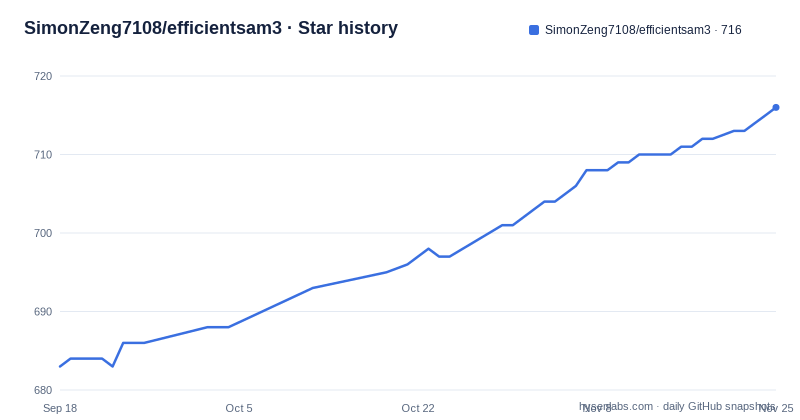
Star history
- SimonZeng7108/efficientsam3716 ★ · +33
| Repository | 2026-09-18 | 2026-11-25 |
|---|---|---|
| SimonZeng7108/efficientsam3 | 683 | 716 |
33 Stars in the last 68 days, measured from the daily GitHub snapshot. Compare with other projects
Editorial analysis
The README says Python 3.10 while pyproject.toml demands 3.12 and torch 2.7
The install section is a short block:
git clone https://github.com/SimonZeng7108/efficientsam3
cd efficientsam3
pip install -e ".[stage1]"
Below it, the prerequisites list Python 3.10 or newer, PyTorch 2.0 or newer, and CUDA 11.8 or newer for GPU support. The package metadata tells a stricter story. The pyproject.toml declares `requires-python = ">=3.12"`, and the `stage1` extra pins `torch>=2.7.0` along with torchvision, mmengine, mmcv 2.1.0 or newer, hydra-core, fairscale, decord, pycocotools and more.
The consequence is that a machine set up exactly to the README prerequisites may fail at `pip install`, because pip will refuse the editable install on Python 3.10 or 3.11. Trust pyproject.toml over the prose and start from Python 3.12 and a recent PyTorch.
The base dependencies are lighter: timm 1.0.17 or newer, numpy, tqdm, `ftfy==6.1.1`, regex, iopath, typing_extensions, huggingface_hub and psutil. The `stage1` extra is the heavy one, since it carries the training and evaluation stack, so expect a large environment even if you only want to load a checkpoint.
Three full students cut SAM3 from 861.5M parameters to roughly 89M to 95M
The full model family replaces both SAM3's vision encoder and its text encoder with lightweight students. Three variants are published. EV-M uses an EfficientViT vision encoder at 22.2M parameters and totals 89.2M. RV-M uses RepViT at 25.6M for a total of 92.7M. TV-M uses TinyViT at 28.3M for 95.3M. All three share a 42.5M distilled text encoder, a 21.0M decoder and 3.5M of other components.
The comparison baseline is ImageSAM3 at 861.5M parameters, made of a 463M vision encoder, a 354M text encoder, a 30.3M transformer and 14.2M other. By that count EV-M is 90% smaller and RV-M and TV-M are 89% smaller.
Those figures measure parameter count, not accuracy or speed. The README describes the students as maintaining competitive performance on downstream benchmarks, but the figures in the visible text are all sizes. The Stage 3 fine-tuned checkpoints, released on 2026-06-11, were fine-tuned on 5% of SA1B data with SACap labels. Before moving a student into an edge application, run it on your own images and compare against SAM3, since a smaller model may miss concepts the large one finds.
SAM3-LiteText only replaces the text encoder, so the model stays above 550M parameters
The second family keeps SAM3's ViT-H vision encoder, about 463M parameters, and swaps in a lightweight MobileCLIP text encoder. The README lists six variants: LiteText-S0 with 42.5M text parameters (550.0M total), LiteText-S1 with 63.5M (571.0M) and LiteText-L with 123.8M (631.3M). Each comes in a 16 and a 32 context length version, giving files such as `sam3_litetext_mobileclip_s0_ctx16.pt`.
The percent smaller figures are 36% for S0, 34% for S1 and 27% for L, measured against the same 861.5M baseline. One entry in the update log says SAM3-LiteText reduces the text encoder by 88% with similar performance, referencing a paper.
So this family is about the text side of the model. If the vision encoder is your bottleneck, LiteText does not help, and a total above 550M parameters is far from edge-sized. Its value is in prompt handling, where the text encoder is the part being shrunk. The context length choice also matters: the variants differ in how many text tokens they handle, and the README table does not say which concept prompts need the longer one. SAM3-LiteText has also been accepted at ICMR2026 and has Hugging Face Transformers documentation.
Loading a checkpoint needs a manual download and a matching set of builder arguments
The quick start for the full model builds EfficientSAM3 from a local checkpoint. Its first lines are:
from sam3.model_builder import build_efficientsam3_image_model
from sam3.model.sam3_image_processor import Sam3Processor
from PIL import Image
The example loads the TV-M model, described as a TinyViT vision encoder plus a MobileCLIP-S0 text encoder, by passing `checkpoint_path="efficientsam3_tinyvit.pt"`, `backbone_type="tinyvit"`, `model_name="11m"`, `text_encoder_type="MobileCLIP-S0"`, `text_encoder_context_length=16` and `load_from_HF=False`.
That last flag is the practical detail. With `load_from_HF=False`, you must download the `.pt` file yourself from the HuggingFace repository first, using the links in the Model Zoo table. The builder arguments also have to match the checkpoint: a RepViT checkpoint needs a different `backbone_type` than the TinyViT one, and the text encoder type and context length must agree with how the weights were trained. A mismatch produces load errors, not a warning.
The LiteText quick start uses a different builder, `build_sam3_image_model`, with the checkpoint `sam3_litetext_mobileclip_s0_ctx16.pt`. The processor class, Sam3Processor, is shared between them.
The license is unknown on GitHub while pyproject.toml says Apache-2.0
GitHub shows no detected license for the repository, and no LICENSE file appears among the top-level entries, which are the README files, data, docs, eval, images, sam3, stage directories and pyproject.toml. The package metadata does carry a statement: `license = {text = "Apache-2.0"}`.
That leaves a gap. A license declared inside a build file is weaker evidence than a license file in the repository, and the README's visible text states no terms for the code or for the checkpoints on HuggingFace. The weights are distilled from SAM3, so the terms that apply to SAM3 are also part of the question.
For a research notebook, this matters little. For anything you ship, ask the authors or check the HuggingFace model card terms before relying on the code or weights commercially. The Apache-2.0 line is a useful signal about the authors' intent, but it is not a substitute for a LICENSE file. The README also lists the authors from the Visual Information Lab at the University of Bristol, the MultiX lab at the University of Amsterdam, the University of Edinburgh and Singapore Management University, which is where to direct a licensing question.
The repository is organised by training stage, and the package version lags the releases
The directory layout follows the training recipe. There are stage1, stage1_geometry_finetune and stage3 folders, each with its own README: README_stage1.md, README_stage1_finetune.md and README_stage3.md, plus README_dataset.md. The sam3 folder holds the model code, with sam3_checkpoints and eval beside it. The update log traces the order: image encoder weights on 2025-12-02, text encoder weights on 2025-12-08 using MobileCLIP S0, S1 and MobileCLIP2 L, geometry-prompt fine-tuned weights on 2026-01-11, and the Stage 3 models on 2026-06-11.
GitHub lists the primary language as Jupyter Notebook, so expect notebooks alongside the Python modules. The release tags run v0.2.0 on 2026-02-18 for SAM3-LiteText, v0.3.0 on 2026-04-13 for EfficientSAM3.1 and the SAM3.1-LiteText image models, and v0.4.0 on 2026-06-11 for the Stage 3 fine-tuned models and a full PCS release. The last push was on 2026-08-11.
The pyproject.toml still says version 0.1.0, so the Python package version does not track the release tags. Pin by git tag or commit, not by the package version printed after install.
Papers and demos exist, but the visible text shows image models rather than tracking
The project description mentions fast promptable concept segmentation and tracking. The README ties itself to two arXiv papers, 2511.15833 and 2602.12173, a project page and a Discord server. The title names progressive hierarchical knowledge distillation from SAM1, SAM2 and SAM3. The SAM3-LiteText line also links a Hugging Face Space that compares it with SAM3.
What the quick start code demonstrates is image processing: an image is opened with PIL, converted to RGB and passed to the processor to create a state. Both quick starts use image model builders, and the release names refer to image models. If you need video tracking, look at the project page and papers instead of assuming the checkpoints do it, because the README examples do not show a tracking call.
Related work that people search for next to this project includes EdgeTAM and EfficientTAM, but the README makes no comparison with them, so there is no basis here for ranking them. The practical way to judge EfficientSAM3 is to run a Stage 3 student and a LiteText model on the same set of images you care about, and compare masks, speed and memory side by side.
Editorial conclusion
EfficientSAM3 is a useful starting point for researchers who want smaller promptable concept segmentation checkpoints and the distillation code behind them. Do not assume the install notes are right: the README says Python 3.10, the package metadata requires 3.12, and GitHub reports no license, so verify both before building a product on the weights.
Frequently asked questions
What is EfficientSAM3?
EfficientSAM3 compresses SAM3 into lightweight, edge-friendly models through progressive knowledge distillation, for promptable concept segmentation. It offers full student models and SAM3-LiteText variants.
How big are the EfficientSAM3 models?
The full models EV-M, RV-M and TV-M have 89.2M, 92.7M and 95.3M parameters, compared with 861.5M for ImageSAM3. The SAM3-LiteText variants range from 550.0M to 631.3M.
What Python version does EfficientSAM3 need?
The README lists Python 3.10 or newer, but pyproject.toml declares requires-python of 3.12 or newer and the stage1 extra needs torch 2.7 or newer. Use Python 3.12.
Official sources
Add this badge to your README
If you maintain this project, the badge below links readers to this analysis and shows its maintenance status from the daily GitHub snapshot. Paste the markdown into your README; add ?metric=license or ?metric=stars to the image URL for a different field.

[](https://hysenlabs.com/projects/simonzeng7108-efficientsam3)Star history chart for your README
[](https://hysenlabs.com/projects/simonzeng7108-efficientsam3)Was this useful?