Skywork-UniPic: three generations of a unified image model in one repository
Open-source SOTA multi-image editing model
At a glance
- What is it?
- The UniPic repository holds model weights and reference implementations for three generations of a unified multimodal model, from a 1.5B parameter autoregressive model to a multi-image editor that accepts up to six input images and runs in eight inference steps. Each generation lives in its own directory with its own weights, its own paper and its own Hugging Face collection, and there are no tagged releases.
- Who is it for?
- Adopt UniPic-3 if your work involves composing or editing several images at once and you want an open implementation with published weights rather than a hosted API. Do not expect a packaged library or a tagged release to depend on, because the repository is a set of directories of weights and reference code with no GitHub releases.
- Can I use it commercially?
- Yes. MIT is a permissive licence: you can use, modify and sell software built on it, as long as you keep its copyright and licence notices.
- Is it still maintained?
- Yes. The repository last received commits 118 days ago.
- What is it written in?
- Mainly Python, according to GitHub's language statistics.
Answers come from the project's GitHub data, last synced on November 7, 2026, and from our analysis. They are not legal advice.
Star history
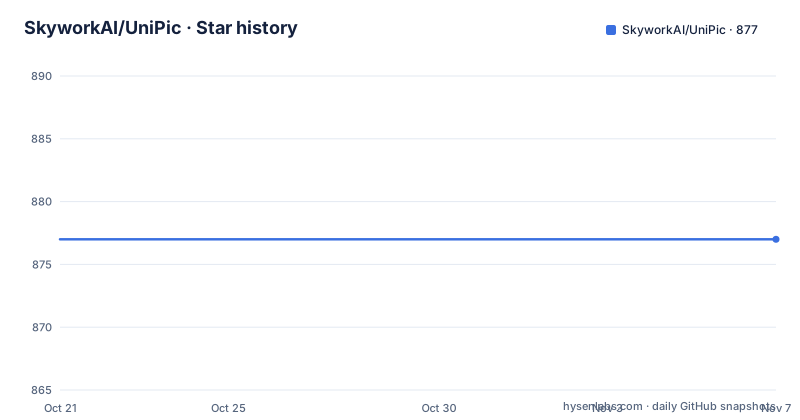
- SkyworkAI/UniPic877 ★ · +0
| Repository | 2026-10-21 | 2026-11-07 |
|---|---|---|
| SkyworkAI/UniPic | 877 | 877 |
0 Stars in the last 17 days, measured from the daily GitHub snapshot. Compare with other projects
Editorial analysis
What the repository is: weights and reference code for three models
The repository is not a library. It hosts the model weights and the official implementations of the UniPic unified multimodal series, and the README organises them into three distinct modeling paradigms.
The top level of the tree is correspondingly flat: a LICENSE, a README, and three directories named UniPic-1, UniPic-2 and UniPic-3. Each directory holds its own README and its own materials, which is the right shape for a series where each generation is a separate model with a separate paper and a separate set of weights.
The unified framing is worth pausing on. The project describes itself as a unified multimodal model for image editing, generation and understanding, and the key features list names three capabilities: text-to-image generation, image editing including inpainting, outpainting and object manipulation, and image understanding for visual tasks. The claim is that one model family covers all three, rather than a stack of specialised models that each need their own prompt handling.
The licence is MIT, with the file at the root of the repository. For a model release that is the permissive end of the spectrum, which is the detail most likely to matter to a company planning to host the model itself.
UniPic-1: one autoregressive transformer for perception and synthesis
UniPic-1 is the oldest of the three and the one with the clearest single idea. It has 1.5B parameters and uses unified autoregressive modeling for joint visual understanding and generation, which the README describes as enabling a single transformer to handle both perception and synthesis tasks.
The point of that design is that understanding and generation are usually two different models with two different interfaces. A pipeline that needs to look at an image and then produce one either calls two systems or uses a model with two heads. One autoregressive transformer that does both means the visual representation is shared rather than translated.
The size is the other fact to note. At 1.5B parameters, UniPic-1 is small by the standards of current image models, and small models of this kind are the ones that can be run on a single consumer GPU. The README's news table dates the release to 2025-07-30 and describes it as autoregressive unified modeling from scratch, which is worth noting because from-scratch training means the weights are the project's own rather than a fine-tune of someone else's checkpoint.
The directory is also where the earlier README path differs from the current one. The news table links the UniPic-1 entry under a UniPic2 tree rather than the UniPic tree, a leftover from a repository rename that the links in the table still carry.
UniPic-2: diffusion post-training on efficient architectures
UniPic-2 moves to a different family of architectures. It comes in SD3.5M-Kontext and MetaQuery variants based on efficient architectures with diffusion post-training, and the README describes the results as state-of-the-art in text-to-image generation, fine-grained image editing and multimodal reasoning.
The terms describe a specific recipe. The base architectures are efficient ones, the base model for one variant is named after SD3.5M and the other after MetaQuery, and the contribution is diffusion post-training, meaning the weights are adapted with diffusion training rather than trained autoregressively as in UniPic-1. Post-training is the cheaper path: you start from a trained base and adapt it, instead of pretraining a model from scratch.
That choice has a practical consequence for anyone reading the repository. The lineage runs through existing diffusion bases, so the training recipe and the base checkpoints are part of the story, and comparing UniPic-2 against a from-scratch model like UniPic-1 is comparing two different kinds of work.
The release date in the README's news table is 2025-08-13, listed as unified model weights with diffusion-based post-training, and the entry links both a Hugging Face collection and an arXiv paper.
UniPic-3: multi-image editing, one to six inputs, eight-step inference
UniPic-3 is the current focus and the one the README describes in the most detail, with the headline claim being an open-source SOTA multi-image editing model.
The capability is a unified framework for single-image editing and multi-image composition, supporting one to six input images with flexible resolutions. Multi-image editing is a genuinely different problem from editing one picture. The model has to decide which elements belong together, keep identities and styles consistent across sources, and place them coherently in one output. A single-image editor has no such reconciliation to do.
The efficiency claim is the other headline: eight-step inference with a 12.5 times speedup, achieved through CM plus DMD distillation. Those are two distillation techniques applied to the model, and the practical effect is that the sampler runs eight denoising steps instead of the several dozen a typical diffusion model needs. For an interactive editing tool that difference is between a usable latency and an unusable one.
The cost of distillation is that it trades fidelity for speed, so the eight-step path and the full sampling path are different models in effect and should be evaluated separately for whatever you are building. The README's news table dates the release to 2026-01-09 and links a GitHub directory, a Hugging Face collection and an arXiv entry for it.
Where the weights live and how the releases are structured
Each generation is published to a Hugging Face collection rather than packaged for installation, and the README links a separate collection per version: one for UniPic-1, one for UniPic-2, and one for Skywork UniPic-3.
That arrangement is normal for open model releases and it shapes what you can do. There is no pip package in this repository, no install command in the README and no inference script at the top level. What you get is weights plus reference implementations, which means the usual sequence is to install a diffusion or autoregressive inference stack of your own choosing, download the checkpoint from Hugging Face, and adapt the reference code in the relevant UniPic directory.
The version history is documented in a table at the top of the README rather than in tagged releases. The repository has no GitHub releases, so there is no release page to bookmark and no changelog to diff against. The dates in the table are the anchors: 2025-07-30 for UniPic-1, 2025-08-13 for UniPic-2 and 2026-01-09 for UniPic-3.
The last push to the repository was on 2026-07-13, which is well after the UniPic-3 release date, so there has been work on the tree since the newest model appeared. Without tags it is not possible to tell from the repository alone which of those commits belong to which model, so the per-generation README is the place to look.
Limits: no package, no benchmarks to lean on, three incompatible lineages
The first limit is the one already mentioned and it deserves emphasis: there is nothing to install. A developer arriving from a package index has to build their own environment, find the right inference framework for the architecture in question, and work through the reference code. That is normal for model releases, and it does mean adoption cost is measured in engineering time rather than in a dependency line.
The second limit is that the README quotes performance claims without numbers. It calls UniPic-3 an open-source SOTA multi-image editing model and describes UniPic-2 as delivering state-of-the-art performance. There is no table of benchmark results, no comparison against named baselines and no evaluation protocol described in the README itself. The numbers the project does give are about the model rather than about quality: 1.5B parameters, one to six input images, eight inference steps, 12.5 times speedup. Each generation links an arXiv paper, which is where the evaluation detail lives. The absence of inline results is not unusual for this kind of release, but it does mean you cannot pick a version by reading the README alone.
The third limit is structural. Three generations with three different modeling paradigms sit in one repository, and the paradigms differ in more than size. UniPic-1 is autoregressive from scratch, UniPic-2 is diffusion post-training on existing bases, and UniPic-3 is a distilled multi-image editing model. Code, sampling configuration and prompt conventions will differ between them, so a workflow that works against one is not automatically portable to another. Each per-generation README has to be read on its own.
Finally, the licences are MIT for the code, but the README does not state the licence terms for the model weights or the training data, and it does not describe a permitted-use policy. For a research release that is unremarkable. For a commercial deployment it is a question to ask before you build a product on it.
UniPic against a hosted image editing API and against running a base diffusion model
Two comparisons matter for a team deciding where to put this kind of capability.
The first is against a hosted image editing API. The practical difference is where the weights live and who keeps the GPU warm. A hosted service gives you an endpoint, a pricing model and someone else's capacity plan, with no local hardware and no inference stack to maintain. An open model you host yourself costs you the GPU, the serving code and the queueing, and in exchange you keep the data on your own infrastructure and can modify the pipeline. For a tool where every image is a customer document, that difference in where the bytes go is often the deciding factor, and it is the reason open weight releases of this kind exist at all.
The second is against running an existing base diffusion model yourself with an off-the-shelf editing pipeline. Here UniPic-3's multi-image support is the real distinction. Single-image editing with a base model is well-trodden. Taking three to six images and producing one coherent composition is a harder problem that general-purpose editing checkpoints tend to handle poorly, and it is the specific capability the eight-step distilled model is built for. If your requirement is editing one image well, an existing base model is the cheaper answer and you would be paying for capability you do not use.
The trade-off runs the other way as well. UniPic-3's speed comes from distillation, which is a fidelity compromise, and its own README offers no benchmark table to help you judge that compromise against your subject matter. The most sensible route is to run both the distilled path and the full sampling path on a handful of your own images and compare, since the difference in generation count is the difference in how much room the sampler has to recover detail.
Editorial conclusion
Adopt UniPic-3 if your work involves composing or editing several images at once and you want an open implementation with published weights rather than a hosted API. Do not expect a packaged library or a tagged release to depend on, because the repository is a set of directories of weights and reference code with no GitHub releases. Verify first that the model you pick fits your hardware and that the eight-step distilled variant is the one you want, since the full sampling path is a different cost, and read the per-generation README before you assume an API from one version applies to another.
Frequently asked questions
What is Skywork-UniPic and how many model versions does the repository hold?
The repository hosts weights and official implementations for three generations of a unified multimodal model: UniPic-1 with 1.5B parameters and autoregressive modeling, UniPic-2 in SD3.5M-Kontext and MetaQuery variants built on diffusion post-training, and UniPic-3 for single-image editing and multi-image composition with one to six input images.
How do I get the UniPic model weights?
Each generation is published as a separate Hugging Face collection, linked from the README alongside the corresponding GitHub directory and arXiv paper. There is no pip package in the repository and no GitHub releases, so you download the checkpoint and use the reference implementation in the matching UniPic directory.
What does the 8-step inference in UniPic-3 mean in practice?
The README states that UniPic-3 does eight-step inference with a 12.5 times speedup, achieved through CM plus DMD distillation. The point of the step count is latency: a diffusion sampler that needs eight denoising steps is far quicker to respond than one that needs several dozen.
Official sources
Add this badge to your README
If you maintain this project, the badge below links readers to this analysis and shows its maintenance status from the daily GitHub snapshot. Paste the markdown into your README; add ?metric=license or ?metric=stars to the image URL for a different field.

[](https://hysenlabs.com/projects/skyworkai-unipic)Star history chart for your README
[](https://hysenlabs.com/projects/skyworkai-unipic)Was this useful?