deepdive: a research skill that files the evidence
Deepdive skill for Claude Code — 12-phase research pipeline: plan-review gate, parallel sub-agent search, claims-ledger triangulation with dissent protection, relevance × authority evidence filter, multi-angle red team, four-layer citation verification. 105 blocks, 29 channels, 460+ stat sources, 47 APIs, 1072 verified endpoints.
At a glance
- What is it?
- A Claude Code skill that turns a research request into a phased pipeline whose output is a folder rather than a chat log: a plan document, sources with verbatim quotes, a claims ledger, a red-team pass and per-claim citation markers. The plan-review gate and the no-progress circuit breaker are the two parts that do the real work.
- Who is it for?
- deepdive fits a researcher who needs to defend a decision later and can afford to approve a plan before the spending starts, because the gate is the feature. It does not fit someone who wants a quick answer in one turn, since the pipeline's value is the folder afterwards.
- Can I use it commercially?
- Yes. MIT is a permissive licence: you can use, modify and sell software built on it, as long as you keep its copyright and licence notices.
- Is it still maintained?
- Yes. The repository received new commits within the last day.
- What is it written in?
- Mainly Python, according to GitHub's language statistics.
Answers come from the project's GitHub data, last synced on November 15, 2026, and from our analysis. They are not legal advice.
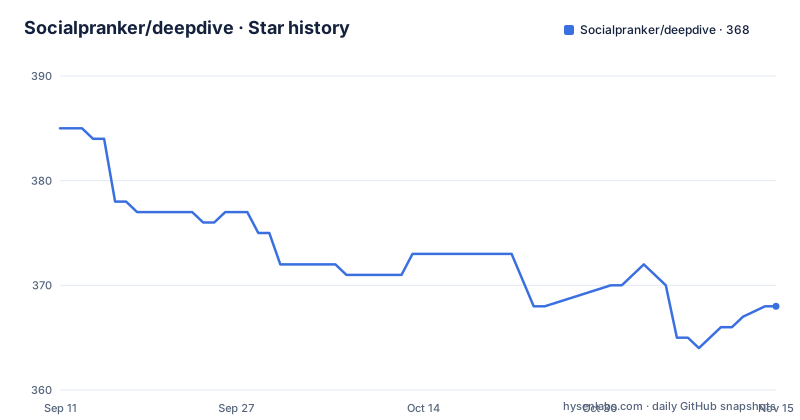
Star history
- Socialpranker/deepdive368 ★ · -17
| Repository | 2026-09-11 | 2026-11-15 |
|---|---|---|
| Socialpranker/deepdive | 385 | 368 |
-17 Stars in the last 65 days, measured from the daily GitHub snapshot. Compare with other projects
Editorial analysis
One clone, then a folder instead of a chat log
Installation is a single clone into the skills directory:
git clone https://github.com/Socialpranker/deepdive.git \
  ~/.claude/skills/deepdive
After that you type a request in a Claude Code session. The documented triggers are plain phrases, Investigate X, Validate this hypothesis, and one Russian phrasing, so the trigger vocabulary is multilingual rather than a slash command.
What comes back is the reason to use this. The worked example in the README takes a request about the trade-offs between Postgres logical replication and CDC tooling and produces a reframed question with three hypotheses and a decision spec, a genre choice, a plan.md of 17 sections, 23 saved sources in a sources/ directory with quotes and provenance, an adversarial pass with three counter-arguments, and a report under research/.
The comparison table puts it as a shift in output type: atomic theses in findings/FN.md that you can reuse, and every claim carrying a marker such as [s12] that resolves to a specific quote in a specific file.
Thirteen rows in the table, twelve in the description
The phase table lists thirteen rows, including the fractional ones: Reframing at 1, Genre and block selection at 2, Plan at 3, then Capability Discovery at 3.5, the Plan-review gate at 3.7, Search at 4, Claims-ledger and triangulation at 5, Evidence filter at 5.5, Wiki reconcile at 5.7, Synthesis with a multi-angle red team at 6, Verify at 6.5, Refresh targets at 7 and a Decision walkthrough at 8.
The repository description calls it a 12-phase pipeline, so the front-page marketing line and the table disagree by one. The table is the one to trust: it is generated, with count markers in the README text and a phases.yaml file at the repository root, plus a catalog-sync workflow in .github.
Each phase also carries a model routing, and the routing is the interesting part. Opus handles the phases where reasoning multiplies, which the table marks as 1, 3 and 6, Haiku handles the parallel fan-out in phase 4, and Sonnet covers the rest. The skill announces that routing and an estimated cost once, up front.
The plan-review gate is the step that matters
Before any search fires, phase 3.7 shows you the reframing, the hypotheses, the genre and the channels, and lets you approve or edit them. How strict that gate is depends on the mode: deep waits for an explicit go-ahead, medium is a soft check, and shallow skips it entirely.
The documentation is unusually direct about where the value sits. Editing the plan before execution is called the single most important step in the pipeline, the comparison to Gemini Deep Research is that it calls plan review its biggest lever over output quality, and the argument is that a wrong plan executed perfectly still produces a wrong report.
That framing changes what the skill is. Most research prompts optimise the answer; this one optimises the step before the answer, and it costs you one review before it spends anything.
A router picks the decomposition, not just the question
Reframing does more than restate the request. A router classifies the question's profile as factual, multi-step, relational, comparative or landscape, and that classification decides how the work is decomposed.
A factual question gets flat independent subquestions. A multi-step question of the form X given Y gets least-to-most levelling. A comparative question gets a shared axis matrix with mandatory opposition queries for each candidate, which means each option is searched for its own weaknesses rather than only its strengths.
The documentation calls choosing the wrong decomposition a silent failure mode, and the reason is structural: everything downstream inherits the shape. Search, scoring and synthesis all operate on subquestions, so a flat decomposition of a layered question produces five shallow answers that look like progress and are not.
The search loop has three brakes
Phase 4 is a bounded loop rather than a single pass, with three safeguards that exist to stop it spending quietly or giving up quietly.
The cheap goal-check runs a Haiku pass after each round that tags every subquestion met, partial or unmet with a one-line reason. That tag list is what the expensive Opus evaluation reads later instead of re-deriving the gap from scratch, and it is what decides the next round's dispatch.
The no-progress circuit breaker stops the loop after two consecutive rounds that add nothing new to the source pool, regardless of the remaining budget. The unresolved thread is moved to Open Questions rather than chased, which is the difference between a bounded failure and an expensive one.
Least-to-most decomposition covers layered questions: L1 rounds run first, the concrete facts they surface are carried forward, and the L2 queries launch already sharpened by that context. Independent subquestions still run flat. In the worked example, four sub-agents across twelve channels produced 23 sources.
Skepticism is marked at the ledger, not at the write-up
The scoring phase goes beyond the usual credibility, recency and bias rating and adds input-level skepticism. A source that measures its own product, self-reports a benchmark, or is directly disputed by another collected source receives a strict caveat marker, in the forms vendor, self-reported and disputed followed by a source number.
The timing is the design decision. The marker is applied before the claim reaches claims.csv, not after synthesis has already built on it, which means the contamination is visible to the stages that consume the ledger rather than being a footnote on the finished report.
The rest of the verification stack follows the same instinct: an evidence filter described as relevance times authority, a multi-angle red team in synthesis, and the example run's adversarial pass with three counter-arguments plus a role framed as execute this. The description also claims four-layer citation verification, and QUICKSTART.md promises a first result in about five minutes.
Portable to other models, with an eval harness in the tree
The methodology is not tied to Claude Code. For Codex, Gemini or a local model the instruction is to load SKILL.md plus the files under references/ into the model's context manually, skip the sub-agent parts, and use separate chat sessions per subtopic instead. What you lose is the parallel fan-out and the automatic routing; what you keep is the phase structure and the ledger.
The repository carries the machinery a skill this size needs: .claude-plugin/ for packaging, phases.yaml as the source of the phase table, references/ for the loaded methodology, runner/ and scripts/, tests/ with a pytest.ini, an eval/ directory, docs/, assets/, QUICKSTART.md, CONTRIBUTING.md and a code of conduct.
Scale numbers are given in the repository description as 105 blocks, 29 channels, more than 460 statistical sources, 47 APIs and 1072 verified endpoints; of those, the visible README confirms the 29 channels and the 460-plus statistical sources. There are no GitHub releases, the last push to main is dated 2026-09-27, the repository is not archived, and the licence is MIT.
Editorial conclusion
deepdive fits a researcher who needs to defend a decision later and can afford to approve a plan before the spending starts, because the gate is the feature. It does not fit someone who wants a quick answer in one turn, since the pipeline's value is the folder afterwards. Before your first run, decide which mode you want, because deep waits for your explicit approval while shallow skips the gate entirely.
Frequently asked questions
How do I install and start the deepdive skill?
Clone the repository into ~/.claude/skills/deepdive, then in a Claude Code session type a request such as Investigate X. Other documented triggers include Validate this hypothesis and one Russian phrasing, and QUICKSTART.md promises install, invoke and a first result in about five minutes.
How many phases does the deepdive pipeline have?
The README phase table lists 13 rows, including the fractional ones at 3.5, 3.7, 5.5, 5.7 and 6.5, while the repository description calls it a 12-phase pipeline. Each phase is routed to a model, with Opus on the reasoning-heavy reframing, plan and synthesis phases and Haiku on the parallel search fan-out.
What does the deepdive plan-review gate do?
Before any search runs, phase 3.7 shows the reframing, the hypotheses, the chosen genre and the channels, and lets you approve or edit them. Strictness scales with mode: deep waits for an explicit go-ahead, medium is a soft check, and shallow skips the gate.
How does deepdive stop a search from wasting budget?
With three safeguards: a cheap goal-check that tags each subquestion met, partial or unmet with a reason, a no-progress circuit breaker that stops after two consecutive rounds add nothing new to the source pool, and least-to-most decomposition for layered questions so second-level queries start from first-level facts.
How does deepdive handle biased or self-serving sources?
It flags input-level skepticism at the ledger stage. A source that measures its own product, self-reports a benchmark, or is disputed by another collected source gets a caveat marker such as vendor, self-reported or disputed with a source number, applied before the claim reaches claims.csv.
Official sources
Add this badge to your README
If you maintain this project, the badge below links readers to this analysis and shows its maintenance status from the daily GitHub snapshot. Paste the markdown into your README; add ?metric=license or ?metric=stars to the image URL for a different field.

[](https://hysenlabs.com/projects/socialpranker-deepdive)Star history chart for your README
[](https://hysenlabs.com/projects/socialpranker-deepdive)Was this useful?