BungeeCord Guide for Linking Minecraft Servers
BungeeCord, the 6th in a generation of server portal suites. Efficiently proxies and maintains connections and transport between multiple Minecraft servers.
At a glance
- What is it?
- BungeeCord is a Java Layer 7 proxy for operators who want to move Minecraft players among multiple backend servers. Its main operational constraint is the need to run backends without authentication and block direct access.
- Who is it for?
- Adopt BungeeCord when player routing between several Minecraft servers is the primary requirement and the operator can secure the unauthenticated backends. Do not select it from this repository evidence alone if offline mode, direct backend exposure, or an unclear custom licence is unacceptable.
- Can I use it commercially?
- Check first. The repository uses a licence we do not classify automatically, so read its LICENSE file before any commercial use.
- Is it still maintained?
- Yes. The repository last received commits 2 days ago.
- What is it written in?
- Mainly Java, according to GitHub's language statistics.
Answers come from the project's GitHub data, last synced on November 6, 2026, and from our analysis. They are not legal advice.
Star history
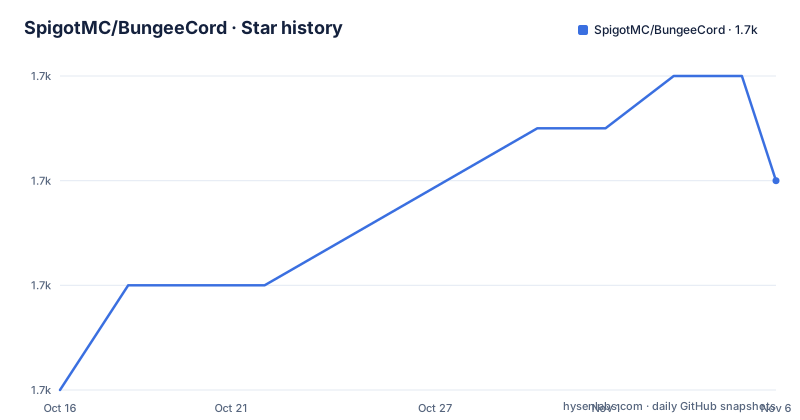
- SpigotMC/BungeeCord1,736 ★ · +4
| Repository | 2026-10-16 | 2026-11-06 |
|---|---|---|
| SpigotMC/BungeeCord | 1.7k | 1.7k |
4 Stars in the last 21 days, measured from the daily GitHub snapshot. Compare with other projects
Editorial analysis
BungeeCord's role across a Minecraft server network
BungeeCord solves a specific network topology problem: placing multiple Minecraft servers behind one proxy so that a player can be connected to the appropriate server and transferred between them. The README describes it as a "Layer 7 proxy designed to link Minecraft servers" and says that its main purpose is teleporting players between those servers. This makes it relevant to administrators who split a Minecraft community into distinct servers, whether by game mode, world, player population, or another operational boundary that the operator controls.
It is not a Minecraft server implementation by itself. Its role is between connecting players and backend servers, maintaining and proxying their connections and transport. The repository layout supports that distinction. Directories such as `proxy/`, `protocol/`, and `config/` sit alongside API and supporting modules, including `api/`, `chat/`, `event/`, `serializer/`, and `query/`. Those names indicate a multi-module Java project rather than a single script or a standalone server plugin. The README does not document supported server software versions, operating systems, protocol ranges, or exact configuration behavior, so those details cannot be established from the repository information.
The appropriate user is therefore a server operator who already understands Minecraft server deployment and can secure a network of backend instances. BungeeCord is a poor fit for a single-server installation with no routing requirement, or for an operator who cannot prevent untrusted clients from reaching the backend servers directly.
BungeeCord's proxy path and repository structure
The documented connection model has three distinct parts: a player, the BungeeCord proxy, and one or more Minecraft servers. BungeeCord accepts the player's connection and proxies transport to the relevant backend. Its stated ability to teleport players means the proxy also participates in moving a connected player from one backend server to another rather than treating every destination as an isolated connection.
The source is divided into modules that correspond to different parts of that job. `proxy/` is the most direct indication of the proxy implementation, while `protocol/` is separated for protocol-facing work. `config/` points to configuration support, and `api/`, `event/`, and `chat/` indicate interfaces and event-oriented code around network activity. Additional directories cover logging, serialization, query handling, native components, dialogs, NBT, module support, and Maven resolution. This layout suggests that connection handling and the surrounding plugin-facing API are not confined to one Java class.
The README calls BungeeCord both a proxy and an API, but it does not publish API method signatures or a supported extension contract. Repository names alone cannot establish whether an external integration is source-compatible across commits. The default branch is `master`, and no GitHub releases are listed. For adoption decisions, the relevant architecture fact is therefore narrow but useful: this is a Java proxy with separated configuration, protocol, proxy, API, event, and supporting modules, not a general-purpose reverse proxy or a load balancer documented as such.
Offline backend mode creates BungeeCord's main security boundary
The README contains an explicit security warning that should govern any evaluation. For BungeeCord to function as intended, the Minecraft servers must run with `online-mode=false`. That removes server-side authentication of the usernames presented by connecting clients. The README states that users may connect directly to a backend under any username they choose.
A warning message shown to users does not protect the backend. The README specifically says that the kick message, "If you wish to use IP forwarding, please enable it in your BungeeCord config as well!", does not protect Spigot servers. The documented mitigation is access restriction, with a firewall guide offered as an example. In other words, the proxy must be the enforced entry point, rather than merely the normal route used by most players.
This is a real failure mode. An operator can deploy a working proxy and still leave a backend reachable on its public address. Direct clients could bypass the intended routing path and exploit the loss of backend authentication. The README does not provide firewall commands, port values, operating-system rules, or a complete hardening procedure, so this article cannot prescribe an exact network configuration. It does establish the requirement clearly: firewall-based access control is part of a safe deployment, not an optional extra suggested by the warning message alone.
Obtaining BungeeCord binaries and preparing a first deployment
The project does not provide installation commands in the README, so there is no justified shell command or Java startup command to reproduce here. For end users, the README directs readers to the BungeeCord downloads page on Jenkins. It separately directs developers or source users to the project's source-code link on SpigotMC. The repository itself contains `pom.xml`, which is consistent with a Maven-based Java build, but no documented build invocation is supplied, so an invented command such as `mvn package` would not be reliable guidance.
A first real deployment should therefore begin with obtaining a precompiled binary from the documented Jenkins location. Before connecting players, identify every backend server that will run with `online-mode=false`, then restrict those servers so clients cannot bypass BungeeCord. The README does not document the configuration file syntax, listening address, backend address format, or startup arguments, so those values must be taken from the downloaded release's own configuration rather than inferred from the repository module names.
The observable first milestone should be a test player connecting through the proxy and being routed to a selected backend. A second milestone is an attempted direct connection to a backend address, which the operator's firewall should block. The README establishes that access restriction is required, although it does not claim that BungeeCord itself provides a replacement for firewall enforcement.
BungeeCord licensing, maintenance, and upgrade boundaries
The repository is not archived, and its last push was on 2026-10-10. That recent repository activity is a maintenance fact, but it does not identify a release cadence, long-term support policy, or compatibility policy for particular Minecraft versions. The repository has no GitHub releases, so GitHub's release list does not provide version history for upgrade planning. End-user binaries are instead linked through Jenkins.
The licence is recorded as a custom licence that GitHub cannot classify, with the repository's `LICENSE` file identified as the authoritative location. The README contains no grant terms, redistribution conditions, or modification rules. Accordingly, this article cannot state whether a particular hosting arrangement or redistribution model is permitted. Reviewing `LICENSE` and, if necessary, obtaining project-specific clarification is a prerequisite rather than a legal conclusion.
The absence of GitHub releases also changes how upgrades should be assessed. There is no documented statement about automatic updates, rollback, migration compatibility, or whether configuration changes occur between binaries. An operator cannot infer upgrade safety from the recent push alone.
Choosing between BungeeCord and direct server access
The relevant alternative for a one-server setup is direct player connection to the Minecraft server. That approach removes BungeeCord's routing layer and its associated requirement for unauthenticated backends, although the README does not establish whether direct access meets any broader operational requirement. It is simpler when there is only one backend and no documented need to teleport players between servers.
For a multi-server network, the alternative is several separately addressed Minecraft servers without a central proxy. Each backend can retain its own address, while operators manage player movement outside BungeeCord. The difference is architectural: direct access leaves each server as the connection endpoint, while BungeeCord is designed to maintain connections and proxy transport between players and multiple servers.
That trade-off is not free. BungeeCord introduces a network component that must be deployed and protected, and its documented `online-mode=false` requirement shifts a significant security responsibility to network controls. Operators who cannot enforce firewall restrictions, identify all backend entry points, and monitor bypass attempts should not adopt this design given the documented security requirements.
Editorial conclusion
Adopt BungeeCord when player routing between several Minecraft servers is the primary requirement and the operator can secure the unauthenticated backends. Do not select it from this repository evidence alone if offline mode, direct backend exposure, or an unclear custom licence is unacceptable. Verify the exact binary and configuration for your server first, then confirm that every backend firewall rejects connections that bypass the proxy.
Frequently asked questions
What is SpigotMC/BungeeCord used for?
BungeeCord is a Layer 7 proxy designed to link Minecraft servers. Its main stated purpose is maintaining proxied connections and transporting players between multiple backends.
How do I download BungeeCord?
The README directs end users to precompiled binaries on the project's Jenkins downloads page. It does not provide installation commands.
Does BungeeCord require online-mode=false on Minecraft servers?
According to the README, the Minecraft servers must run with `online-mode=false` for BungeeCord to work. This creates a direct-access security risk, so the README says backend access should be restricted with controls such as a firewall.
Is SpigotMC/BungeeCord actively maintained?
The repository is not archived, and its last push was on 2026-10-10. The repository information does not establish a release schedule or long-term support policy.
What licence does BungeeCord use?
The repository identifies a custom licence that GitHub cannot classify. The repository points to the `LICENSE` file but does not reproduce its terms in the README.
Official sources
Add this badge to your README
If you maintain this project, the badge below links readers to this analysis and shows its maintenance status from the daily GitHub snapshot. Paste the markdown into your README; add ?metric=license or ?metric=stars to the image URL for a different field.

[](https://hysenlabs.com/projects/spigotmc-bungeecord)Star history chart for your README
[](https://hysenlabs.com/projects/spigotmc-bungeecord)Was this useful?