xTuring froze its version number in 2023 and kept changing the library
Build, personalize and control your own LLMs. From data pre-processing to fine-tuning, xTuring provides an easy way to personalize open-source LLMs. Join our discord community: https://discord.gg/TgHXuSJEk6
At a glance
- What is it?
- stochasticai/xTuring wraps data preparation, LoRA and INT8/INT4 fine-tuning, generation and perplexity evaluation into one Python API. Its README describes GPT-OSS, Qwen3 and MiniMax M2 support, while its release tag and its dependency pins still point at September 2023.
- Who is it for?
- Use xTuring when you want one API surface across LoRA, INT8 and INT4 fine-tuning on your own hardware, and go to the source checkout rather than the package if you need the GPT-OSS or Qwen3 registry names, since those postdate the 0.1.8 tag.
- Can I use it commercially?
- Yes. Apache-2.0 is a permissive licence: you can use, modify and sell software built on it, as long as you keep its copyright and licence notices.
- Is it still maintained?
- Yes. The repository last received commits 18 days ago.
- What is it written in?
- Mainly Python, according to GitHub's language statistics.
Answers come from the project's GitHub data, last synced on November 23, 2026, and from our analysis. They are not legal advice.
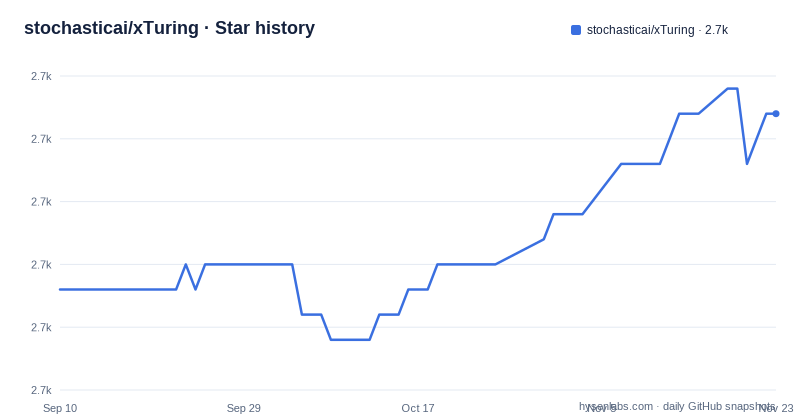
Star history
- stochasticai/xTuring2,681 ★ · +7
| Repository | 2026-09-10 | 2026-11-23 |
|---|---|---|
| stochasticai/xTuring | 2.7k | 2.7k |
7 Stars in the last 74 days, measured from the daily GitHub snapshot. Compare with other projects
Editorial analysis
Version 0.1.8 has not moved since September 2023
pyproject.toml names version 0.1.8, and that is also the newest release tag, v0.1.8, dated 2023-09-07. The two tags before it, v0.1.7 and v0.1.6, are dated July 2023, so the release train stopped three years ago. The repository did not. The last commit is dated 2026-09-24, and the highlights name GPT-OSS, Qwen3 and MiniMax M2 integrations that postdate the tag. That splits the project into two things: what `pip install xturing` resolves to, which is the 0.1.8 build, and what the README documents, which is the source tree with its gpt_oss and qwen3 registry names. The project keeps a Development Installation section for the second case:
git clone https://github.com/stochasticai/xturing.git
cd xturing
pip install -e .
pip install -r requirements-dev.txt
pre-commit install
pre-commit install --hook-type commit-msg
The metadata has not caught up either. The package still classifies itself as Development Status :: 3 - Alpha, while a comment in one README example calls the 120B checkpoint production-ready.
transformers 5.x breaks the paths Qwen3-Omni depends on
The installation section sets a floor and a ceiling in one paragraph. xTuring requires transformers>=4.36.0, and the README says not to upgrade to 5.x, because 5.x drops the load_in_8bit and load_in_4bit loading kwargs that the INT8 and INT4 engines rely on, and nothing currently shipped needs 5.x. Qwen3-Omni support sits on the far side of that wall: it needs transformers>=5.0.0, and the README states it is not released yet, pointing at pull request #318. The two documented requirements cannot both hold. Everything that touches quantized loading depends on the kwargs a 5.x upgrade removes, which covers the Llama2 INT8 path, the GenericLoraKbitModel used for INT4 fine-tuning, and the CPU example built on llama2_int8. The opening paragraph lists GPT-OSS, LLaMA and LLaMA 2, Qwen3, MiniMax M2, GPT-J, GPT-2, DistilGPT-2 and Mamba as supported families, but every snippet in the highlights sits on Qwen3, GPT-OSS, LLaMA 2 or Mistral.
Three dependencies are pinned to exact versions
The dependency list mixes open ranges with hard pins. torch >= 1.9.0, deepspeed>=0.15.1, gradio>=5.31.0 and scipy >= 1.0.0 float, pyarrow is boxed in as >= 8.0.0, < 21.0.0, and three packages are frozen outright: datasets==2.14.5, evaluate==0.4.0 and bitsandbytes==0.41.1. Those exact pins are what hold the quantized and evaluation paths in place, since bitsandbytes supplies the low-bit kernels the README leans on and a floating version would let the loader change shape underneath the INT8 and INT4 engines. The price is that a fresh install resolves to a fixed-era stack rather than the newest releases of anything. The Python metadata is looser still: requires-python says >=3.7 with no upper bound, while the declared classifiers stop at Python 3.9.
A Qwen3-Omni example sits next to a note saying it is not released
Highlight number 8 shows instruction data generation through a local multimodal checkpoint, and it prints a different import path from every other example in the README, xturing.model_apis.qwen:
from xturing.datasets import InstructionDataset
from xturing.model_apis.qwen import Qwen3OmniTextGenerationAPI

engine = Qwen3OmniTextGenerationAPI(model_name_or_path="Qwen/Qwen3-Omni-30B-A3B-Instruct")
dataset = InstructionDataset.generate_dataset("./tasks.jsonl", engine=engine)
The installation section, a screen earlier in the same document, says Qwen3-Omni support is not released yet. Both statements ship together. The snippet is written against the transformers 5.x requirement that the installation section tells you not to install, so the data generation path it documents cannot run in the configuration the rest of the README sets up. The README does not say whether the tree has moved past the pin, and it does not say whether the class is importable in the 0.1.8 build. What it settles, twice, is the dependency conflict.
Registry keys for bundled families, Hugging Face paths for the generic engines
Two naming schemes coexist. The bundled families are addressed by registry key strings that BaseModel.create looks up: qwen3_0_6b_lora, gpt_oss_120b_lora, gpt_oss_20b, gpt_oss_20b and llama2, with llama2_int8 selecting the Intel quantized path. The generic engines take a Hugging Face identifier instead, as in GenericLoraKbitModel('mistralai/Mistral-7B-Instruct-v0.2'), the only example naming a model the family list does not obviously cover. There is a third door as well: the class imports, Llama2() directly, or GenericModel as the LLaMA 2 bullet and the pointer to the working example both call it. Quantization is part of the key rather than an argument, so llama2 and llama2_int8 are separate registry entries instead of one entry with a mode flag. Check which side of that split your model sits on before writing the create call.
One dataset object and four calls
The API surface is narrower than the feature list suggests. InstructionDataset takes a directory path in Alpaca format, model.finetune(dataset=...) trains, model.generate(texts=[...]) returns output for prompts, and model.evaluate(dataset) scores. The quickstart wires all four together:
from xturing.datasets import InstructionDataset
from xturing.models import BaseModel

dataset = InstructionDataset("./examples/models/llama/alpaca_data")

model = BaseModel.create("qwen3_0_6b_lora")

model.finetune(dataset=dataset)
output = model.generate(texts=["Explain quantum computing for beginners."])
print(f"Model output: {output}")
The comment on that block calls the 0.6B LoRA checkpoint the lightweight, CPU friendly starting point, and the GPT-OSS alternative carries the opposite warning, that it requires significant resources. Batching is a keyword on the two read-side calls rather than a training option, spelled outputs = model.generate(dataset = dataset, batch_size=10), and the same parameter is accepted by evaluate.
evaluate returns perplexity and nothing else
The evaluation bullet makes a broad promise and then narrows it: evaluate any causal LM on any dataset, currently supports perplexity. The example matches that scope, calling model.evaluate(dataset) on a loaded dataset and printing the number, and the README prints it with the label Perplexity of the evalution, misspelling evaluation in the string itself. That is the whole metric surface, on a package version pinned to evaluate==0.4.0, so loading other Hugging Face evaluation modules behind it is not something the dependency list invites. The example also pairs the dataset with gpt_oss_20b, the non-LoRA key, while the fine-tuning highlights use gpt_oss_20b_lora, so evaluation and training in the same session mean two different registry entries for what the README calls the same model family.
The examples disagree about where the alpaca data lives
The quickstart opens InstructionDataset with ./examples/models/llama/alpaca_data, and the README links that same folder as the data location. Most later examples instead pass ../llama/alpaca_data, a relative path that only resolves from a working directory one level under examples/models. If you copy an evaluation or INT4 snippet into a script at the repository root, that path will not point where the quickstart says the data is. The README also points at a runnable script, examples/models/qwen3/qwen3_lora_finetune.py, and at notebooks under examples/features, and the tree carries both a legacy directory and a playground_ui directory alongside datasets, models, notebooks and features. Directory layout in this project is not uniform, so verify the path before the first run.
Editorial conclusion
Use xTuring when you want one API surface across LoRA, INT8 and INT4 fine-tuning on your own hardware, and go to the source checkout rather than the package if you need the GPT-OSS or Qwen3 registry names, since those postdate the 0.1.8 tag. Check three things before you start: which transformers version is installed, because 5.x removes the loading kwargs the quantized engines depend on, whether the Qwen3-Omni path you want exists in your copy, and whether the exact pins on datasets, evaluate and bitsandbytes fit the rest of your environment. Anyone who wants to contribute has to install two pre-commit hooks first, which is a small signal about how the project expects patches to arrive.
Frequently asked questions
What does xTuring actually do?
It puts data preparation, fine-tuning, generation and evaluation of open-source LLMs behind one API. Fine-tuning runs through model.finetune(dataset=...), generation through model.generate(texts=[...]), and evaluation through model.evaluate(dataset), with LoRA and INT8/INT4 precision offered as ways to cut cost.
Which transformers version does xTuring need?
The README requires transformers>=4.36.0 and tells you not to upgrade to 5.x, because 5.x drops the load_in_8bit and load_in_4bit loading kwargs that the INT8 and INT4 engines rely on. pyproject.toml separately sets requires-python to >=3.7.
Is Qwen3-Omni supported by xTuring yet?
Not according to the installation section, which says Qwen3-Omni support is not released yet and points at pull request #318, since it requires transformers>=5.0.0 while the same section forbids a 5.x upgrade. A dataset generation snippet for the model still appears among the highlights.
How do I run xTuring from source?
Clone the repository, move into the xturing directory, then run pip install -e . followed by pip install -r requirements-dev.txt. The README marks two pre-commit hooks as required before contributing: pre-commit install and pre-commit install --hook-type commit-msg.
What metrics can xTuring evaluate a model on?
Perplexity is the only metric named. The evaluation bullet says any causal LM can be evaluated on any dataset and that perplexity is what is currently supported, model.evaluate(dataset) returns the result, and the dependency list pins evaluate to 0.4.0.
Official sources
Add this badge to your README
If you maintain this project, the badge below links readers to this analysis and shows its maintenance status from the daily GitHub snapshot. Paste the markdown into your README; add ?metric=license or ?metric=stars to the image URL for a different field.

[](https://hysenlabs.com/projects/stochasticai-xturing)Star history chart for your README
[](https://hysenlabs.com/projects/stochasticai-xturing)Was this useful?