strace: a ptrace based Linux tracer whose test suite carries a different license
strace is a diagnostic, debugging and instructional userspace utility for Linux
At a glance
- What is it?
- strace/strace is the C implementation of the Linux system call tracer, built on the kernel's ptrace facility, with autotools at the root, CI running on two platforms, and a repository whose metadata records no license even though the files say LGPL 2.1 for the tool and GPL 2.0 for the tests.
- Who is it for?
- strace is the right tool when the question is what a process actually asked the kernel for, and its documentation is unusually honest about where that ability comes from, since every feature traces back to ptrace. Three things to check before depending on it in a workflow.
- Can I use it commercially?
- Check first. The repository uses a licence we do not classify automatically, so read its LICENSE file before any commercial use.
- Is it still maintained?
- Yes. The repository last received commits 5 days ago.
- What is it written in?
- Mainly C, according to GitHub's language statistics.
Answers come from the project's GitHub data, last synced on November 15, 2026, and from our analysis. They are not legal advice.
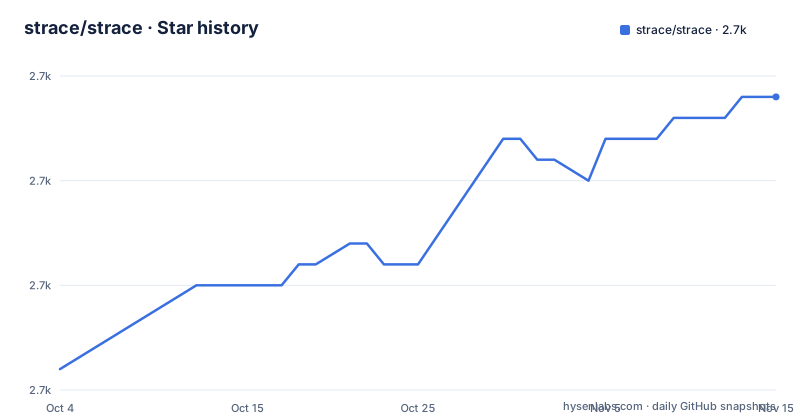
Star history
- strace/strace2,724 ★ · +13
| Repository | 2026-10-04 | 2026-11-15 |
|---|---|---|
| strace/strace | 2.7k | 2.7k |
13 Stars in the last 42 days, measured from the daily GitHub snapshot. Compare with other projects
Editorial analysis
Two licenses in one tree, and an empty metadata field
The utility is released under the GNU Lesser General Public License version 2.1 or later, with the terms in the `COPYING` file at the root and a `LGPL-2.1-or-later` file beside it. The test suite is a separate grant: GPL version 2 or later, spelled out in `tests/GPL-2.0-or-later` and `tests/COPYING`. That split is deliberate and is stated in the README rather than buried, but it means anyone redistributing needs both files read rather than one. What is less settled is the machine readable side: the repository's own license field records no value at all, so the only authoritative statements are the two files above and the licence file names. For what changed between versions, the tree points at `NEWS` rather than a changelog in the repository.
ptrace is the mechanism, and it is named as such
The README is direct about where the ability comes from: strace is a userspace utility whose operation is made possible by the kernel feature known as ptrace, and the file links to the ptrace manual page rather than describing an internal implementation. What it monitors is enumerated in three categories, system calls, signal deliveries, and changes of process state, which is wider than the syscall trace its name suggests. It is also explicit that the tool tampers with those interactions rather than only watching them. The interface is described as a traditional command line one, which is the project's own framing of its own compatibility promise. Nothing in that description is aspirational: no kernel bypass, no userspace hooking, no alternate transport. If ptrace is restricted in the environment, the utility has nothing left to fall back on.
Two CI systems, one branch, and a coverage service
The build is checked in more than one place. The README badge points at a GitHub Actions workflow file `ci.yml` filtered to the `master` branch, and a `.gitlab-ci.yml` sits at the root as well, so the same branch is built on both platforms. Coverage is wired the same way, with a `.codecov.yml` at the root and a codecov badge pointing at the `master` branch. Packaging sits beside them: a `debian/` directory, a `strace.spec.in` template for RPM builds, a `.packit.yml` for Fedora, and a pointer to repology for the downstream versions users actually install. None of these are built from this tree in any obvious way, which is the point of listing them: the repository is upstream source, and the binaries most people run come from distribution packages assembled elsewhere.
Autotools sources, no configure script, and templates for the man page
The build system is the GNU autotools one and the generated files are kept out of the repository. The root has `configure.ac`, `Makefile.am`, a `bootstrap` script, `build-aux/` and `m4/`, and no `configure` executable among them, so a git checkout has to be bootstrapped before anything will configure. That is what `INSTALL-git.md` is for, and it is the only build documentation the README links. Two other artifacts are templates rather than finished files: the manual page source is `doc/strace.1.in`, and the RPM spec is `strace.spec.in`. Both take their version and date from the build, which is why the version has to be bumped in the source tree before either one is regenerated. `dist/` is where release tarballs are assembled, and `bundled/`, `ci/`, `maint/` and `attic/` hold the pieces around that process.
Three README files that are not the README
The root carries `README.md` and three siblings that read like leftovers from different eras. `README-configure` and `README-hacking` sit beside a file named `README-github_gitlab-autogenerated-archives.txt`, whose name states its whole job: it explains the release archives that GitHub and GitLab generate automatically, which are a different artifact from the tarballs assembled in `dist/`. Around them are the files a project of this age accumulates: `AUTHORS`, `CREDITS.in` with its `.in` suffix meaning it is processed, `ChangeLog-CVS` from the CVS era still being carried forward, `.mailmap` for mapping contributors onto the identities they commit under, and a `GPG-KEY` for verifying releases. The presence of `ChangeLog-CVS` next to a GitHub Actions badge is the clearest sign of how long the project has been in continuous use.
Releases land about every two months
Three releases are on record and the spacing between them is regular: v7.0 on 2026-04-26, v7.1 on 2026-06-15, and v7.2 on 2026-08-18. The default branch is `master` and its last push is dated 2026-09-15, which is nearly a month after the v7.2 tag, so the branch carries work that is not in any release. That gap is normal for this kind of tool and it matters for two decisions. A distribution packaging a fixed version is building from something older than what the branch contains, and anyone reading `NEWS` for changes is reading about v7.2 unless they build from the branch themselves. The repository is not archived, has 2706 stars, 502 forks and 109 open issues, and the questions that accumulate in that tracker are largely about per platform syscall name decoding, which is the part of the work that never stops.
AGENTS.md and CLAUDE.md sit next to CONTRIBUTING.md
The contributor surface is unusually wide for a C utility. The README indexes it: a developer documentation index at `doc/README.md`, `CONTRIBUTING.md` for how to contribute, `INSTALL-git.md` for building from the repository, the man page source at `doc/strace.1.in`, and `SECURITY.md` for vulnerability reporting, each named with what it is for. Development happens on GitHub through issues, pull requests and code reviews, and there is also a mailing list, `strace-devel`, with its own list info page and pipermail archives. Alongside the human facing files sit `AGENTS.md` and `CLAUDE.md`, so the same rules an automated contributor would read are stored in files written for two different tools.
Editorial conclusion
strace is the right tool when the question is what a process actually asked the kernel for, and its documentation is unusually honest about where that ability comes from, since every feature traces back to ptrace. Three things to check before depending on it in a workflow. The licensing is split down the middle, LGPL 2.1 or later for the utility and GPL 2.0 or later for the test suite, so read both files if you redistribute. Builds come from a git checkout through configure.ac and bootstrap rather than a shipped configure script. And the newest release on record, v7.2 from 2026-08-18, is older than the last push on 2026-09-15, so pin a tag rather than tracking master.
Frequently asked questions
What are the differences between strace and ptrace?
ptrace is the kernel feature, and strace is the userspace utility built on top of it. The README names ptrace as the thing that makes strace's operation possible and links to the ptrace manual page, and describes what strace does with it: monitoring and tampering with system calls, signal deliveries and changes of process state.
Is there a Windows version of strace?
Nothing in this repository describes one. The project states it is a userspace utility for Linux whose operation depends on the kernel ptrace feature, and the destinations it points at are a git build through INSTALL-git.md and downstream packages listed on repology. Any Windows build would have to come from elsewhere.
What license is strace released under?
The utility is under the GNU Lesser General Public License version 2.1 or later, with the terms in the COPYING file at the root. The test suite is separately licensed under the GNU General Public License version 2 or later, with its own COPYING file under tests/. The repository's license metadata field records no value.
How do you build strace from a git checkout?
The tree holds autotools sources rather than a generated configure script: configure.ac, Makefile.am, a bootstrap script, build-aux/ and m4/. INSTALL-git.md is the build documentation the README points to, and the man page and RPM spec are templates, doc/strace.1.in and strace.spec.in, that take their version from the build.
Where does strace run its continuous integration?
On both hosting platforms for the master branch: the README badge links a GitHub Actions workflow file ci.yml filtered to master, and a .gitlab-ci.yml sits at the root. Coverage is wired to the same branch through .codecov.yml and a codecov badge.
Official sources
Add this badge to your README
If you maintain this project, the badge below links readers to this analysis and shows its maintenance status from the daily GitHub snapshot. Paste the markdown into your README; add ?metric=license or ?metric=stars to the image URL for a different field.

[](https://hysenlabs.com/projects/strace-strace)Star history chart for your README
[](https://hysenlabs.com/projects/strace-strace)Was this useful?