goodsKill: ten seckill scenarios, two of them already marked deprecated
A mock flash-sale microservices project built on Spring Cloud 2025.x, Dubbo 3.x and AI, integrating common open-source components such as Elasticsearch, Gateway, MyBatis-Plus and Sharding-JDBC.
At a glance
- What is it?
- A Chinese-language simulated flash sale microservices project, built as a study of Spring Cloud, Dubbo, Seata, sharding and a state machine, with a module list, a compose file full of default credentials, and a README that admits it omits most of what a real sale needs. The gaps between the documentation and the tree are the interesting part.
- Who is it for?
- Use goodsKill as a reading reference rather than a starting skeleton, which is exactly how the project describes itself: a framework assembled from good techniques for study and lookup, with the author stating that real flash sale scenarios are far more complex and that parts of the implementation detail are omitted. Three things to know before you copy any of it.
- Can I use it commercially?
- Yes. MIT is a permissive licence: you can use, modify and sell software built on it, as long as you keep its copyright and licence notices.
- Is it still maintained?
- Yes. The repository last received commits 13 days ago.
- What is it written in?
- Mainly Java, according to GitHub's language statistics.
Answers come from the project's GitHub data, last synced on November 15, 2026, and from our analysis. They are not legal advice.
Star history
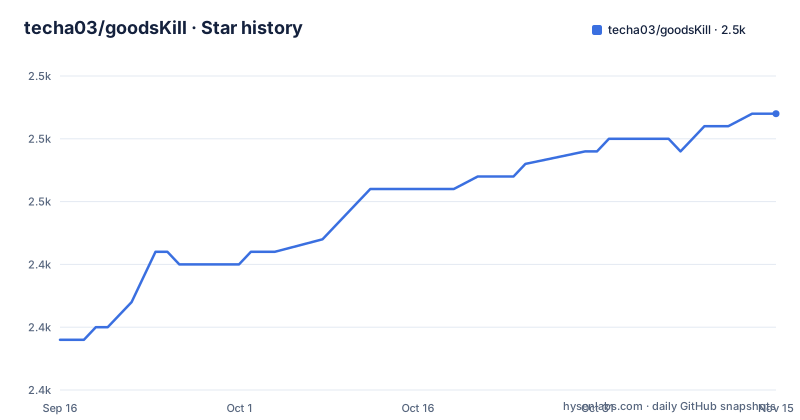
- techa03/goodsKill2,457 ★ · +18
| Repository | 2026-09-16 | 2026-11-15 |
|---|---|---|
| techa03/goodsKill | 2.4k | 2.5k |
18 Stars in the last 60 days, measured from the daily GitHub snapshot. Compare with other projects
Editorial analysis
The module list is shorter than the tree
The documentation lists ten modules. goodskill-admin for Spring Boot Admin monitoring, goodskill-ai, goodskill-gateway, goodskill-order-provider, goodskill-seckill-provider, goodskill-spring-boot-starter, goodskill-common, goodskill-web, goodskill-job and goodskill-seata. The repository root holds more than that. There is a goodskill-auth module, a goodskill-canal module, a goodskill-chat-provider module, and two user interface modules, goodskill-customer-ui and goodskill-ui. There are also two YAML files at the root, goodskill-common-connection.yml and goodskill-common.yml, which are the Nacos configuration files the quick start tells you to copy into the config centre, plus a doc/ directory and a docs/ directory side by side. So authentication, binlog capture, a chat provider and two front ends exist in the code without appearing in the module table.
The first scenario is spelled sychronized in three places
Ten flash sale approaches are listed, reachable through one controller called SeckillMockController. They run from a synchronized lock and a Redisson distributed lock through Kafka, an atomic database update, a ZooKeeper distributed lock, a Redis stock decrement with an asynchronous message and MongoDB persistence, Spring Cloud Stream, and Sentinel rate limiting combined with an atomic update. Two are marked as deprecated: ActiveMQ, which is scenario three, and waiting for the result in real time, which is scenario six. The first scenario is spelled Sychronized throughout, missing the n, and that misspelling is carried into the HTTP path, since the curl example posts to /sychronized on the web module, and into the heading above the example. Anyone writing a test against that endpoint has to reproduce the typo rather than correct it.
The image table publishes working credentials
The development environment table lists fourteen Docker images with their ports and, where relevant, their logins. Nacos 3.2.1 on 18080 with nacos and nacos, Redis with the password 123456, MySQL 8.0.29 with root and Password123, PostgreSQL on the pgvector pg15 image with goodskill and Password123, MinIO with root and password, Seata 2.0.0 with seata and seata, and Grafana OTel LGTM with admin and admin. The Spring Boot Admin console is documented separately at a fixed hostname with the login user and 123456. Five of the images are tagged latest rather than a version, including Redis, RabbitMQ, MinIO, the Kafka UI and the Grafana stack, so a compose run today is not the compose run the table describes. The compose file additionally hardcodes a Nacos authentication token as a base64 string.
ZooKeeper is in the stack table while Nacos does the registry work
The architecture paragraph says service registration, discovery and the configuration centre are all Nacos, with Dubbo 3.x and the native RestClient handling calls between services. The technology table then lists ZooKeeper as the distributed coordination service. Both are in the table, and ZooKeeper also has its own image pinned at 3.6.2 and its own hosts entry. The same table carries two message queues, Kafka and RabbitMQ, two relational databases, MySQL and PostgreSQL, MongoDB for the Redis scenario, Elasticsearch with Kibana, MinIO for object storage, GraphQL, Sa-Token for authentication, Flyway, Seata, Spring Statemachine and Spring AI. The README itself warns that in a real project more technology is not better and that each addition brings maintenance and usage cost, which is an unusual admission to make in the middle of a stack table with this many rows.
The hosts file has thirteen entries and one is not in the image table
The quick start asks you to add a block of mappings to your hosts file: kafka, nacos, redis, mysql, zookeeper, mongo, elasticsearch, rabbitmq, logstash, postgres and minio, all pointing at 127.0.0.1, plus www.goodskill.com with a comment saying to change that one to the remote address if the gateway runs on another machine. Twelve of those services appear in the image table. Logstash does not, even though the observability paragraph describes Grafana OTel LGTM with a bundled Collector, Grafana, Loki, Mimir and Tempo, which is a different logging path from Logstash. The gateway hostname is the one that matters most, since every curl example in the document targets http://www.goodskill.com:8080 rather than localhost, so the name has to resolve before the examples work.
The sample log output is dated 2021
A collapsible block at the end of the scenario list shows what the web console prints when a scenario runs, and the lines are timestamped 2021-04-14, with the scenario name, the seckill id and a final line counting successful transactions. That is the only sample output in the document, and it predates the newest release by three years. Two other endpoints are documented nearby: the aggregated gateway OpenAPI document at http://localhost/doc.html with the gateway service enabled, which uses the knife4j style doc.html path, and the Spring Boot Admin console on port 19031 behind a hostname. None of the three URLs uses localhost consistently, which is why the hosts entry has to exist before any of them can be opened.
Three main classes, two YAML DataIds, and three numbers in a request body
Configuration goes through Nacos: add a DataId for goodskill-common-connection.yml and another for goodskill-common.yml, both in the DEFAULT_GROUP, with contents taken from the files of the same names in the project root. Three applications are then started from their own main methods, OrderApplication for the order service, SeckillApplication for the seckill provider, and SampleWebApplication for the web module that exposes the simulation. A run is three numbers in a JSON body: requestCount for how many buyers, seckillCount for how many items and seckillId for the activity. Each activity id maps to a single item id, and calling the endpoint again reinitialises stock, which is why the same example can be repeated. The rate limiting scenario needs a Sentinel rule configured in the console against a resource named limit.
The project describes itself as a study and mirrors to Gitee irregularly
The preface is unusually blunt about scope. It says the project is built on Spring Cloud 2025.x, Spring Boot 4.x and JDK 21, that it is currently fairly bare with many incomplete parts, that a real flash sale scenario is far more complex than what is implemented here, that some implementation details from real scenarios are omitted, and that it is for study and reference. The name is explained too: the project is called goodsKill for the flash sale sense, with a note about the awkward English, and can also be read as good skill. Building is a Maven install in the goodsKill root, with a variant that skips the unit tests, and the middleware comes up with a single compose command:
docker-compose up -dThe compose file pins most images by version but leaves a handful at latest, and the visible part of it builds Nacos from a local context under doc/docker/nacos, mounts three configuration files into it, and also mounts a Prometheus configuration out of that same nacos directory. A Gitee mirror is offered for people whose clone is slow, with the note that it is synced irregularly. The release list holds two tags, v2.7.4 from 2023 and v3.2.4 from April 2024, while the last recorded push is dated 2026-07-07.
Editorial conclusion
Use goodsKill as a reading reference rather than a starting skeleton, which is exactly how the project describes itself: a framework assembled from good techniques for study and lookup, with the author stating that real flash sale scenarios are far more complex and that parts of the implementation detail are omitted. Three things to know before you copy any of it. The module list in the documentation is out of date, since the tree carries at least five more modules than the ten described. Several middleware images are tagged latest and the compose file and documentation publish working default credentials. And two of the ten scenarios are marked deprecated in the documentation itself, so the set of approaches is smaller than it first appears.
Frequently asked questions
What is techa03/goodsKill?
A simulated flash sale microservices project, MIT licensed, built as a study of Spring Cloud, Dubbo, Seata, sharding and a state machine. It exposes a unified simulation endpoint and the author describes it as a learning reference rather than a production skeleton.
How do I build and run goodsKill?
Run mvn clean install in the goodsKill root, or add -DskipTests. Start the middleware with docker-compose up -d, create the seckill database in MySQL and run goodskill-web/src/main/sql/seckill.sql, then start OrderApplication, SeckillApplication and SampleWebApplication.
Which seckill scenarios does goodsKill implement?
Ten, through SeckillMockController: a synchronized lock, a Redisson lock, ActiveMQ which is deprecated, Kafka, an atomic database update, waiting for the result in real time which is also deprecated, a ZooKeeper lock, Redis stock decrement with an asynchronous message and MongoDB persistence, Spring Cloud Stream, and Sentinel rate limiting with an atomic update.
Where is the goodsKill Spring Boot Admin console?
At http://www.goodskill.com:19031 with the documented login user and 123456. The aggregated gateway OpenAPI document is at http://localhost/doc.html with the gateway service enabled.
Which middleware versions does goodsKill expect?
Nacos 3.2.1, Kafka 3.9.1, Mongo 6.0.7, MySQL 8.0.29, ZooKeeper 3.6.2, Elasticsearch 9.2.2 with Kibana 9.2.2, PostgreSQL on the pgvector pg15 image, Seata 2.0.0 and MinIO, with Redis, RabbitMQ and Grafana OTel LGTM left at latest. Sharding-JDBC is 5.5.0 and Apache Dubbo 3.3.x.
How is goodsKill configured?
Discovery and configuration go through Nacos, with DataIds for goodskill-common-connection.yml and goodskill-common.yml in the DEFAULT_GROUP. Hosts entries map kafka, nacos, redis, mysql, zookeeper, mongo, elasticsearch, rabbitmq, logstash, postgres and minio to 127.0.0.1, plus www.goodskill.com for the gateway.
Official sources
Add this badge to your README
If you maintain this project, the badge below links readers to this analysis and shows its maintenance status from the daily GitHub snapshot. Paste the markdown into your README; add ?metric=license or ?metric=stars to the image URL for a different field.

[](https://hysenlabs.com/projects/techa03-goodskill)Star history chart for your README
[](https://hysenlabs.com/projects/techa03-goodskill)Was this useful?