techiescamp/linux-foundation-coupon: Kubernetes and Linux Foundation discount codes
Latest Linux Foundation Coupon Codes For Certification, Courses, Skillcreds, IT Professional Programs and Skillcreds
At a glance
- What is it?
- techiescamp/linux-foundation-coupon is a README-based coupon directory for Linux Foundation training, Kubernetes certifications, bundles, subscriptions, and related programs. It is useful for locating offer codes, but its lack of a license, releases, and automated verification makes it an informal reference rather than an official purchasing system.
- Who is it for?
- Kubernetes professionals and Linux Foundation learners who can independently check eligibility, expiration, and checkout pricing may adopt this repository as a short-lived coupon reference. Organizations, procurement teams, and developers who require traceable licensing, an official issuer relationship, or stable automation should not depend on it as a purchasing system.
- Can I use it commercially?
- Not without permission. GitHub finds no licence file in the repository, and without a licence all rights are reserved by default: you may read the code but not reuse it. Check the README, or ask the authors, before using it.
- Is it still maintained?
- Yes. The repository last received commits 2 days ago.
- What is it written in?
- GitHub does not report a main language for this repository.
Answers come from the project's GitHub data, last synced on October 23, 2026, and from our analysis. They are not legal advice.
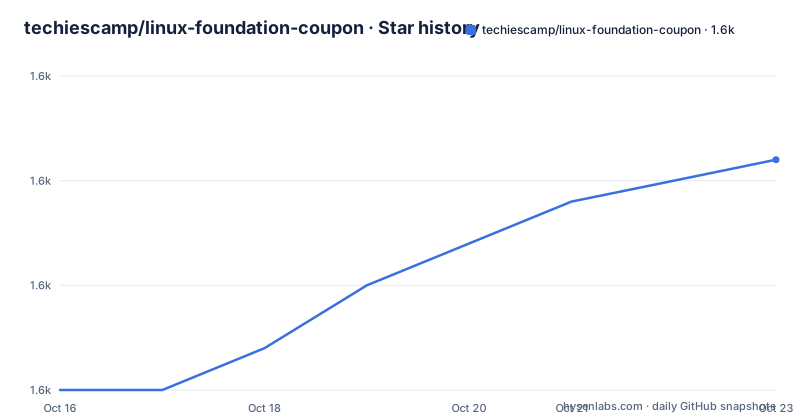
Star history
- techiescamp/linux-foundation-coupon1,596 ★ · +11
| Repository | 2026-10-16 | 2026-10-23 |
|---|---|---|
| techiescamp/linux-foundation-coupon | 1.6k | 1.6k |
11 Stars in the last 7 days, measured from the daily GitHub snapshot. Compare with other projects
Editorial analysis
A Coupon Directory for Linux Foundation Training Purchases
techiescamp/linux-foundation-coupon addresses a narrow purchasing problem: finding discount codes for Linux Foundation and related training offers. The README targets DevOps engineers, application developers, cloud engineers, security specialists, and people assembling multiple Kubernetes certifications. Its topics also reflect that focus through CKA, CKAD, CKS, and Kubernetes-related labels.
This is not an application, package, command-line utility, or API. Based on the repository layout, its only top-level file is README.md, and the documented content consists of coupon codes, links to purchase pages, descriptions of eligible programs, and notes about expiry. It solves discovery rather than certificate delivery. A reader still has to open a Linux Foundation or campaign landing page, select a product, and enter the code there.
The repository also covers more than Kubernetes. The README lists Thrive One subscriptions, FinOps certifications, KubeCon + CloudNativeCon North America 2026 passes, Kubernetes bundles, a Golden Kubestronaut upgrade path, and a Linux Foundation rewards discount. This makes the directory more useful for users planning several purchases, but its organization is campaign-oriented rather than catalog-oriented. Offers are divided by promotion, so a reader looking for one certification may need to search the page rather than compare certification requirements in a stable reference table.
The README presents the repository as community support for the DevOps community. It does not identify a formal relationship with the Linux Foundation, and there is no homepage or release history establishing one. Coupon ownership, redemption authority, and continued operation therefore need confirmation on the destination checkout page.
How README Coupon Redemptions Connect to Checkout
The repository uses a static information flow. README.md supplies a coupon code and a destination URL. The destination page supplies the purchasable product, and the checkout appears to be where the reader must confirm whether the code is accepted. No synchronization mechanism, API, price calculator, or automatic validation layer is described in the repository.
For example, the October 2026 security campaign associates OCT26CYBERCT with listed security certifications and bundles, while OCT26NONCYBERCT is associated with broader certification bundles. The DevOps campaign lists DCUBE30 and directs the reader to kube.promo/devops. The event section names COMTECHIES20 for KubeCon + CloudNativeCon North America 2026, while the FinOps section names COMTECHIES_20 for learn.finops.org. These are separate campaign codes, not one universal Linux Foundation code.
The README does not document a reusable command, configuration file, SDK, or deployment. That makes its data flow easy to understand, but also limits automation. A script could not infer eligibility from the project because it offers no documented machine-readable feed, validation endpoint, or stable schema for prices and expiry. Any extraction or checkout integration would need to parse Markdown links and still deal with the external vendor's rules.
Several descriptions also require careful reading. The security heading claims "UpTo 47% OFF," but the first sentence says "flat 35%" for individual certifications. Other bundle wording refers to percentages such as 40%, 38%, and dollar savings. These are README claims, not checkout guarantees. The actual discount must be established for the selected item at redemption time.
Applying an October 2026 Kubernetes Coupon
There is no installation procedure because this repository contains documentation rather than installable software. The README does not describe cloning a release, building a container, installing a package, or starting a service. A first use consists of locating the relevant campaign and following its listed purchase link.
For a Kubernetes certification bundle, start with the security or DevOps campaign near the top of README.md, then confirm that the linked page is the intended product. Enter the campaign's exact code in the checkout field. For example, OCT26CYBERCT is listed for CKS, KCSA, and the KCSA + CKS Exam Bundle, while OCT26NONCYBERCT is listed for bundles including CKA + CKAD, CKA + CKS, and the five-certificate Kubestronaut bundle.
For the separate DevOps sale, the README identifies DCUBE30 as the code and kube.promo/devops as the purchase destination. The reader should check the product name, total price, discount shown after applying the code, and any terms displayed before payment. The same code is also referenced for Kubestronaut options, but the repository does not claim that every product has the same final price or eligibility.
No confirmation output can be quoted because the repository contains no command and no checkout recording. The concrete success signal available to a buyer is a valid price reduction on the external checkout page. If the checkout rejects the code, applies a smaller amount, or asks for a different product, the README provides no troubleshooting process.
Kubernetes Bundle Choices and Documented Constraints
The README groups offers around common Kubernetes learning paths. For someone with no Kubernetes certification, it points to the Kubestronaut Bundle. For someone holding CKA or CKAD, it provides CKA-to-Kubestronaut and CKAD-to-Kubestronaut upgrade links. The Golden Kubestronaut section targets existing Kubestronauts and lists LFCS, PCA, ICA, CCA, CAPA, CGOA, CBA, OTCA, and KCA exams.
These bundles can reduce the need to buy items separately, according to the README. They can also impose an eligibility decision before payment. The page distinguishes starting from no Kubernetes certification from upgrading after CKA or CKAD. A coupon does not eliminate that prerequisite, and the repository does not document how previous certification evidence is validated.
The event offer has a narrower scope. The README says the All-Access Pass covers all 18 CNCF-hosted co-located events as well as KubeCon + CloudNativeCon, while the KubeCon + CloudNativeCon Only Pass does not include access to the co-located events. That is a meaningful product difference. A buyer focused on adjacent CNCF sessions should inspect the pass description rather than treating both passes as equivalent.
Some statements are explicitly time-sensitive. The Thrive One note says its offer ends on October 23, while several other sections say only that a code expires soon or that the sale is limited. The README title is updated for October 2026, but the repository does not publish a machine-readable expiry field or explain who checks stale entries. Coupon validity must therefore be treated as external to the Markdown document.
Why the Linux Foundation Rewards Path Is Different
The repository documents a real alternative to searching its campaign list: the Linux Foundation rewards program. According to the README, spending $500 with the Linux Foundation can unlock a 50% discount on a certification or training program. Rewards are checked through the linked OpenProfile rewards page. This is an account benefit rather than a public promotional code entered from the README.
The two approaches differ in discovery and eligibility. The README offers public campaign codes such as DCUBE30, COMBUNDLE25, OCT26CYBERCT, and OCT26NONCYBERCT, each tied to particular offers described on the page. Rewards require checking an account-associated benefit after the stated spend threshold. The repository does not say that campaign coupons and rewards can be combined, so choosing one path may affect the available price.
The rewards route has its own adoption constraints. A buyer needs an account, qualifying prior or current spending, and access to the rewards interface. The README does not document reset periods, reward expiration, refund handling, or whether every training product qualifies. Those points cannot be inferred from the coupon directory.
For an occasional buyer, the campaign list may be the easier starting point. For an organization or individual already invested in Linux Foundation purchases, checking rewards first is sensible because the documented percentage is higher than several listed sale percentages. The checkout still controls whether that reward can be applied.
Maintenance Signals, Releases, and Repository Licensing
The repository is not archived, and its last push was on 2026-10-15. Those are the available maintenance signals. There are no GitHub releases, no changelog, and no documented process for retiring expired coupons. A fresh push therefore says that repository content changed, but it does not prove that every coupon was checked with the seller.
Upgrade cost is low for readers because there is nothing to install or migrate. It is higher for automation because the repository has no versioned release containing a stable offer schema. An automated consumer would have to parse prose and Markdown links, track which code belongs to which campaign, and detect stale content. There is also no repository-level API contract describing price changes, redemption status, or removal history.
The repository license is unknown from the available repository information. That matters if an organization wants to copy, modify, transform, or redistribute the coupon list as part of an internal catalog. Lack of a stated license does not grant a general right to reuse the content. The repository contains no license file among the listed top-level entries, and the README does not provide licensing terms. Confirm reuse rights before incorporating the text or links into a product.
Coupon accuracy also depends on external systems that this project cannot control. Links can redirect, inventory can change, checkout eligibility can depend on geography or account state, and campaign dates can pass without a corresponding repository update. The absence of releases makes rollback and historical offer tracking especially limited: there is no documented release artifact to return to.
Editorial conclusion
Kubernetes professionals and Linux Foundation learners who can independently check eligibility, expiration, and checkout pricing may adopt this repository as a short-lived coupon reference. Organizations, procurement teams, and developers who require traceable licensing, an official issuer relationship, or stable automation should not depend on it as a purchasing system. Verify the destination domain, selected product, coupon eligibility, discount at checkout, and expiration terms before paying.
Frequently asked questions
How do I use a coupon from techiescamp/linux-foundation-coupon?
Open the campaign link in README.md, select the listed certification, training program, bundle, subscription, or pass, and enter that campaign's exact coupon code during checkout. The repository provides no installation step or automatic redemption mechanism.
Does techiescamp/linux-foundation-coupon provide one code for every Linux Foundation product?
No. The README associates different codes with specific campaigns and product groups, including Kubernetes bundles, security certifications, Thrive One, FinOps, and an event pass. Eligibility must be confirmed on the linked purchase page.
Can Linux Foundation rewards be combined with techiescamp/linux-foundation-coupon codes?
The README says that a $500 rewards program can produce a 50% discount, while separate campaign codes offer other discounts. It does not state whether rewards and coupon codes can be combined.
Official sources
Add this badge to your README
If you maintain this project, the badge below links readers to this analysis and shows its maintenance status from the daily GitHub snapshot. Paste the markdown into your README; add ?metric=license or ?metric=stars to the image URL for a different field.

[](https://hysenlabs.com/projects/techiescamp-linux-foundation-coupon)Star history chart for your README
[](https://hysenlabs.com/projects/techiescamp-linux-foundation-coupon)Was this useful?